Description
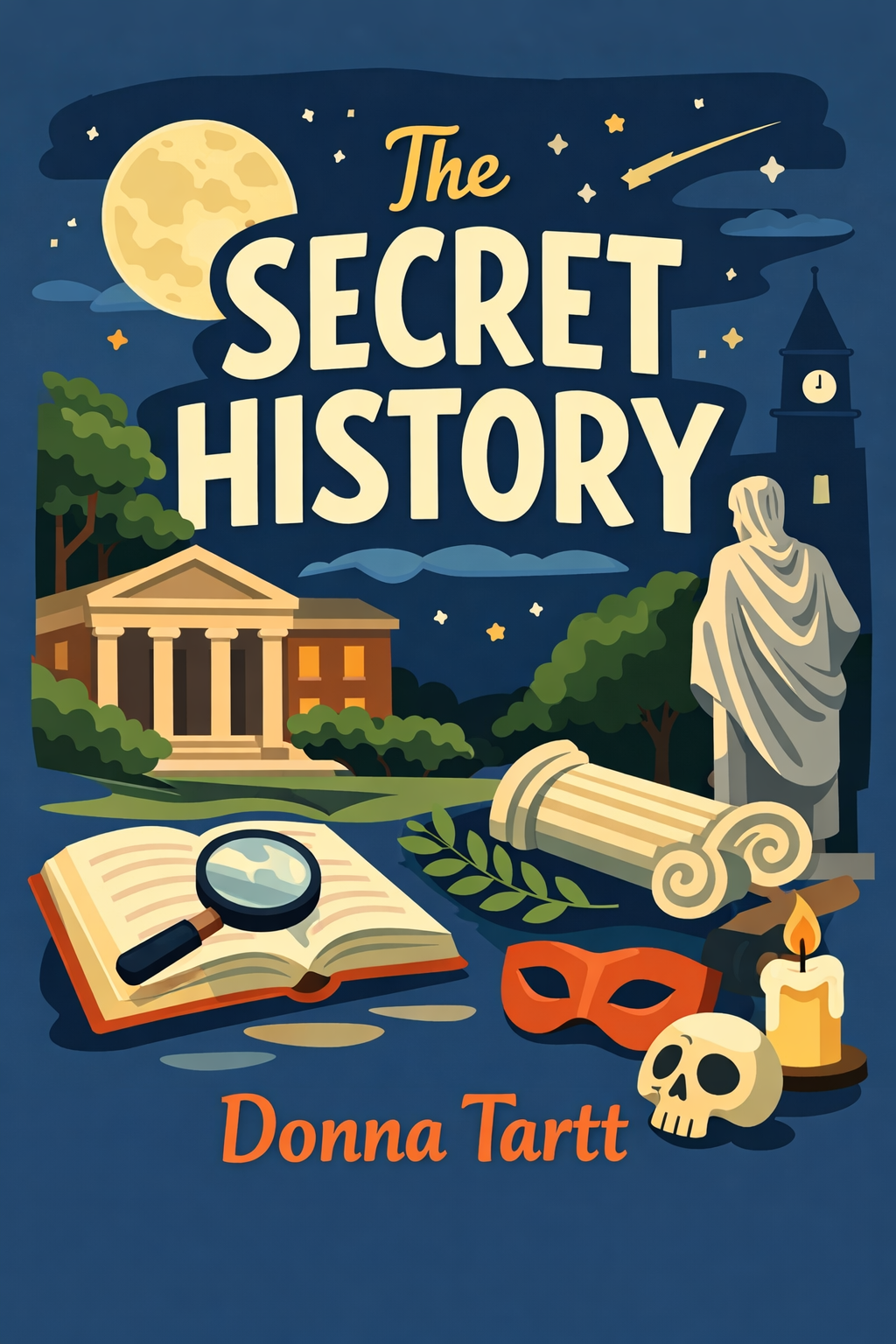
Donna Tartt’s novel unfolds as a psychological excavation of a crime, told from the perspective of Richard Papen, a young man who escapes his mundane California life for the prestigious Hampden College in Vermont. He is immediately drawn to a small, insular group of Classics students who exist in a rarefied world apart from the rest of the campus. Under the tutelage of their charismatic and morally ambiguous professor, Julian, they study Greek not as a dead language but as a living philosophy, one that prizes beauty, abstraction, and the pursuit of transcendent experience above conventional morality. Richard, yearning for the sophistication and intensity they represent, manages to gain entry into their circle, which includes the wealthy and anxious Francis, the inseparable and ethereal twins Charles and Camilla, the intellectually formidable and emotionally detached Henry, and the boorish, parasitic Edmund “Bunny” Corcoran.
The story is not a whodunit; Richard confesses the group’s murder of Bunny in the opening pages. The true mystery lies in the corrosive “why,” which is slowly revealed through Richard’s recollections. The central tragedy is set in motion when Henry, inspired by Julian’s intoxicating lectures on Dionysian rites and the ecstasy of losing the self, orchestrates a real bacchanal in the Vermont woods. He, Francis, Charles, and Camilla attempt to recreate the ancient ritual, a pursuit that spirals into a night of primal chaos and results in the accidental killing of a local farmer. This first death is a secret that binds the four in a pact of terrified silence, a secret from which Bunny, and initially Richard, are excluded.
When Bunny discovers the truth by reading Henry’s diary, the group’s dynamic fractures irreparably. Instead of solidarity, Bunny reacts with a sense of personal betrayal and leverages his knowledge into a campaign of financial and emotional blackmail. His once-tolerated crudeness curdles into calculated cruelty, as he needles each member about their deepest vulnerabilities. The secret of the bacchanal becomes a weapon, and the group, now including Richard who is brought into the confidence, begins to see Bunny not as a friend but as an existential threat. The philosophical abstractions of their studies collide with a grim, practical problem: how to ensure his silence. What begins as an intellectual fascination with amorality hardens into a concrete, amoral act. The decision to kill Bunny is presented less as a crime of passion than one of cold, logical necessity from their warped perspective, a final, dark application of their removed, classical worldview to a messy modern dilemma.
The aftermath of Bunny’s murder is where the novel’s deepest psychological exploration occurs. The expected relief never comes; instead, the weight of their guilt manifests in a slow, psychological disintegration. The single, unifying secret that once held them together now poisons every interaction. Paranoia replaces camaraderie. Each character unravels in their own way: Charles descends into alcoholism and violent jealousy; Francis retreats into a haze of pills and anxiety; Henry remains stoic but increasingly isolated; and Camilla becomes a ghost of her former self. Richard, our narrator, is both participant and observer, forever altered by his proximity to this darkness, his initial awe for the group replaced by a hollow complicity. They are haunted not by law enforcement, who accept Bunny’s death as an accident, but by their own consciences and the crumbling facade of their exceptionalism.
Ultimately, *The Secret History* is a profound study of the dangers of aesthetic and intellectual elitism. The students’ attempt to live a life of beautiful ideas, insulated from conventional consequences, proves to be a fatal illusion. Their tragedy is a modern echo of the very Greek myths they worship, where hubris—the overconfidence in their own separateness and superiority—invites a devastating nemesis. The murder is the climax, but the true narrative force lies in the meticulous, devastating portrayal of the fallout, revealing how the act of preserving a secret society required its utter destruction from within. The novel leaves us contemplating the seductive power of wanting to belong to an exclusive world, and the terrifying moral costs such belonging can sometimes demand.