Description
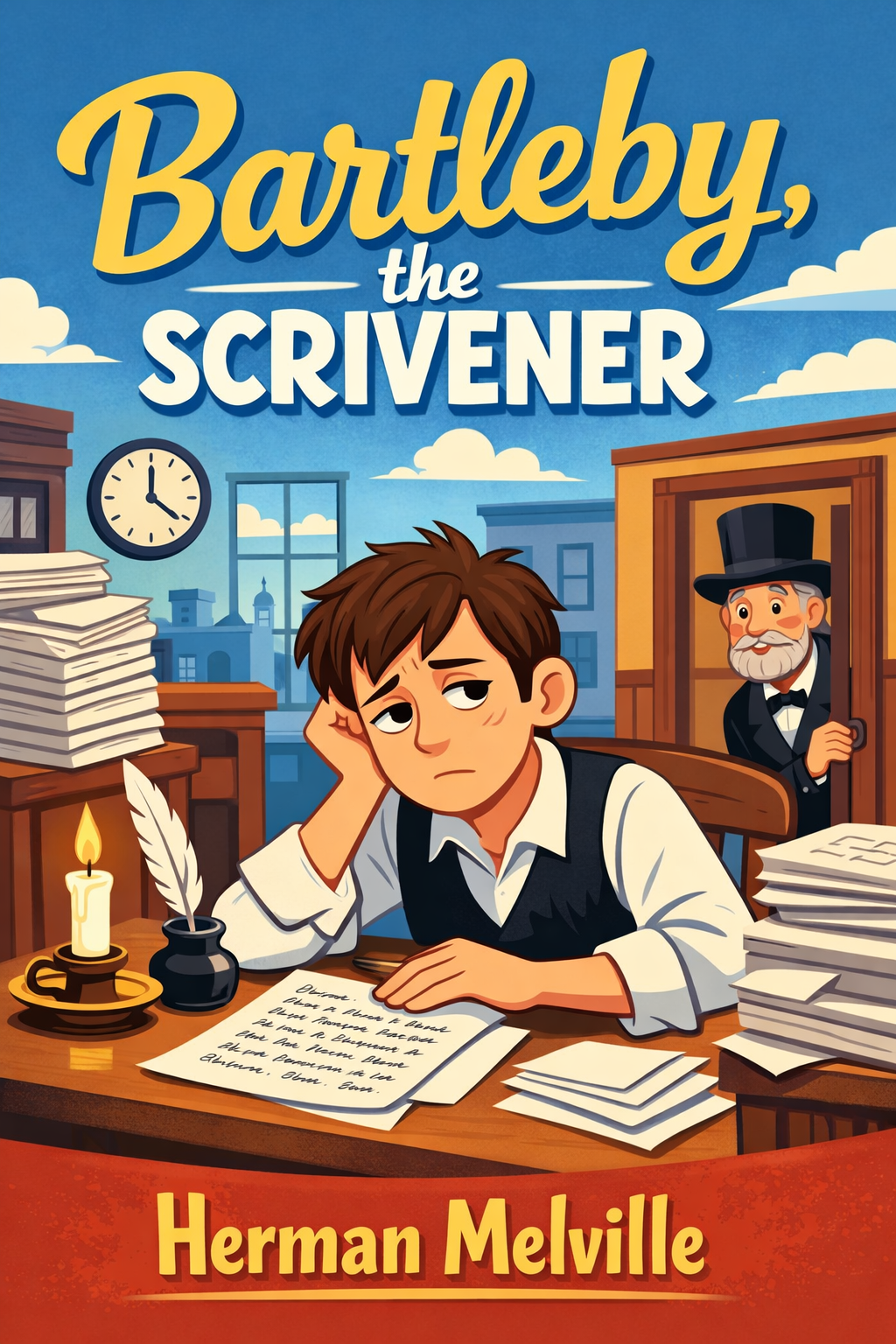
In the heart of bustling Wall Street, an elderly, complacent lawyer narrates the tale of his most perplexing employee. His office is a microcosm of eccentricity, staffed by the erratic Turkey, the dyspeptic Nippers, and the young errand boy Ginger Nut. Into this orderly disorder arrives Bartleby, a pale, silent man hired as an additional scrivener to copy legal documents. Initially, he works with silent, feverish intensity. The first crack in his compliance appears when the lawyer asks him to proofread his own work. Bartleby’s reply, delivered with sterile calm, is not a defiant “I will not,” but a passive, inscrutable, “I would prefer not to.”
This phrase becomes a refrain, a soft but immovable barrier against every request that falls outside the narrow act of copying. Bartleby prefers not to run errands, not to fetch a colleague, not to engage. The lawyer, more baffled than angry, finds himself psychologically paralyzed. He is repelled by the disobedience yet fascinated by the man’s unsettling aura of quiet despair. His attempts at rationalizing the behavior—perhaps Bartleby’s eyesight is failing—yield nothing. The mystery deepens when the lawyer discovers Bartleby has been secretly living in the office, a ghostly resident subsisting on ginger cakes and staring at the dead brick wall outside his window. This revelation floods the lawyer with a profound, pitying sadness; he sees Bartleby not as a stubborn employee but as a profoundly lonely soul, a victim of an “innate and incurable disorder.”
The lawyer’s sympathy, however, exists in constant tension with the demands of his professional world. He tries kindness, offering Bartleby a home, and he tries firmness, giving him notice. Both are met with the same placid preference not to comply. Bartleby’s passive resistance begins to infect the office, the very word “prefer” echoing in the speech of others, as if his quiet malady is contagious. Ultimately, societal pressure triumphs over compassion. When clients begin to complain about the strange, silent man in the corner, the lawyer chooses the only escape he can conceive: he moves his entire business to a new location to abandon Bartleby.
This act of desertion does not end the lawyer’s entanglement. The new tenants of his old office soon track him down, for Bartleby will not leave the building. He has become a fixture of the stairwell, a silent, haunting presence. The lawyer, now publicly implicated, makes a final, desperate visit. He offers Bartleby a series of alternative futures—a clerkship, a bartending job, a position as a traveling companion—but each is declined with the same passive refusal, now followed by a new, heartbreaking coda: “but I am not particular.” Bartleby has no preferences left, only a profound negation of all options life presents. The lawyer, defeated, flees.
The story concludes with the inevitable consequence of such absolute withdrawal in a society that cannot accommodate it. Bartleby is removed by the authorities to the Tombs, the city prison, where he continues his passive resistance, preferring not to eat. He dies curled in a courtyard, facing a wall. In a final, melancholic epilogue, the lawyer shares a rumor he later heard: that Bartleby once worked in the Dead Letter Office, endlessly handling correspondence destined never to reach its intended recipient. This anecdote, possibly apocryphal, offers a haunting metaphor for Bartleby’s existence—a man whose own connections to the world were severed, leaving him to sort through the ghosts of others’ failed communications, until he himself became a kind of dead letter, silently returned to sender.
The tale operates on a level far deeper than a simple office anecdote. Bartleby is less a character and more a philosophical force, a human question mark. His “prefer not to” is a radical act of non-participation that exposes the unspoken contracts of society, work, and human interaction. He is a mirror, reflecting the lawyer’s own moral compromises and the dehumanizing architecture of the nascent corporate world, symbolized by the walled-in office on Wall Street. Is he a figure of clinical depression, a proto-existentialist hero, a victim of capitalist alienation, or a spiritual ascetic? The story, in its brilliant ambiguity, sustains all these readings. It is a profound exploration of the limits of charity, the weight of conscience, and the unsettling power of passive resistance, leaving a reader to ponder, long after the final page, what we are to do with the Bartlebys of our own world—those who, in their quiet refusal, challenge the very foundations upon which we have built our lives.