Description
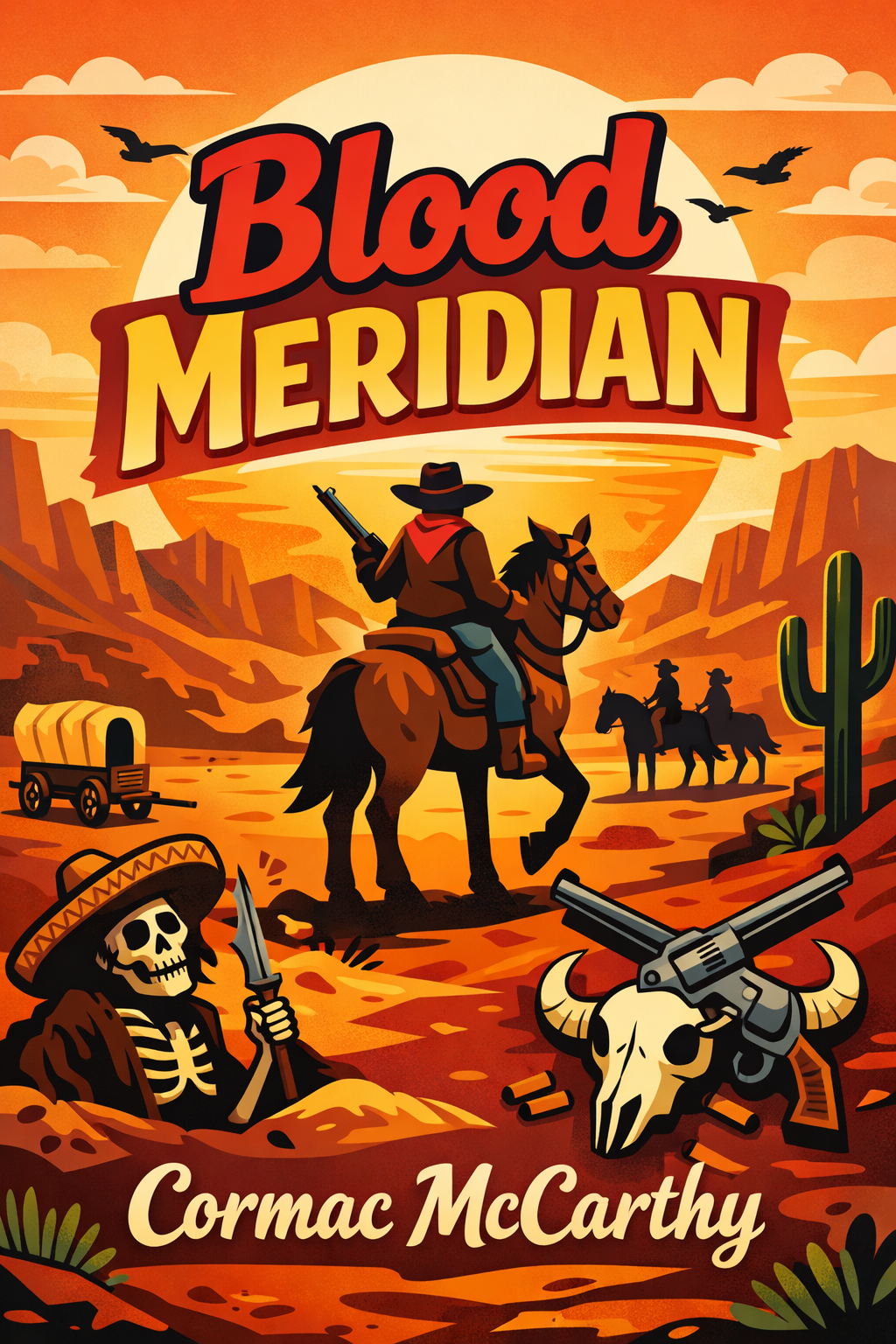
The story begins with a boy known only as “the kid,” born into a bleak Tennessee in 1833. His mother dies in childbirth, his father is a drunkard, and by fourteen he is already a hardened runaway, drifting westward with a taste for mindless violence. His path is a series of brutal encounters, from brawls in New Orleans to gouging out a bartender’s eyes in Texas. This capacity for cruelty leads him to Captain White, a racist filibuster leading an illegal paramilitary expedition into Mexico after the official end of the Mexican-American War. The kid joins, seeking purpose and spoils, but the desert itself seems to rebel against the intrusion. The expedition is a disaster, ending in a horrific massacre by Comanche warriors. The kid, one of the few survivors, is captured and imprisoned in Chihuahua City.
In the fetid prison, he reunites with a violent acquaintance, Toadvine. Their fate shifts when they attract the attention of a mysterious gang riding into town. The gang is led by John Joel Glanton, a historical figure, and includes among its members a colossal, hairless, and eerily learned man called Judge Holden. The gang is under contract with the Mexican government to hunt Apache scalps for bounty. The kid and other prisoners are freed to join this enterprise. Thus begins the core of the narrative: the kid’s immersion into Glanton’s gang as it rides a bloody circuit across the deserts of northern Mexico and the American Southwest.
The gang is a microcosm of the borderlands chaos—a collection of Americans, Mexicans, and displaced Native Americans, all united by greed and a capacity for extreme violence. Their mission quickly spirals beyond its official bounds. The distinction between hostile and peaceful tribes, or between Native Americans and Mexicans, becomes meaningless. The hunt for scalps transforms into a wholesale campaign of slaughter against any vulnerable group they encounter. They massacre peaceful Tigua villagers, annihilate a band of Gileños, and eventually turn on Mexican civilians themselves, scalping them and fraudulently presenting the trophies for bounty. The violence is relentless, graphic, and presented with a terrifying matter-of-factness. The landscape is a character in this horror, a vast, ancient, and indifferent arena of rock, sun, and blood.
Presiding over this carnival of carnage is Judge Holden. He is the gang’s intellectual and spiritual center, a polymath who speaks multiple languages, draws detailed sketches of flora and fauna, and delivers chillingly eloquent monologues on war, history, and human nature. The judge posits that war is not merely an activity but the ultimate state of man, a divine game and the truest form of sovereignty. He claims that the man who would rule must first master violence, and that the gang’s bloody work is a sacred engagement with the fundamental truth of existence. His actions embody his philosophy: he is capable of sudden, shocking cruelty, such as the casual murder of a captive infant, yet he also displays a childlike curiosity. He is a puzzle the kid cannot solve, a force of nature that both repels and fascinates.
As the gang’s atrocities mount, so does the retaliation. They are pursued by Mexican military units and targeted by the tribes they have wronged. The kid, now a young man, becomes a veteran of this endless war, but a subtle distance grows between him and the judge’s absolute worldview. He shows occasional, faint glimmers of something like mercy, such as sparing a wounded Comanche or refusing to kill a fellow gang member at the judge’s behest. These acts are small, almost meaningless in the scale of the surrounding horror, but they mark him as an anomaly in the judge’s eyes. For the judge, who believes that in the anarchic world only the will to dominate matters, any refusal to fully commit to the bloodshed is a fatal weakness, a betrayal of life’s central principle.
The gang’s final act is a protracted siege of chaos in the town of Yuma, at the Colorado River crossing. Having taken over a ferry, they extort and murder travelers, their internal discipline crumbling into drunken paranoia. The local Yuma tribe, long abused, finally rises and wipes most of the gang out in a surprise attack. The kid, again, survives. He escapes into the desert and spends years drifting, a ghost haunted by the violence he has witnessed and participated in. The judge, too, survives the Yuma massacre, seemingly indestructible.
Years later, in 1878, the kid—now referred to as “the man”—encounters the judge in a Fort Griffin saloon. The judge, unchanged, corners him in an outhouse. He condemns the man for his failed resistance, for his pathetic attempts at clemency in a world that recognizes only strength. The judge declares that the man, who never fully surrendered to the bloody sacrament of war, was never a true player in the great game, and thus has no place in the world the judge is shaping. The novel’s famously ambiguous and terrifying conclusion unfolds in a jakes, leaving the man’s ultimate fate to the reader’s darkest imagination, while the judge dances on, a monstrous embodiment of eternal violence, claiming he will never die. The book closes not with redemption or justice, but with the chilling suggestion that the judge’s philosophy—that war is god—is the brutal, unshakable truth of the world it has depicted.