Description
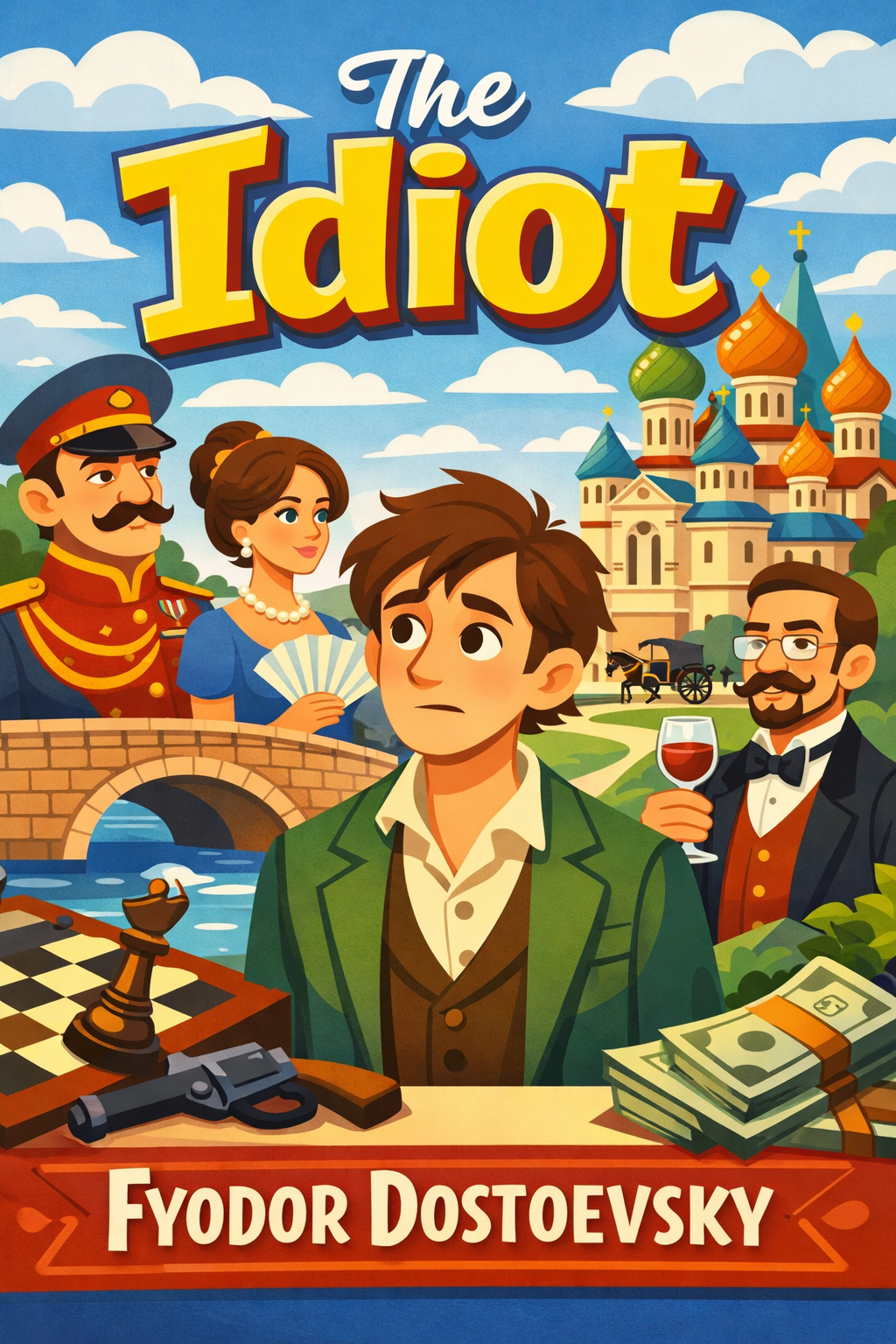
In the bustling heart of St. Petersburg, Prince Lev Nikolayevich Myshkin returns to Russia after years spent in a Swiss sanatorium, a man out of time. He is the “idiot” of the title—not intellectually deficient, but afflicted with a profound and debilitating epilepsy, and possessing a preternatural, almost childlike goodness. His innocence is not naivety but a radical form of perception, an ability to see directly into the souls of others and respond with immediate, unconditional compassion. This purity, entirely devoid of guile, social calculation, or ego, makes him a bewildering and disruptive force in the sophisticated, corrupt, and deeply self-interested circles he enters.
The prince is swiftly drawn into a complex web of relationships centered on two contrasting women. The first is Nastasya Filippovna, a woman of stunning beauty who has been tragically ruined by her guardian, Totsky. She is consumed by a fiery, self-destructive pride, viewing herself as a fallen creature oscillating between a desire for vengeful degradation and a desperate, unfulfilled yearning for redemption. Myshkin, seeing only her profound suffering and intrinsic worth, offers her a love based on pity and a hope for salvation, a proposition that both attracts and horrifies her. The second woman is Aglaya Yepanchina, the youngest daughter of a wealthy, respectable family. She is vibrant, capricious, and embodies a more conventional, if restless, youthful idealism. Intrigued and challenged by Myshkin’s strange nature, she develops a passionate, competitive affection for him, setting the stage for a devastating emotional conflict.
These personal dramas play out against a backdrop of vividly drawn characters who represent the sickness of Russian society. There is the volatile, poverty-stricken Parfyon Rogozhin, whose obsession with Nastasya Filippovna burns with a passionate, possessive intensity that stands in direct opposition to Myshkin’s selfless love. Rogozhin’s chaotic energy and eventual violence form a dark counterpoint to the prince’s serenity. Surrounding them are cynical aristocrats like the ambitious Gavril Ardalionovich and the nihilistic skeptic Lebedev, who manipulate, scheme, and philosophize, their words and actions highlighting the gulf between intellectual posturing and Myshkin’s active, lived virtue.
The novel’s central tension arises from the collision of Myshkin’s holy foolishness with the worldly logic of society. His sincere declarations are met with laughter, suspicion, or exploitation. His refusal to judge others and his capacity for forgiveness are interpreted as weakness or idiocy. In a world governed by money, status, and lust, his moral clarity becomes a kind of social offense. The tragic core of the story lies in the inevitable destruction of this goodness. Myshkin’s very presence acts as a catalyst, bringing the hidden passions, hatreds, and contradictions of those around him to a violent boil. His attempt to save Nastasya Filippovna only accelerates her tragic fate, and his love becomes an unwitting instrument of her doom.
The climax is a harrowing convergence of these forces. The rivalry between Myshkin’s compassionate love and Rogozhin’s jealous obsession reaches its terrible conclusion, leaving all parties shattered. In the aftermath, Myshkin’s fragile psyche, which has been strained throughout by the moral ugliness he witnesses and the overwhelming empathy he feels, completely breaks. He returns to a state of innocence, but now it is the blank innocence of catatonia, a retreat from a world that could not bear his light. His final departure for Switzerland is not a homecoming but a defeat, symbolizing the exile of genuine goodness from a society that has no room for it.
Ultimately, the novel is a profound and painful exploration of the human condition. It questions whether true, Christ-like goodness can survive in a fallen world, or if it must inevitably be crushed by the weight of human sinfulness, passion, and reason. Myshkin is not a hero who reforms the world; he is a mirror held up to it, revealing its spiritual poverty. His tragedy is not merely personal but universal, suggesting that the loss of such innocence is the price a complex, cynical world exacts. The story leaves us with a haunting ambiguity: was the prince a holy fool, a genuine moral ideal, or merely a sick man whose illness took the form of virtue? In asking this, Dostoevsky forces us to confront our own capacity for both compassion and cruelty, and the often tragic cost of living with an open heart in a closed world.
Book Title: The Idiot