Description
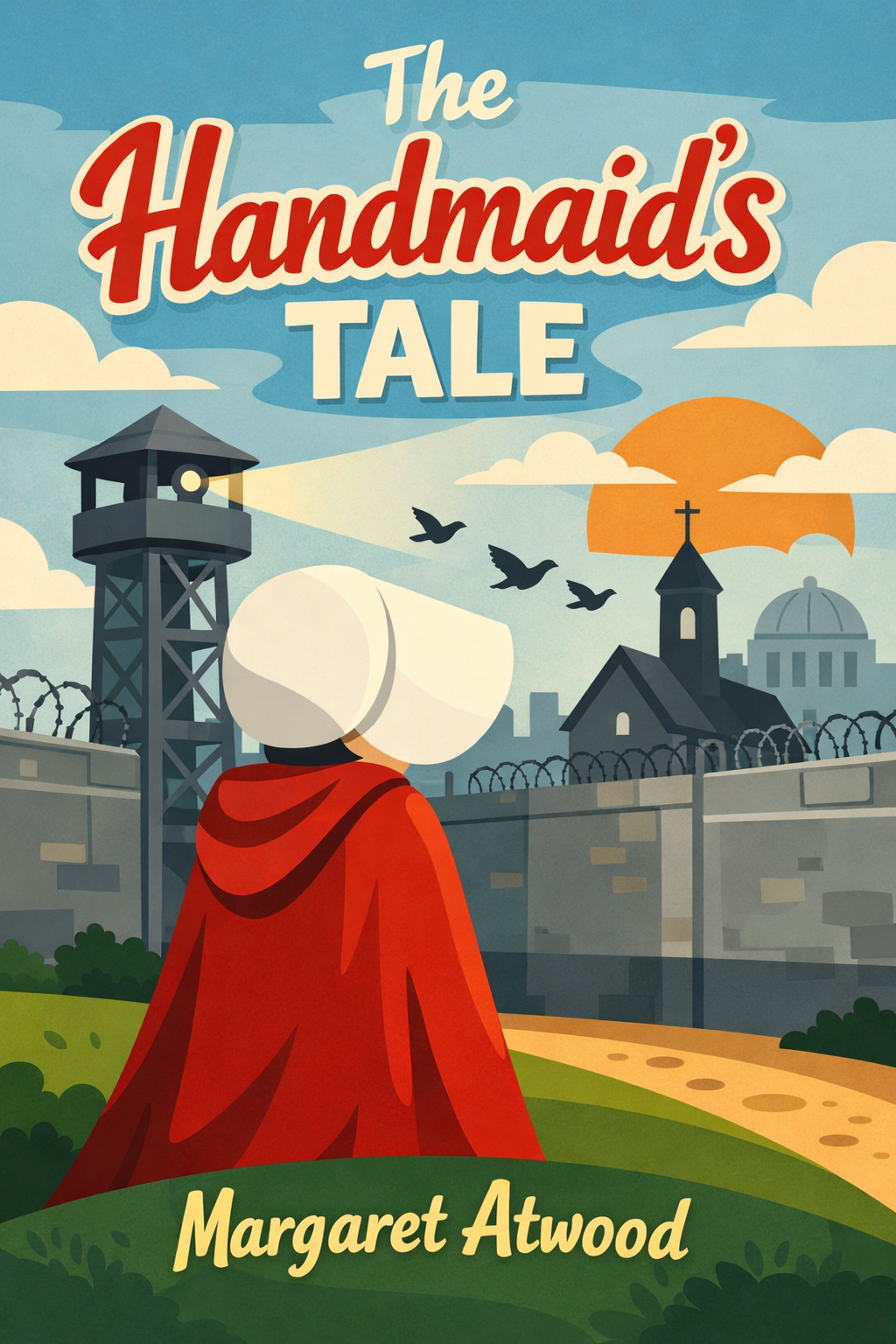
In a nightmarish future, the United States has been overthrown and replaced by the Republic of Gilead, a totalitarian theocracy built on extreme religious fundamentalism and patriarchal control. Environmental disasters and plummeting birthrates have created a crisis of fertility, which the new regime uses to justify its brutal reorganization of society. Women are stripped of all rights, forbidden to read, own property, or control their own bodies. They are categorized solely by their utility: Wives of the ruling Commanders, Marthas who serve as domestic laborers, Aunts who indoctrinate and police other women, and Handmaids.
The story is narrated by Offred, a Handmaid assigned to a high-ranking Commander known only as Fred. Her name literally means “Of Fred,” signifying her status as his property. Her sole purpose is to bear a child for him and his bitter, disillusioned Wife, Serena Joy. Offred’s life is a tightly controlled routine of isolation, surveillance, and ritualized rape known as “the Ceremony,” performed with chilling formality. Her world is one of muted colors, prescribed greetings, and constant fear, policed by the ever-watchful “Eyes” of the state.
Yet, Offred’s mind remains her own. In the silence of her sparse room, she escapes into memories of her past life: her career, her love for her husband Luke, and the joyful chaos of raising her young daughter. Their attempted escape over the border and their violent separation haunt her. These memories are a source of both pain and strength, a proof of a reality Gilead seeks to erase. The present is punctuated by her guarded shopping walks with another Handmaid, Ofglen, where subtle shifts in tone and carefully chosen words hint at a hidden world of resistance.
Small, secret acts become profound rebellions. Offred savors the illicit feel of butter stolen to moisturize her skin, treasures a single, purloined daffodil pressed beneath her mattress, and obsessively traces Latin words scratched into her floorboard by a previous Handmaid: *”Nolite te bastardes carborundorum”* — “Don’t let the bastards grind you down.” These tiny gestures are a desperate hold on her individuality and humanity.
The fragile monotony of her existence begins to fracture. The Commander, in a bizarre breach of protocol, summons her to his study secretly at night. Their encounters shift from the impersonal violence of the Ceremony to a strange, forbidden intimacy. They play Scrabble, a dangerously subversive act as she forms words with the forbidden letters; he gives her old magazines to read. This relationship is fraught with peril and complexity—a mix of coercion, complicity, and a twisted form of companionship that offers a glimpse of the man behind the dogma, yet never obscures his power over her.
Simultaneously, a more dangerous alliance forms with Serena Joy. Desperate for a child, Serena suggests that Offred secretly try to conceive with the Commander’s chauffeur, Nick, a man with ambiguous loyalties. This proposal, born of shared desperation, creates a tense and unlikely conspiracy between the Wife and the Handmaid. Offred’s involvement with Nick evolves from a transactional arrangement into a genuine, risky affair, offering her a fleeting sense of passion and autonomy in a world designed to strip her of both.
Through Ofglen, Offred learns of “Mayday,” an underground resistance network fighting Gilead from within. The stakes of rebellion are made horrifyingly clear during a compulsory “Salvaging” ceremony, where Handmaids are forced to participate in the execution of a supposed criminal, and a subsequent “Particicution,” where they are whipped into a frenzy to collectively murder a man accused of rape. The regime expertly channels female rage into supporting its own violent order. Later, Ofglen reveals that the executed “criminal” was a member of Mayday, shocking Offred with the reality that resistance is everywhere and brutally punished.
The precarious balance of Offred’s life shatters when Ofglen is discovered and vanishes, replaced by a new, fervently pious Handmaid. Soon after, Serena Joy discovers the stolen cloak that Offred wore to her secret meetings with the Commander. Facing certain, terrible punishment, Offred is given a stark choice by Nick, who may be an Eye or a resistance fighter: she can trust him and the Mayday network, or face the consequences. With no other hope, she chooses to trust. As black vans—possibly belonging to the secret police—arrive at the house, Nick helps her escape, telling her to believe the men are friends.
Her story ends abruptly, mid-flight. A final, fictional historical note, set centuries later, reveals that Offred’s narrative was pieced together from audio recordings found in a military trunk. Academics debate the authenticity of her tale and the precise history of Gilead, which eventually fell. Offred’s ultimate fate—whether she reached safety, was captured, or worse—remains unknown. This chilling coda reframes her intimate, desperate account as a fragile artifact, a voice from the darkness that survived to testify, reminding us that the stories of the oppressed are often fragmented, disputed, and perilously close to being lost, yet their echo is a powerful act of defiance against oblivion.