Description
We wander through Dublin on a warm June day, tracing the paths of three souls whose ordinary movements conceal extraordinary inner landscapes. Stephen Dedalus, a young teacher haunted by his mother’s death and his own artistic ambitions, moves through the morning like a displaced prince, his mind sharp with literary theory and personal guilt. He is Telemachus in search of a father, adrift in a city that feels both familiar and foreign. His intellectual restlessness forms one strand of the day’s tapestry, a quest for meaning in the shards of memory and disappointment.
The day’s true heartbeat belongs to Leopold Bloom, an advertising canvasser of Jewish heritage. We follow him from his home on Eccles Street, where he prepares breakfast for his wife Molly, aware of her impending infidelity with the manager Blazes Boylan. Bloom’s journey is an odyssey of the commonplace. He attends a funeral, navigates the gossipy politics of a newspaper office, eats a cheese sandwich, and helps a friend in need. His thoughts are a river of practical concerns, scientific curiosities, poignant memories of his deceased infant son, Rudy, and a gentle, persistent loneliness. He is the modern Ulysses—kind, cuckolded, enduring—and his wanderings map the human experience in all its mundane, heartbreaking, and occasionally grotesque detail.
Their paths converge in the afternoon at the National Library and later in a hospital, where a mutual acquaintance is in labor. The evening spirals into the surreal Nighttown episode, a phantasmagoric descent into Dublin’s underworld of brothels and buried desires. Here, Stephen’s drunken philosophical despair and Bloom’s paternal instincts finally meet. Bloom, seeing Stephen’s vulnerability, follows him, rescues him from a scuffle, and takes him under his wing. In a quiet moment over cocoa at Bloom’s home, a fleeting, wordless connection passes between them—a possible son found, a possible father embraced. It is not a grand resolution, but a moment of quiet, fragile communion.
The book closes not with Bloom or Stephen, but with Molly. As Bloom sleeps beside her, her mind unleashes an unpunctuated, breathtaking torrent of memory, sensation, and emotion. She thinks of her lovers, her girlhood in Gibraltar, the day she agreed to marry Bloom, and the raw, physical reality of life. Her final, resounding “yes” is an affirmation of all of it—the love, the betrayal, the loss, the sheer, overwhelming force of being alive. It is a yes to the entire human cycle that the novel has meticulously chronicled.
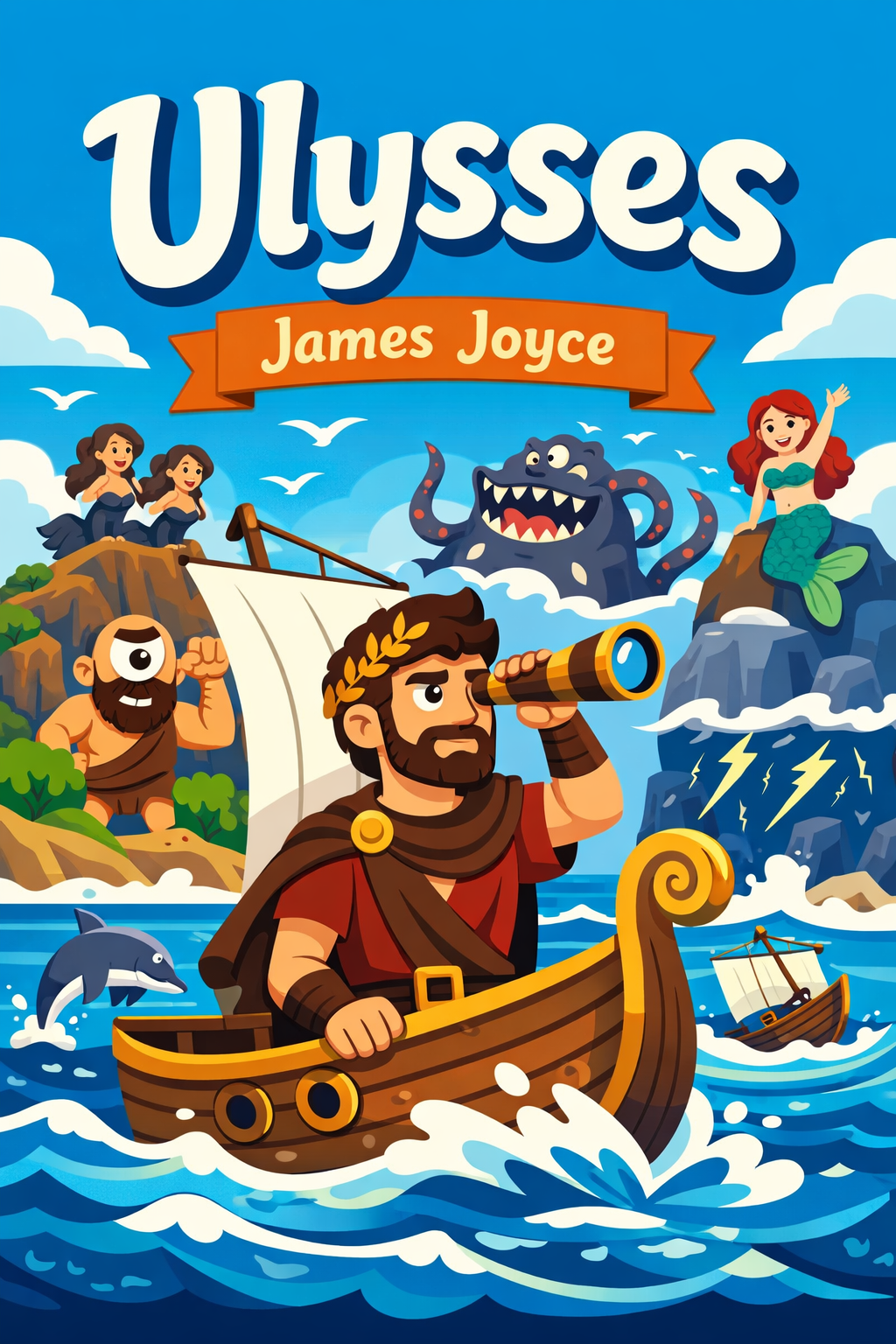
The genius of the work lies in its vast, echoing structure. The seemingly random events of the day—a funeral, a newspaper ad, a concert on the beach—are quietly orchestrated to mirror episodes from Homer’s *Odyssey*, transforming a Dublin stroll into an epic voyage. More profoundly, the narrative dives into the swirling streams of consciousness within each character. We do not just watch them act; we inhabit the rhythm of their thoughts, where a passing object can trigger a philosophical treatise, a childhood memory, or a bodily hunger. The style shifts relentlessly to match its subject, from newspaper headlines to play scripts, from scientific catechisms to romantic parodies.
Ultimately, the book is a monumental celebration of the everyday. It finds the epic in the pub conversation, the mythic in the funeral carriage, and the universal in a man eating kidney. It is about the search for home, for connection, for a son and a father. It acknowledges the weariness, the vulgarity, and the tragedy of life, yet it answers with Molly Bloom’s boundless, sensual yes. It presents not a story to be neatly summarized, but a world to be experienced—a complete, breathing, laughing, mourning universe contained within the boundaries of a single city and a single day.