Description
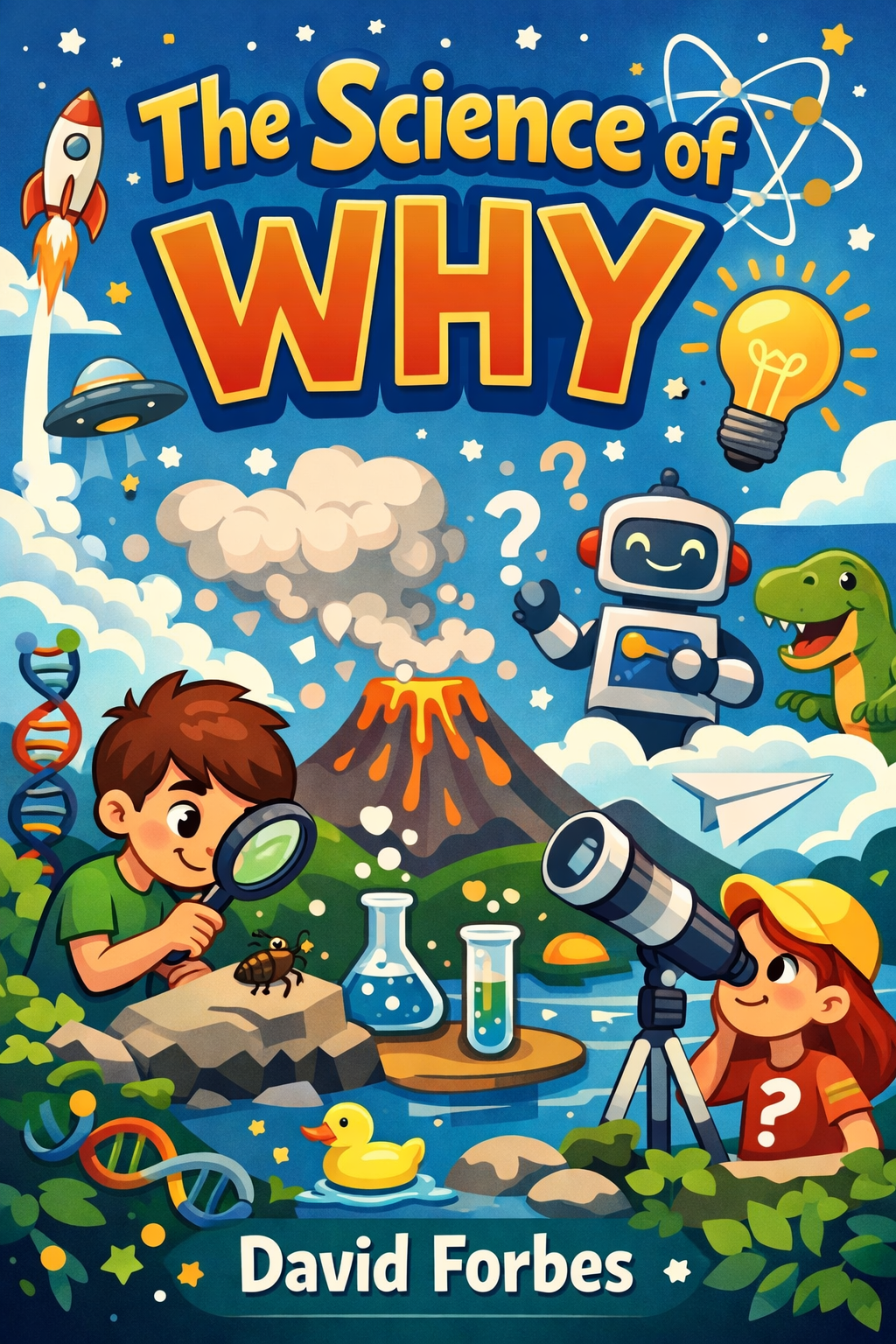
Have you ever stared at the night sky and wondered why it is dark, or pondered the peculiar reason we find babies so irresistibly cute? These are not idle questions but gateways to profound scientific understanding. This book delves into the fascinating realm of inquiry that sits at the intersection of curiosity and knowledge, tackling the seemingly simple “whys” that have puzzled and propelled humanity forward. It argues that our innate desire to ask “why” is the very engine of discovery, transforming mundane observation into the bedrock of physics, biology, and psychology. The journey begins not with complex equations, but with the universal human experience of wonder, demonstrating that the path to deep scientific insight is often paved with childlike questions.
The narrative masterfully connects disparate dots, showing how a question about the color of the sky leads to an understanding of light scattering and atmospheric composition, while a query about yawning unlocks secrets of brain thermoregulation and social empathy. It dismantles the barrier between so-called “soft” and “hard” sciences, proving that the rigor required to explain why we dream is as demanding as that needed to explain why stars shine. Each chapter is a detective story, where the author follows the trail of evidence from initial, often deceptively simple, observation through historical misconceptions, competing theories, and finally to our current, often startling, scientific consensus. We learn that the quest to understand why the Earth has seasons involved epic struggles between ideas, and that the answer to why leaves change color involves a sophisticated process of biochemical recycling that is anything but a simple death.
Beyond natural phenomena, the book applies the same relentless “why” to human behavior and society. It explores the evolutionary reasons behind laughter, the psychological underpinnings of superstition, and the neurological basis for love and attraction. Why do we feel nostalgia? Why do certain patterns of sound become music that moves us? These investigations reveal that our emotions, social structures, and cultural practices are not arbitrary but are deeply rooted in adaptive mechanisms and cognitive processes shaped over millennia. The science behind why we procrastinate or why we conform to group pressure is presented not as trivial trivia, but as crucial knowledge for understanding ourselves and navigating the modern world.
Importantly, the work emphasizes that science is a living, breathing process of continual refinement, not a static collection of facts. For every “why” answered, new and more intricate questions emerge. The explanation for what causes gravity, for instance, has evolved from mystical attraction to Newtonian force to the warping of spacetime, and yet the fundamental “why” still pushes at the boundaries of quantum theory. This book celebrates that uncertainty, framing it not as a weakness of science but as its greatest strength. It shows that being comfortable with “we don’t know yet” is a vital part of the scientific mindset, and that today’s unanswered question is tomorrow’s frontier of discovery.
Ultimately, this is more than a compilation of interesting facts. It is a passionate manifesto for cultivated curiosity. By unpacking the science behind the ordinary and the extraordinary, it equips readers with a new lens through which to view their reality. The world becomes richer, more connected, and more marvelous when you understand the hidden mechanisms at play. The book concludes by inspiring readers to reclaim their innate sense of wonder, to ask their own “whys,” and to appreciate the epic, collaborative human endeavor that is the scientific pursuit of answers. It reminds us that in every “why” lies the potential to see the universe, and our place within it, a little more clearly.