Description
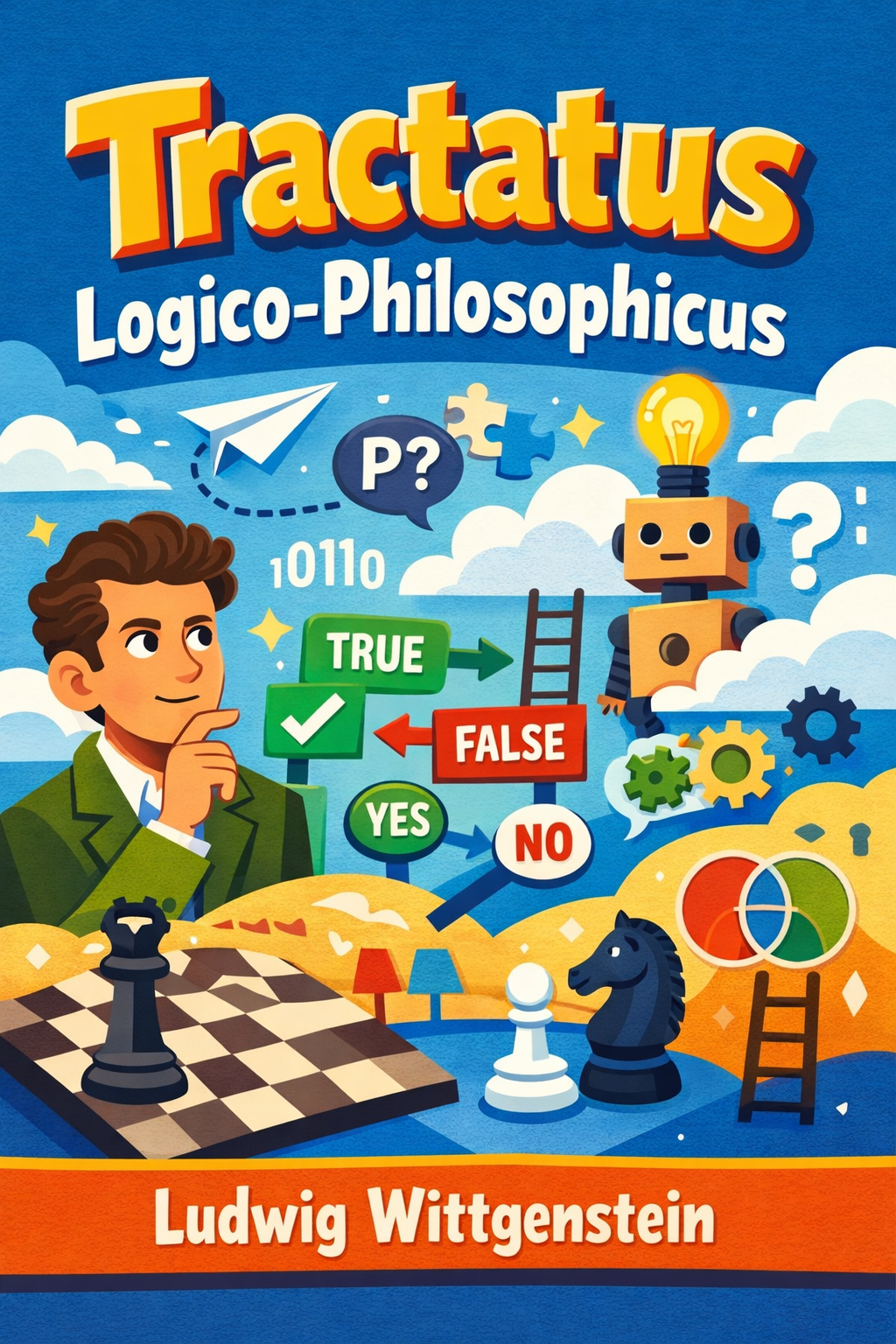
Ludwig Wittgenstein’s “Tractatus Logico-Philosophicus” is a stark and revolutionary work that seeks to draw a definitive boundary around what can be meaningfully expressed through language. Its core proposition is that language functions as a logical picture of the world. Just as a model of a traffic accident uses miniature cars and figures to represent a state of affairs, language uses propositions to picture facts. Anything that can be thought clearly can be said clearly, and the limits of this sayable world are the limits of language itself. Consequently, a vast territory of human concern—including the propositions of traditional metaphysics, ethics, aesthetics, and the very question of life’s meaning—lies outside this boundary. These are not deep truths waiting to be uncovered by more sophisticated philosophy; they are, strictly speaking, nonsense. The book’s famous final line serves as its mantra: “Whereof one cannot speak, thereof one must be silent.”
Wittgenstein builds this argument with austere, numbered propositions. He begins with the fundamental idea that the world is the totality of facts, not of things. Language mirrors this structure by combining simple names into propositions that represent possible states of affairs. The truth or falsity of a proposition depends solely on whether it accurately pictures a fact in the world. This picture theory of language leads to a powerful criterion for meaning: for a sentence to be meaningful, it must be possible to determine exactly what state of affairs in the world would make it true or false. This rules out the grand statements of traditional philosophy. A question like “Does the soul exist?” cannot be answered by pointing to a verifiable fact, and thus the question itself is shown to be a misuse of language, a attempt to say what cannot be said.
This logical purification extends to logic and mathematics themselves. Wittgenstein argues that the propositions of logic and mathematics are tautologies. They do not provide information about the world but instead reveal the scaffolding of language and thought. Saying “Either it is raining or it is not raining” tells us nothing about the weather; it simply displays the logical structure of our language. Mathematics, similarly, is not a discovery of profound truths about reality but a system of equations that show internal relations. It is a method of logic, not a description of the world’s substance. This view sharply contrasts with the belief that mathematics reveals the deep, hidden structure of the universe.
Perhaps the most profound and puzzling consequences of this framework concern the self and value. The philosophical position of solipsism—the idea that only one’s own mind is sure to exist—is, for Wittgenstein, an attempt to express something correct but in an impossible way. The subject, the “I,” is not an object within the world that can be described. It is rather the limit of the world, the perspective from which the world is seen. As he states, “The world is my world.” This is not a factual claim but a logical condition of experience. The feeling of a unified, experiencing self is real, but it cannot be captured in a factual proposition. It shows itself.
This leads to the heart of the Tractatus’s ethical and mystical dimension. All questions of value—what is good, what is beautiful, what is meaningful—are necessarily outside the world of facts. They cannot be stated. If a good will or a beautiful object existed as a fact within the world, it would be just another fact, devoid of its essential value. Value is not *in* the world; it is a condition *of* the world as a whole, seen from a particular perspective. The sense of the world as a limited whole is what is mystical. This is why the deepest truths about existence, ethics, and the meaning of life are ineffable. They can be shown through how one lives and feels, but they cannot be told in the form of factual statements. Philosophy, therefore, is not a body of doctrine but an activity of clarification. Its correct method is to demonstrate to others how they have given no meaning to certain signs in their propositions, to relentlessly analyze language until the nonsensical nature of metaphysical speculation is laid bare. Having used language to climb up and delineate its own limits, one must ultimately throw away the ladder of the propositions of the Tractatus itself, recognizing that even its own philosophical statements are, by its own strict criteria, attempts to say what can only be shown. The work concludes not with a grand theory, but with the instruction to silence, having cleared away the confusion so that what is truly important can, in its own unsayable way, make itself manifest.