Description
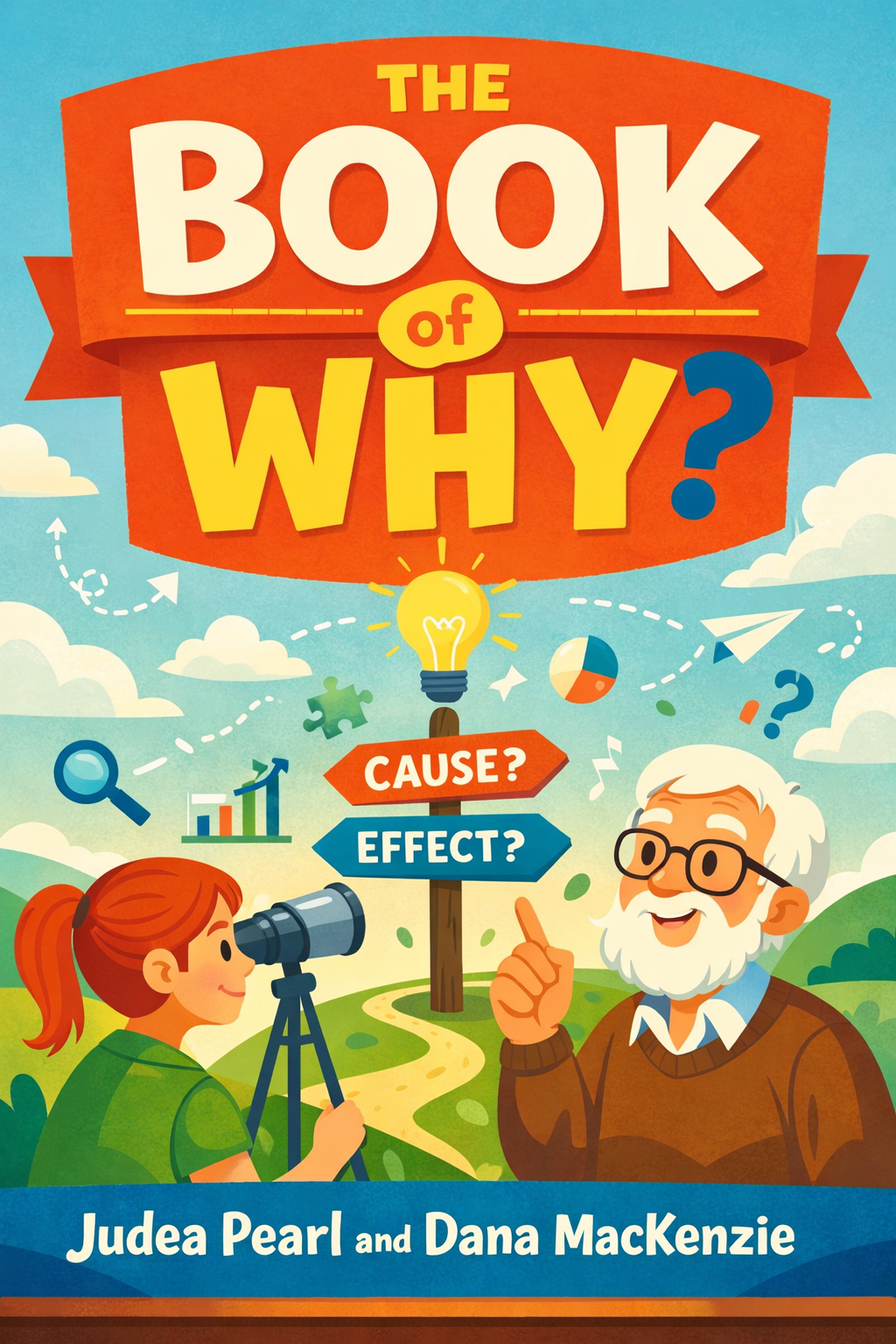
For centuries, the cornerstone of scientific inquiry has been the observation of patterns and correlations—noting that when one event occurs, another tends to follow. We built vast fields of statistics upon this foundation, from economics to epidemiology. Yet, as this compelling work argues, this focus has trapped us in a “statistical dead end.” We became adept at measuring what is, but profoundly limited in asking why things happen. We could see that ice cream sales and drowning incidents rise together, but the tools of traditional statistics could not definitively tell us that eating ice cream does not cause drowning. This book is the master key that unlocks the prison of correlation, inviting us into the richer, more dangerous, and more necessary world of causal reasoning.
The journey begins by diagnosing the ailment of modern data science: its fear of causation. For much of the 20th century, mentioning “cause” in polite scientific company was considered naive or even heretical. The mantra was “correlation does not imply causation,” a necessary caution that hardened into a paralyzing dogma. Researchers were taught to stick to the safe, observable relationships between variables. This aversion, the book reveals, was not merely philosophical but deeply technical. The mathematical language of statistics, developed by giants like Karl Pearson and Ronald Fisher, had no symbols for “because” or “why.” It was a language designed for describing associations, not for encoding the mechanisms that generate them. Consequently, our most powerful models, including many modern machine learning algorithms, became brilliant pattern-finders that are fundamentally incapable of understanding intervention. They can predict, but they cannot imagine what would happen if we changed the world.
The revolutionary pivot comes with the introduction of “causal diagrams” or “causal models.” These are not complex statistical formulae but deceptively simple maps of our assumptions about how the world works. Using little more than circles for variables and arrows for suspected cause-and-effect relationships, we can sketch a model of a system. The true power lies in what we can do with this map. It allows us to move from passive observation to active questioning. We can pose “what if” queries that are the essence of causal thinking: What if we were to intervene and change this variable? What if we could see a hidden factor? The map provides a rigorous, mathematical framework to translate these human questions into estimable probabilities, separating the possible from the impossible and guiding us toward experiments or data analyses that can uncover true causes.
This framework, often called the “Causal Revolution,” is built upon a hierarchy of three distinct levels of cognitive capability. The bottom rung is *Seeing*, or association. This is the realm of raw data and observed correlations: a patient takes a drug and gets better. The middle rung is *Doing*, or intervention. This asks what happens if we *make* someone take the drug, which is different from merely observing those who chose to take it. The top rung is *Imagining*, or counterfactuals. This is the most profound level, dealing with questions about alternate realities: would this patient who recovered *still* have recovered if they had not taken the drug? The book meticulously shows how each level requires its own logic and tools, and how the ladder allows us to climb from simple data to deep understanding. Counterfactuals, once dismissed as metaphysical nonsense, are shown to be the bedrock of responsibility, learning, and scientific explanation itself.
The implications of this shift are vast and practical. In medicine, it clarifies when a clinical trial’s results can be applied to a real-world population, saving lives by ensuring treatments work outside the pristine conditions of a study. In economics, it disentangles the true effect of a policy change from a sea of confounding factors. For the burgeoning field of artificial intelligence, it presents both a critique and a path forward. Current AI, the book argues, is stuck on the first rung of the ladder—it is supremely skilled at association but lacks a model of intervention and counterfactual reasoning. To create machines that possess true intelligence, common sense, and the ability to learn from mistakes as humans do, we must endow them with causal reasoning. A self-driving car needs to understand not just that a pedestrian is present, but what *would* happen if it swerved left versus braking hard.
Ultimately, this is more than a technical manual; it is a plea for a more curious and courageous form of thinking. It argues that the quest for “why” is not a childish distraction but the very engine of human progress. By equipping ourselves with the tools of causal inference, we regain the ability to shape our world with understanding rather than guesswork. We move from being data collectors to becoming theory builders, from observers of a tangled web of events to architects of a better future. The book does not simply offer new equations; it restores a lost vocabulary for curiosity, empowering us to ask the dangerous, beautiful, and essential questions that lead to genuine discovery.