Description
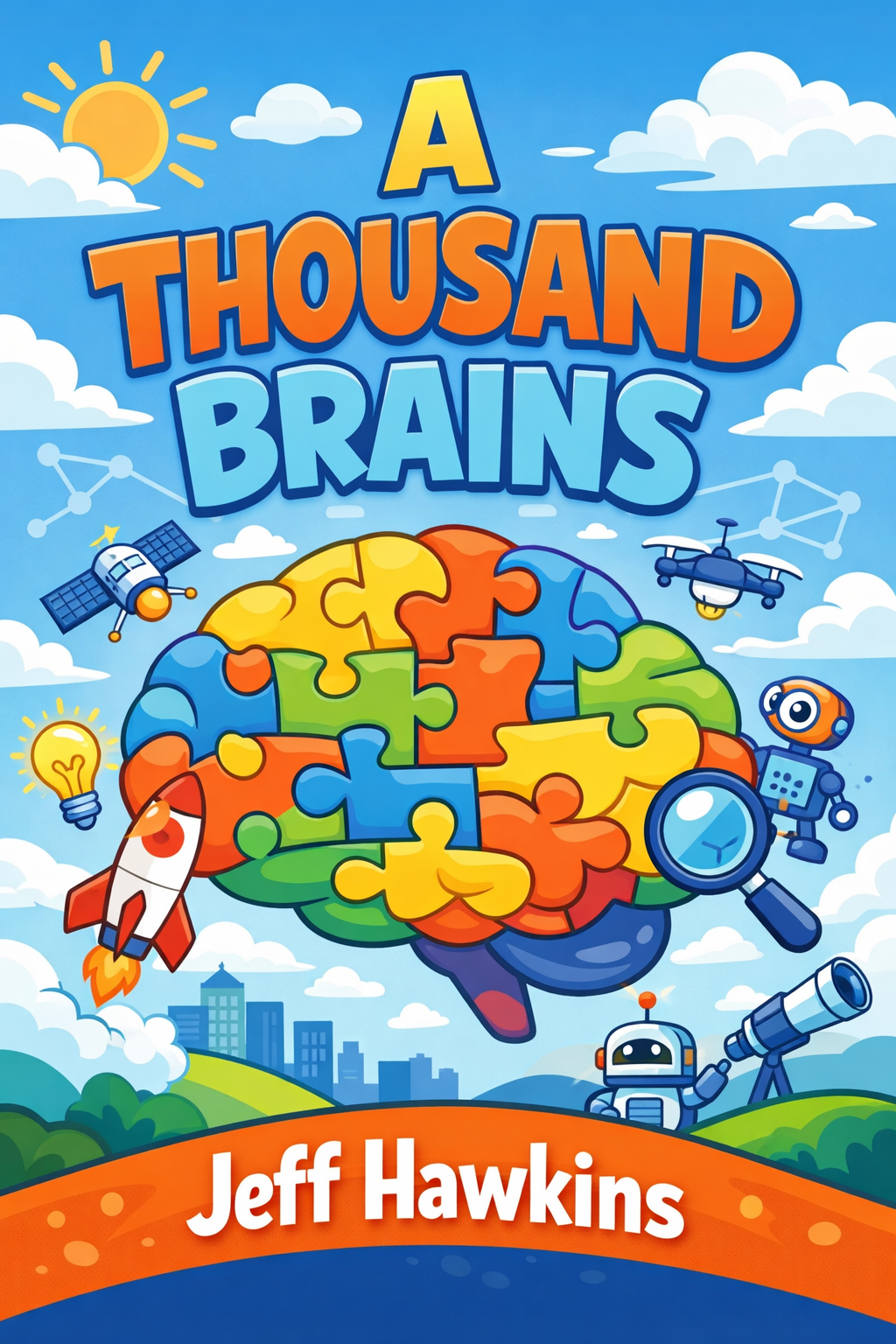
For centuries, the human brain has been one of our greatest mysteries. We have accumulated countless observations about its structure and function, yet a fundamental question persists: how do billions of simple neurons combine to create intelligence, creativity, and consciousness? *A Thousand Brains* presents a breathtaking new theory that reframes our understanding of the mind. It suggests that the key to intelligence lies not in a single, centralized command center, but in a vast, collaborative democracy of thousands of nearly identical computational units, each working in parallel to model the world.
The journey begins with the neocortex, the wrinkled outer layer of the brain responsible for everything you consider high-level thought—language, art, science, and philosophy. Despite governing these diverse functions, the neocortex has a surprisingly uniform structure. It is composed of countless tiny, column-like circuits, each a repeating pattern of neural wiring. This uniformity is puzzling. How can the same basic biological hardware enable us to see a sunset, compose a symphony, and solve an equation? The answer, according to this theory, is that each of these cortical columns is essentially a complete, miniature brain in its own right. Rather than having specialized regions for vision, touch, and language, your brain contains hundreds of thousands of these columns, each capable of learning a model of some aspect of the world.
This leads to a radical reimagining of how the brain operates. The brain is not merely a passive processor of sensory information. It is, at its core, a prediction machine. Imagine a brain isolated in darkness, then connected to a video feed. It would begin to detect patterns and, crucially, start to predict what comes next. Every prediction error would be a learning opportunity, refining its internal model. Now, give that brain a body with hands. It can now actively explore an object, like a stapler, by turning it, pressing it, and opening it. Through this movement, it gathers new data and builds an ever more accurate model. This is what you do every moment. The world you experience is not a direct feed from your senses, but a sophisticated simulation—a controlled hallucination—generated by your brain’s models, all in the service of helping you navigate reality and survive.
This perspective overturns the old idea of the brain as a collection of distinct modules—a vision area, a touch area, a motor area. Instead, each cortical column has its own connections to both sensory inputs and motor outputs. A column processing visual data is also connected to the muscles that move the eyes. This means every column is a little sensorimotor system, building its model by learning the sensory consequences of movement. This elegant design explains long-standing puzzles: why the cortex looks the same everywhere, why it is so resilient to damage, and why brains can rewire so flexibly. The algorithm for intelligence is not a complex, bespoke system for each function. It is a simple, powerful learning algorithm duplicated thousands of times. Understand one cortical column, and you hold the key to understanding the mind.
So, what is happening inside each of these thousands of mini-brains? The fundamental unit of thought is the prediction of sensory input following a movement. Cognition is the process of learning which actions lead to which sensations. Each column operates within its own “reference frame,” a kind of personal coordinate system. Just as a map uses longitude and latitude to plot locations, a column uses its reference frame to map the relationship between movement and sensation. When you blindly feel a coffee cup with one finger, you are using a spatial reference frame to track the shape. The theory proposes this ability evolved from ancient neural mechanisms for physical navigation, like grid cells, which help animals map their surroundings. Evolution brilliantly repurposed this same mapping technology to model not just spaces, but objects, concepts, and abstract ideas.
This brings us to a profound conclusion: your mind is a democracy. You do not have one unified model of a coffee cup or the concept of democracy. You have thousands of models, each residing in different columns, each built from different sensory experiences and reference frames. Your perception of anything is the result of a constant vote among these models. Sometimes the vote is unanimous, leading to a strong, clear perception. Other times, as when an optical illusion fools you, there is conflict and debate. This democratic process extends to abstract thought and beliefs, explaining how we can hold conflicting ideas and why changing a deeply held belief can feel so destabilizing—it requires convincing a whole population of neural models.
The implications of this theory are vast. It provides a new framework for understanding intelligence, both biological and artificial. It suggests that to create true machine intelligence, we must build systems that learn through movement and interaction within reference frames, not just by passively analyzing data. It also offers a fresh, biological perspective on the human condition. Our quest for knowledge and our drive to explore are not merely cultural artifacts; they are built into the very fabric of our thinking organs. Our thousands of brains are compelled to build complete models, to seek knowledge for its own sake. This theory doesn’t just explain how we think; it hints at why we are thinkers, forever driven to map the contours of our reality, from the tangible objects in our hands to the farthest reaches of our imagination.