Description
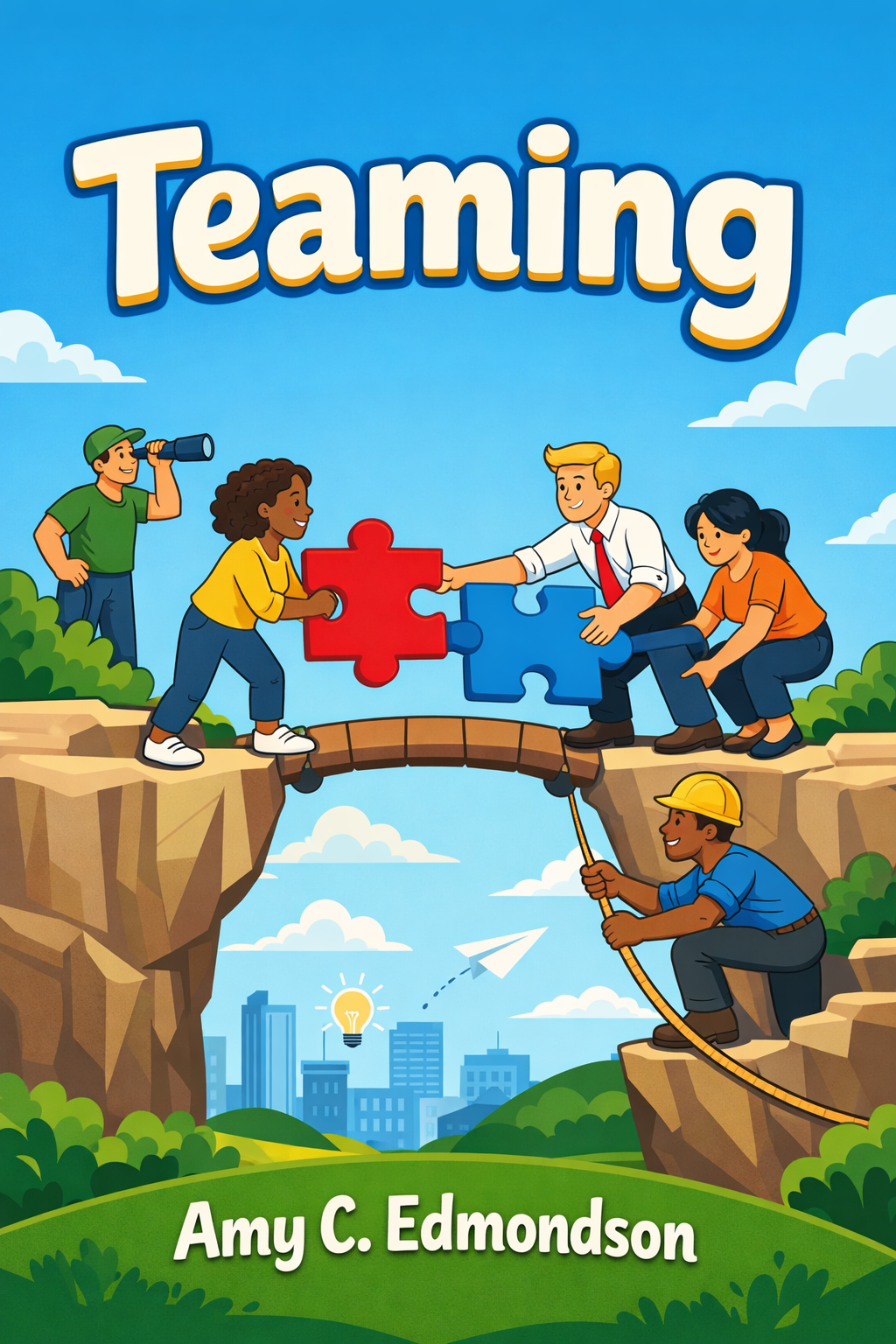
In a world defined by rapid change and intricate challenges, the traditional model of a stable, long-term team is increasingly obsolete. Success no longer depends on individuals working in fixed silos but on the capacity for fluid, spontaneous collaboration—a dynamic process of forming, working, and learning across boundaries in real time. This approach is essential because the problems we face, from developing new technologies to managing healthcare crises, are too complex for any single expert or static department. The knowledge required doubles at a staggering pace, making continuous collective learning the only sustainable advantage. Organizations stuck in industrial-era thinking, which prizes rigid standardization and views failure as a punishable mistake, are being outpaced by those that embrace adaptability, psychological safety, and learning as core activities.
This dynamic collaboration, which we can call teaming, operates like organizational jazz. It requires skilled professionals to improvise together around a shared goal, without the luxury of extensive practice or a fixed score. This is evident in high-stakes environments like an operating room facing an unexpected complication, where a group of specialists must instantly synthesize their expertise. The goal shifts from simply executing a pre-defined plan to learning and adapting while the work is being done. This mindset transforms every project and interaction into an opportunity to build collective intelligence. When a product team shares a rough prototype for early critique, or a marketing group runs a small experimental campaign, they are completing a task and simultaneously enhancing the organization’s shared knowledge base, creating a powerful upward spiral of capability.
Central to this adaptive capability is redefining the role of failure. In a learning organization, not all failure is equal; it exists on a spectrum from blameworthy to praiseworthy. Blameworthy failures involve negligence or violating core protocols, while praiseworthy failures are the thoughtful risks taken in pursuit of innovation. The most forward-thinking institutions treat failures, especially the latter kind, as a rich source of data. They conduct rigorous analyses of setbacks, transforming costly mistakes into institutional wisdom that prevents future errors and sparks new directions. This requires cultivating psychological safety, where team members feel secure enough to admit mistakes, ask naive questions, and offer half-formed ideas without fear of embarrassment or retribution. In such an environment, stories of past failures become powerful teaching tools, more resonant than raw data, guiding future decision-making and encouraging intelligent risk-taking.
Implementing this model requires a fundamental shift from a philosophy of execution-as-efficiency to one of execution-as-learning. The old model seeks to eliminate variance and standardize processes for maximum output. The new model recognizes that in complex work, variance is a source of crucial information. It involves setting clear learning goals alongside performance goals and creating systems to capture insights from the frontline. For example, a healthcare network might establish medical protocols as informed starting points, but empower doctors to deviate based on judgment—provided they document their reasoning and outcomes. This creates a continuous feedback loop where daily practice refines organizational knowledge, turning every patient interaction into a potential learning opportunity.
Ultimately, thriving in complexity demands a new kind of leadership and organizational architecture. Leaders must become architects of learning, focused on framing challenges positively, building bridges across silos, and designing spaces—both physical and cultural—for open dialogue and experimentation. They move from being the sole source of answers to curators of collective problem-solving. This transforms the very culture of work: innovation accelerates as ideas cross-pollinate, employees find deeper meaning in seeing their expertise contribute to a larger whole, and the organization develops the resilience to navigate uncertainty. The goal is to build not just a team, but an organization that is perpetually teaming—a living system that learns and adapts faster than the challenges it faces.