Description
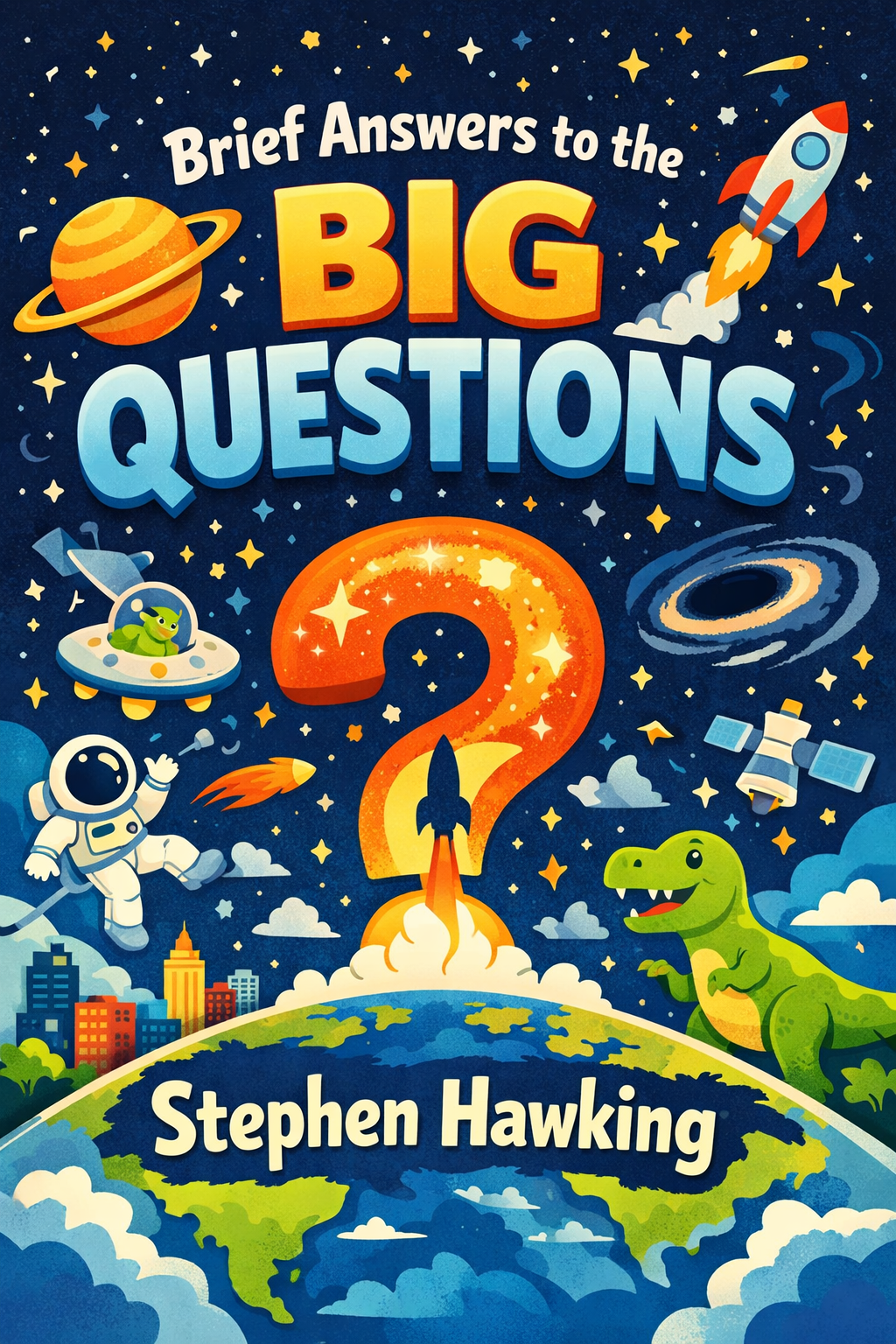
In this final work, the legendary physicist Stephen Hawking turns his brilliant mind to the most pressing and enduring questions of our time. He does not shy away from the grandest inquiries, tackling them with the trademark wit and intellectual rigor that made him a global icon. The book serves as both a summation of his life’s work and a passionate look forward, a guide for humanity written from the unique perspective of a man who spent his life decoding the universe’s deepest secrets.
Hawking begins by wrestling with the ultimate origin story: the Big Bang. He explains why asking what came before it might be meaningless, as time itself began at that singularity. This leads him directly to the question of a divine creator. With characteristic directness, he argues that the laws of physics, particularly a complete theory of quantum gravity, could explain the universe’s spontaneous creation from nothing, rendering the need for a God who lit the blue touch paper obsolete. For Hawking, science provides a more compelling narrative than myth.
The exploration then turns outward, to the possibility of life and intelligence beyond Earth. Hawking is cautiously optimistic about simple microbial life existing elsewhere in our solar system, but he sounds a stark warning about seeking out advanced civilizations. Drawing a grim historical parallel, he suggests that a meeting between a technologically advanced species and a lesser one rarely ends well for the latter. This segues into a urgent discussion of our own planet’s future. He views climate change, resource depletion, and potential self-annihilation through nuclear or biological weapons as existential threats far more immediate than alien invasion.
A significant portion of the book is devoted to the twin revolutions of artificial intelligence and genetic engineering. Hawking sees immense promise in both, from curing diseases to reversing environmental damage. However, his tone becomes one of grave concern when discussing superintelligent AI. He fears that creating an entity smarter than humanity could be our final invention, as it might rapidly redesign itself beyond our control or comprehension, with goals not aligned with our survival. He advocates for proactive research into AI safety and robust ethical frameworks, urging that we solve the control problem before we solve the intelligence problem.
Throughout, Hawking’s personal journey is a powerful undercurrent. He reflects on his own life with motor neuron disease, not with self-pity, but to emphasize the indomitable power of the human spirit and mind. He argues that disability need not be a barrier to great achievement, a lesson embodied by his own career. This personal resilience fuels his ultimate optimism. Despite the dire warnings, he believes our curiosity and reason will propel us forward.
His vision for humanity’s long-term survival is literally stellar. He makes a forceful case that we must become a multi-planet species, establishing self-sustaining colonies on the Moon and Mars as a hedge against planetary disaster. Looking further ahead, he discusses the mind-bending concepts that could make interstellar travel possible, from warp drives to generation ships. The book culminates in a challenge and an inspiration. He urges the next generation to look up at the stars, not down at their feet, to nurture curiosity, and to believe in the power of science and logic to shape a better future.
In essence, this book is Hawking’s parting gift—a clear-eyed, hopeful, and profoundly important manifesto. It is a call to use the tools of science to understand our universe, to confront the dangers we have created, and to take responsibility for our incredible, fragile existence. He leaves readers not with definitive answers, but with something more valuable: a framework for thinking about the big questions and a renewed sense of wonder at the fact that we, a collection of atoms on a minor planet, can even attempt to understand the cosmos.