Description
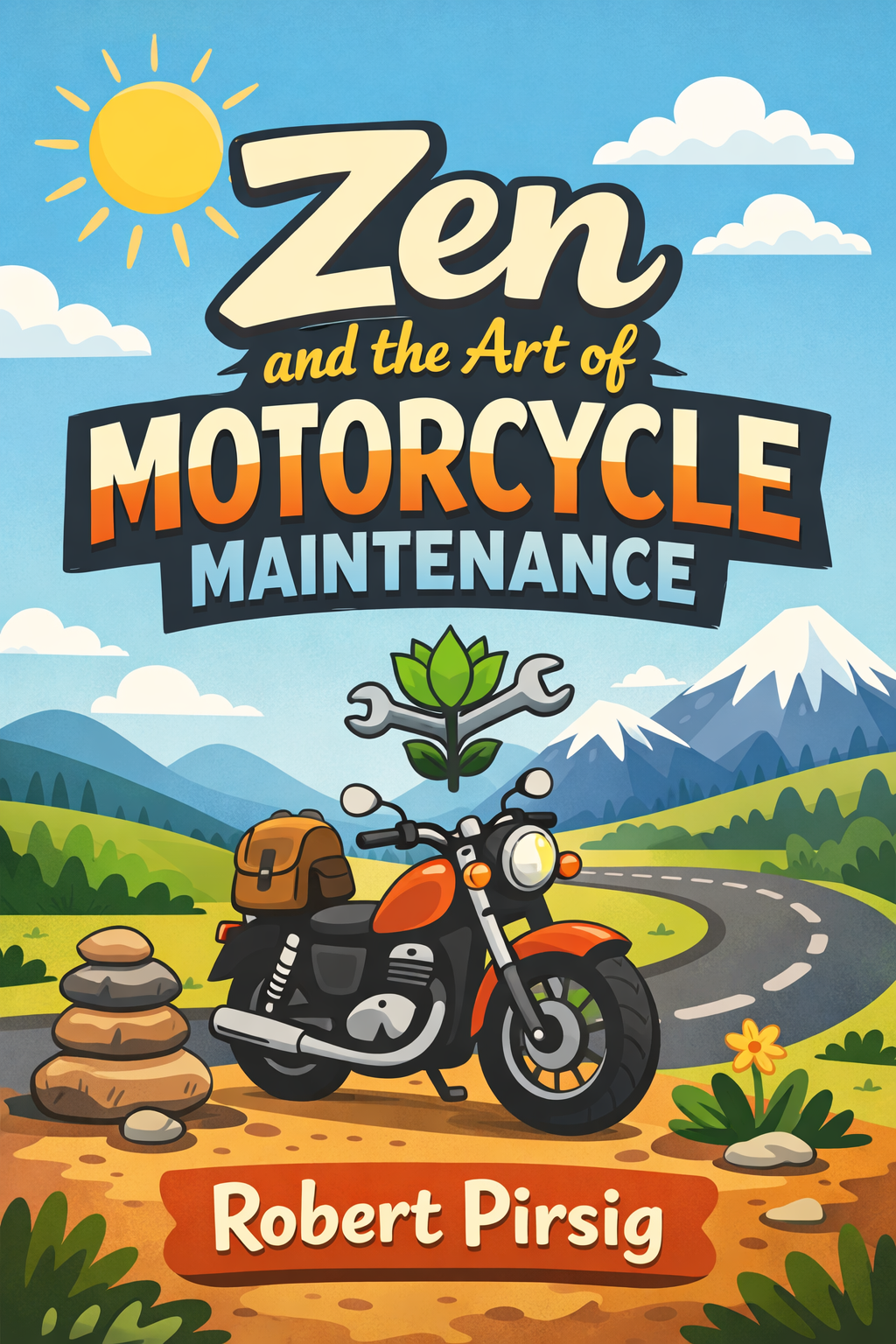
The story unfolds as a deeply personal narrative of a cross-country motorcycle trip taken by a man and his young son, Chris. This physical journey parallels an intense internal voyage into the nature of “Quality” and the fundamental split in human consciousness. The narrator observes this split in his traveling companions, John and Sylvia, who represent a purely romantic view of the world. They appreciate their motorcycle as a sleek object of freedom but are willfully ignorant of its mechanics, seeing such technical knowledge as a destructive intrusion upon their experience. For them, engaging with the gears and pistons would strip the machine of its beauty and mystery.
In contrast, the narrator embodies the classical, rational mode of thought. He understands his motorcycle as a system of interrelated functions, finding satisfaction in diagnosing problems and performing his own maintenance. He values the order, logic, and control that this understanding provides. This dichotomy, he realizes, is not just about machines but reflects a vast cultural chasm. Western thought, he argues, is fractured into two halves: the classical, which includes science, logic, and a focus on underlying form; and the romantic, which encompasses art, emotion, and an appreciation for immediate appearance. Each side views the other with suspicion, leading to a fragmented life and society.
As the miles pass, the narrator grapples with the ghost of his former self, a man he calls Phaedrus. Phaedrus was a brilliant but tormented philosophy professor who pursued a single, consuming question to the point of a mental breakdown and subsequent electroshock therapy. The narrator’s memories of Phaedrus’s intellectual quest slowly resurface throughout the journey. Phaedrus had become obsessed with the concept of “Quality.” He posited that Quality is not an objective property nor a subjective feeling, but a third, pre-intellectual reality that is the source of both subjects and objects. It is the moment of awareness before we analytically separate ourselves from our experience. A beautiful sunset, a well-tuned engine, a perfect mathematical proof—each has Quality, which we recognize before we label it as “romantic” scenery or “classical” function.
Phaedrus believed that this division of the world into classic and romantic is the root of modern alienation. By chasing either cold rationality or fleeting emotion, we lose the unified ground from which both spring. True care, whether for a motorcycle or for one’s own life, arises from engaging with Quality. This means being fully present, attentive, and responsive to the task at hand, merging the doer and the deed. Fixing a motorcycle properly then becomes a deeply moral and even spiritual act, a meditation where the mechanic and the machine are in harmony. This is where the “Zen” of the title resides: not in any formal doctrine, but in the mindful, quality-driven engagement with the immediate reality of one’s life and work.
The narrator’s struggle is to reconcile his current, more stable classical self with the radical, shattered wisdom of Phaedrus. He fears that his son Chris may be inheriting this same intellectual and emotional instability. The trip becomes a test of whether he can integrate Phaedrus’s hard-won insights without succumbing to the same madness. He sees that Phaedrus’s pursuit, while destructive, was a heroic attempt to heal the fundamental wound in how we see the world. The tragedy was that the institution of rational thought—the university—could not accommodate a philosophy that challenged its very foundations.
In the end, the journey points toward a resolution not in abstract theory, but in lived experience. The narrator begins to accept Phaedrus as part of himself. He understands that a life of Quality requires embracing both the rational and the romantic, the technical and the aesthetic, without letting either dominate. It means meeting the world with caring attention. As he and Chris ride onward, there is a sense of tentative peace and reunion. The motorcycle, now a symbol of this unified understanding, carries them forward—not as a romantic escape nor a classical problem to be solved, but as a vehicle for a more complete way of being in the world, where the rider, the machine, and the road are one seamless event of Quality.