Description
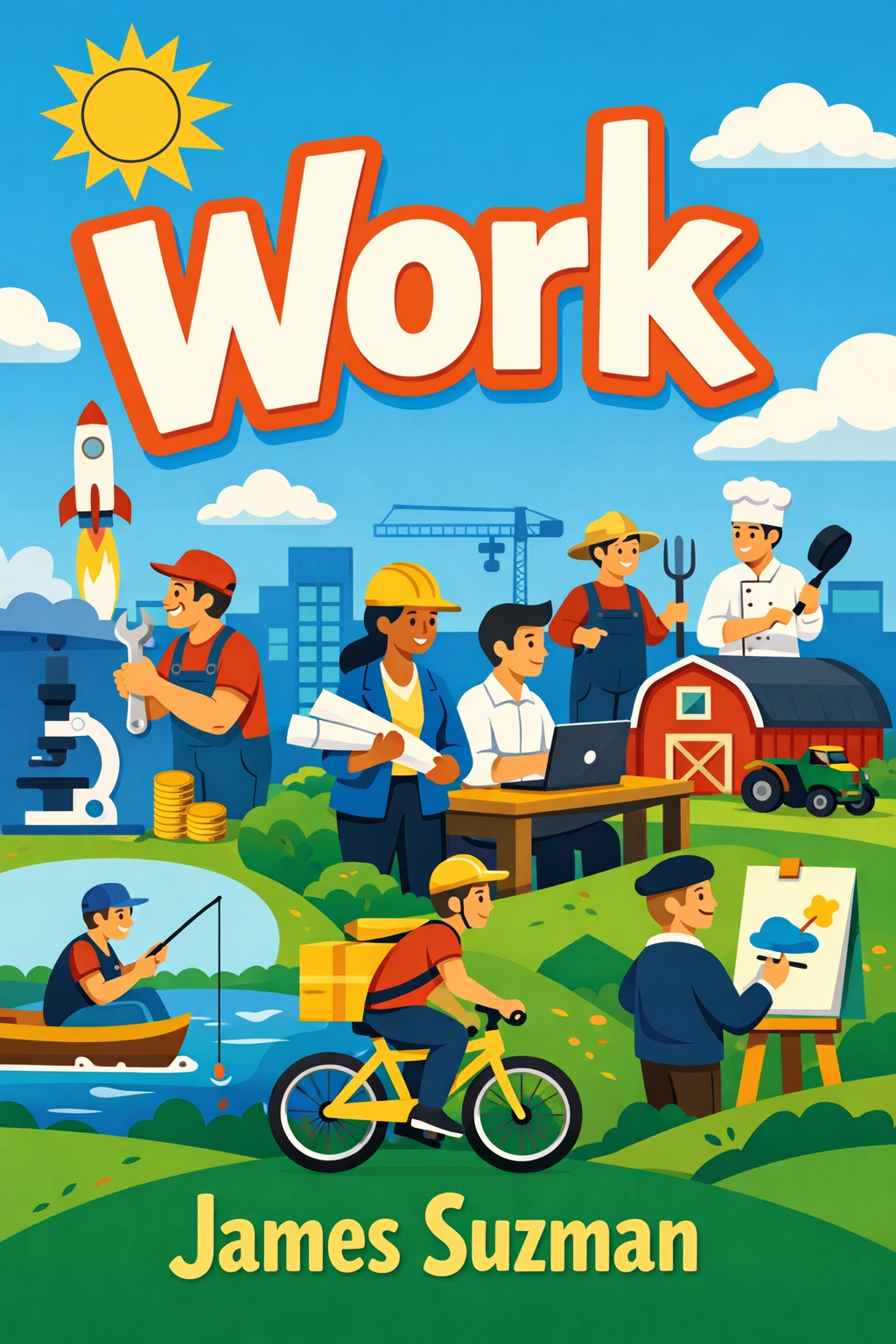
This book presents a profound exploration of work, not as a mere economic activity, but as the fundamental force that has shaped human evolution, society, and consciousness. It begins with a startling premise rooted in physics: life itself is a rebellion against entropy, a process of capturing and expending energy. From the first bacteria transmuting chemical energy to the baffling nest-building rituals of weaver birds, the drive to work—to channel energy—is a biological imperative. This foundational view reframes our entire history, suggesting that our relationship with work is written into the very fabric of our existence.
The narrative then traces how this primal energy was harnessed and transformed by our ancestors. The invention of tools, particularly the enigmatic Acheulean hand-axe, did more than ease survival; it physically sculpted our bodies and, more importantly, catalyzed the explosive growth of our brains. The mastery of fire emerges as the single most pivotal breakthrough. By unlocking more nutrients and creating leisure time around the hearth, fire fostered communication, social bonding, and the first inklings of culture, effectively creating the first division between work and life beyond mere survival.
For most of human history, this balance was surprisingly favorable. Hunter-gatherer societies, as observed in groups like the Ju/’hoansi, often required relatively few hours of work to meet their needs, leaving ample time for community and creativity. The perception of work was immediate and direct. This changed dramatically when Homo sapiens migrated out of Africa into colder climates. Facing seasonal scarcity, they were forced to plan, store, and labor for future benefit—a conceptual shift that planted the seeds of anxiety and surplus accumulation. Ironically, the long winters also provided enforced leisure, fueling an explosion of artistic expression and the first signs of social hierarchy, as seen in the ornate burial of a boy with thousands of ivory beads.
The adoption of agriculture, often hailed as progress, is revealed as a double-edged sword that drastically increased the human workload. While it allowed populations to soar, it trapped communities in a brutal cycle. Any surplus from a good harvest was quickly consumed by more mouths, a phenomenon known as the Malthusian trap. Life became a relentless grind of planting, tending, and harvesting, with periodic collapses leaving genetic scars on our species. From this struggle, however, emerged new concepts: the idea of owned land, stored surplus, and with it, the very origins of money as a measure of value and a means of exchange.
The domestication of animals further revolutionized work, providing muscle power and transportation, but it also established a dangerous template. The logic of controlling another species for labor was tragically applied to humans themselves, giving rise to organized slavery. As agricultural surplus enabled the rise of cities, work was again reimagined. People were no longer generalists feeding their families but specialists—potters, soldiers, priests—integrated into a complex social machine. Work became a social identity, dictated by rigid hierarchies and institutional powers far removed from the individual.
The final great transformation was the Industrial Revolution, which severed the last tangible connection between labor and its product. The factory system created unprecedented material wealth but also an era of staggering inequality and alienation. Work was atomized, timed, and owned by others. This legacy directly informs our current moment of crisis, as we stand at the brink of another revolution powered by AI and biotechnology. The central anxiety of our age—that machines will render human labor obsolete—strikes at the core of our species’ identity, forged over millions of years of channeling energy through tools, fire, and social collaboration.
Ultimately, this historical voyage shows that work is far more than a job. It is the evolving dialogue between human ingenuity and our environment, a story of adaptation that has defined our bodies, our minds, our societies, and our deepest fears. Understanding this long arc is essential to navigating the uncertain future of our fundamental human drive.