Description
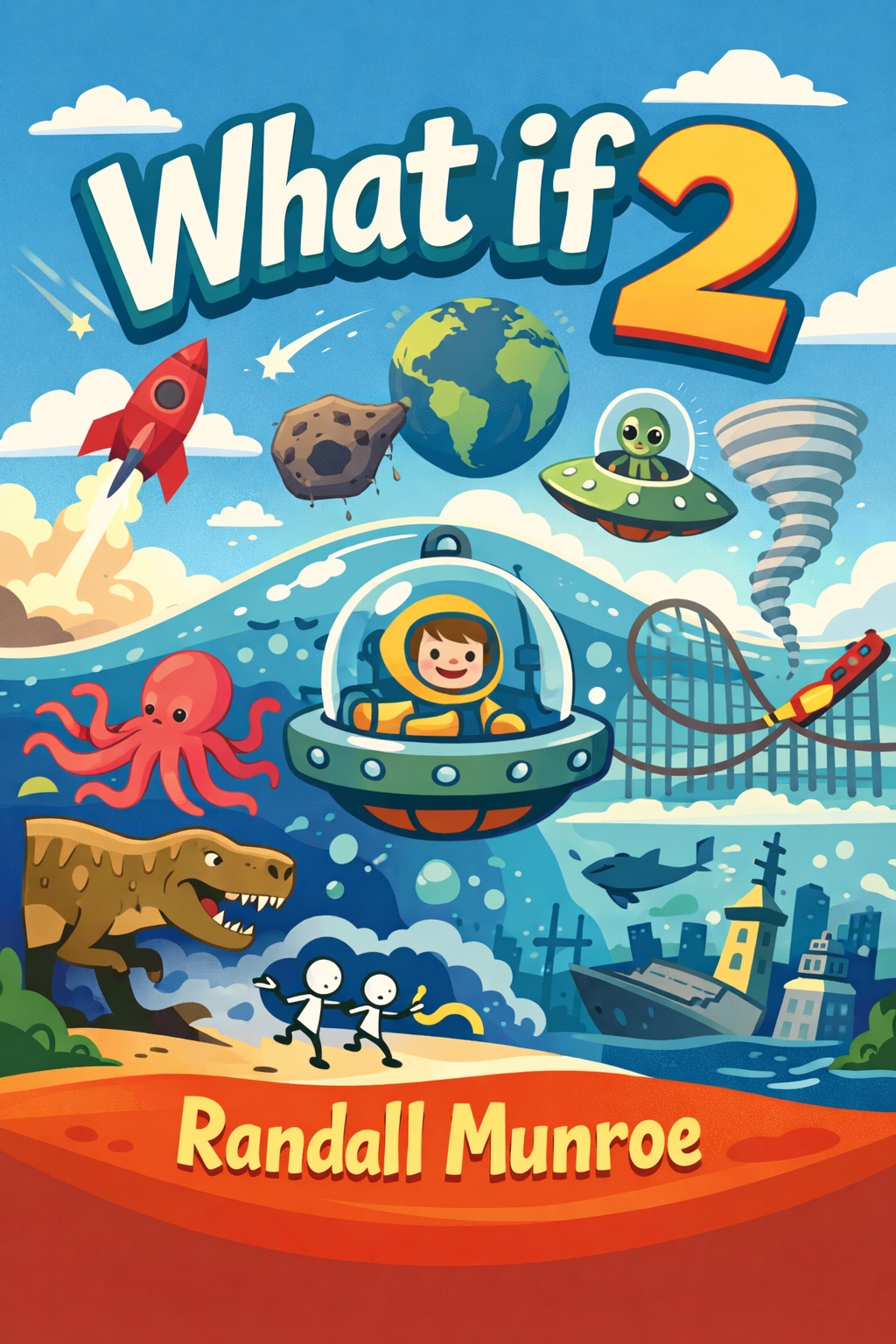
What If? 2 invites readers on another delightful journey through the bizarre corridors of scientific curiosity, where no question is too strange to be taken seriously. The book operates on a simple, powerful premise: by interrogating the world with questions that seem ridiculous on the surface, we often uncover profound and unexpected truths about physics, biology, history, and human nature. This volume continues the tradition of its predecessor, tackling a fresh batch of reader-submitted inquiries with a signature blend of deep scientific rigor and accessible, often hilarious, explanation.
The charm of the work lies in its method. Each chapter, though not labeled as such, begins with a deceptively silly premise. Imagine, for instance, draining the oceans to see what lies beneath, or determining how many pigeons it would take to lift a human into the air. The initial reaction might be a chuckle, but the exploration that follows is anything but a joke. The author meticulously deconstructs each scenario, applying first principles of mathematics, chemistry, and physics. The process of answering “what if we could throw a baseball at nearly the speed of light?” involves a step-by-step walkthrough of relativistic physics, atmospheric ionization, and nuclear fusion, transforming a cartoonish idea into a masterclass in particle behavior and energy release. The humor never derails the science; instead, it acts as a vehicle, making complex concepts memorable and engaging.
Beyond the laughs and the fascinating facts, a deeper philosophy emerges. The book argues implicitly for the value of curiosity unbound by practicality. In a world often focused on immediate utility, it champions the kind of wondering that leads to foundational discoveries. By following a question about building a periodic table out of actual, physical cubes of each element to its logical—and sometimes dangerous—conclusion, the book celebrates the spirit of inquiry for its own sake. This process mirrors the way many great scientific breakthroughs begin: not with a goal-oriented plan, but with a “what if” moment that seems, at first glance, to be mere whimsy.
The range of topics is astonishingly broad, ensuring that every reader finds multiple questions that hook their imagination. One moment you’re contemplating the logistical nightmare of assembling a humanoid robot from every element on the periodic table, and the next you’re pondering the geological and societal impacts of the Earth suddenly stopping its rotation. The author deftly jumps from astrophysics to microbiology, from historical analysis to futuristic speculation, all while maintaining a consistent, conversational tone. This variety demonstrates the interconnectedness of knowledge, showing how a question about biology might require an understanding of physics, or a historical hypothetical hinges on principles of economics.
A subtle but powerful undercurrent in these explorations is a reflection on human scale and our place in the universe. Questions like “what if everyone on Earth jumped at the same time?” or “how quickly could a virus spread if it was transmitted by handshakes?” ground cosmic principles in relatable human experience. They make the vast forces of physics or the exponential growth of epidemiology tangible. Conversely, questions about interstellar travel or geological deep time shrink human concerns to a humbling perspective. This constant zooming in and out fosters a sense of wonder about the ordinary world and our extraordinary universe.
Ultimately, the book is more than a collection of amusing answers. It is a toolkit for thinking. By modeling how to dissect an implausible scenario with plausible science, it teaches critical thinking, estimation, and the scientific method. It encourages readers to look at the world and ask their own “what if” questions, breaking down problems into manageable parts and researching the core principles at play. The tone is never condescending; it feels like learning from a brilliantly funny friend who is just as excited about the journey to the answer as the answer itself. It transforms the reader from a passive consumer of facts into an active participant in a grand, ongoing conversation about how our world works.
In its final essence, this work is a profound celebration of human curiosity. It proves that knowledge is not a sterile collection of data but a living, breathing landscape to be explored with joy and imagination. By taking our silliest thoughts seriously, it validates the innate desire to understand, to poke, to prod, and to wonder. It leaves readers with a renewed sense of awe for the complexities of reality, a handful of incredible facts to share, and, most importantly, the infectious urge to look at the mundane world and ask, with a grin, “Yeah, but what if…?”