Description
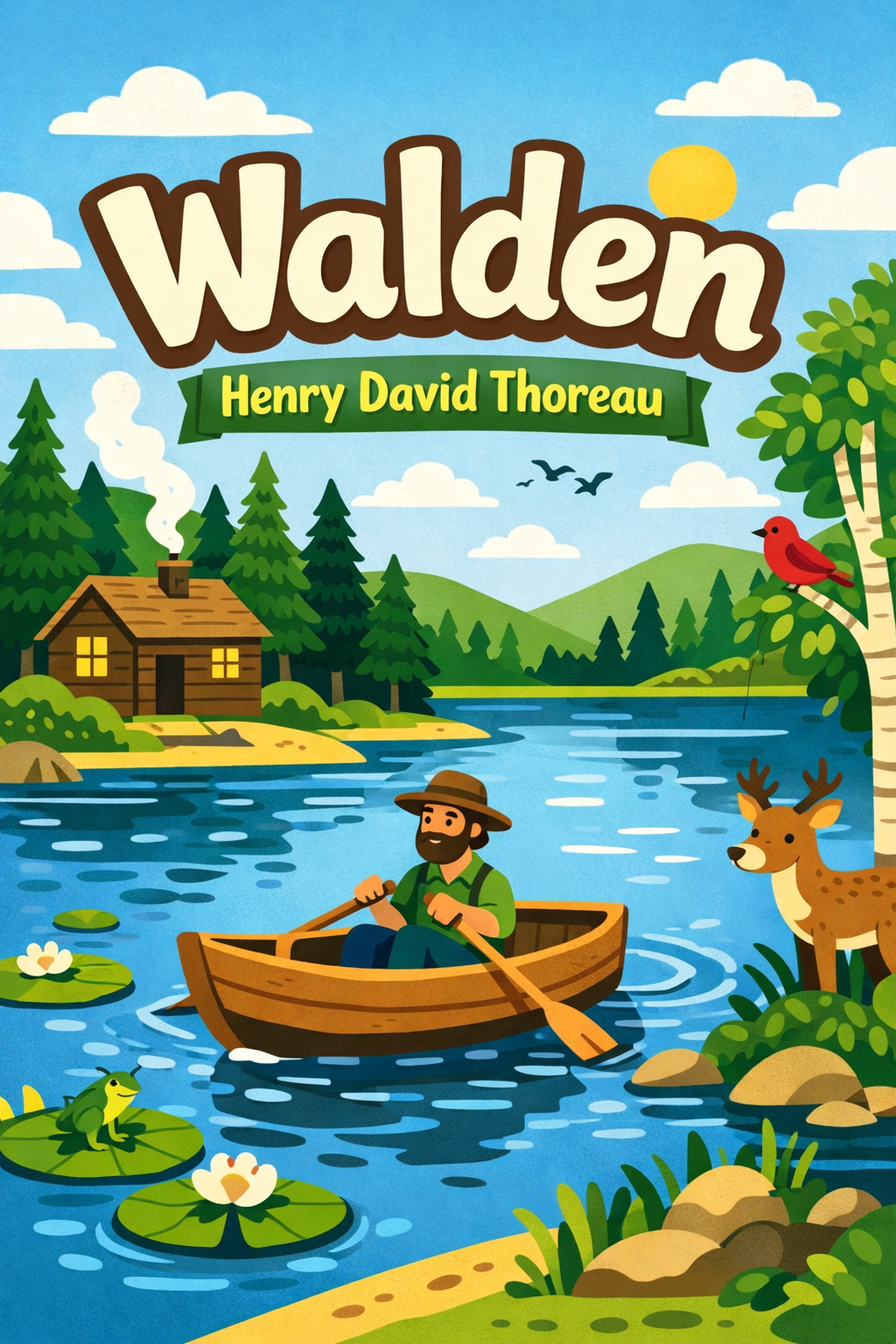
In the mid-19th century, a man named Henry David Thoreau embarked on a personal experiment in deliberate living. Disenchanted with the increasing complexity and materialism of society, he sought to strip life down to its fundamental truths. To do this, he borrowed an axe, walked into the woods near Concord, Massachusetts, and built a modest, one-room cabin on the shores of Walden Pond. For two years, two months, and two days, he lived there alone, supporting himself through his own labor, observing the natural world, and deeply contemplating the purpose of human existence.
The narrative is not merely a chronicle of survival, but a philosophical meditation woven from the threads of daily experience. Thoreau meticulously records his costs, demonstrating how little money is actually required to meet one’s basic needs when freed from societal expectations. He describes the process of constructing his shelter, planting a bean field, and the quiet rhythm of his days, which were filled with reading, writing, walking, and observing. The simplicity of his lifestyle afforded him what he valued most: time and freedom. He argues that people often become slaves to their possessions and their relentless pursuit of wealth, working themselves into a state of exhaustion to afford luxuries they have no time to enjoy. By contrast, his life at Walden was an exercise in economy—not of money, but of life itself, aiming to suck out all the marrow of it.
Nature is not just a backdrop for this experiment; it is the central teacher. Thoreau becomes a meticulous student of the pond, the woods, the animals, and the changing seasons. He measures the depth of Walden Pond, charts the melting of the ice in spring, and listens to the distinct voices of owls, loons, and chirping crickets. These observations are never purely scientific; they are always pathways to larger insights. The ant war he describes becomes a commentary on human conflict. The thawing clay of the railroad cut sparks a reflection on creativity and inner vitality. The pond itself, clear and deep, becomes a mirror for the soul, symbolizing the transparency and depth to which a person should aspire.
Throughout his stay, Thoreau engages with visitors and reflects on the village life from which he has stepped back, not fully retreated. He receives guests in his cabin, from simple woodcutters to philosophers, and these interactions serve as counterpoints to his solitude. He criticizes the herd mentality of society, the blind adherence to tradition, and the neglect of individual conscience. His famous call to “live deliberately” is a plea to wake up from the slumber of routine and to confront the essential facts of life directly, to see if he could learn what it had to teach, and not, when he came to die, discover that he had not truly lived.
The changing seasons provide the structure for his internal and external journey. The lush abundance of summer gives way to the introspection of autumn and the stark, pure silence of winter. This winter period is particularly profound, a time of distillation where the landscape is reduced to its essentials, much like his own life. When spring finally arrives with its explosive renewal, Thoreau feels a corresponding rebirth within himself. The ice breaks up with thunderous groans, the earth softens, and life returns with irresistible force. He sees this as evidence of perpetual, hopeful renewal, both in nature and in the human spirit.
He concludes that his experiment was a success, not because he proposes everyone should live in the woods, but because he proved a point about sufficiency and focus. He learned that by reducing material clutter and social noise, one could gain immense spiritual and intellectual wealth. He left Walden for as good a reason as he went there, having more lives to live. The book is an enduring invitation, not to wilderness solitude per se, but to an internal exploration. It challenges every reader to identify their own “Walden,” to simplify their own existence, and to march to the beat of their own drum, regardless of societal pressure. It is a testament to the idea that the universe is wider than our views of it, and that a life of conscious purpose, closely aligned with the rhythms of the natural world, is the richest life of all.