Description
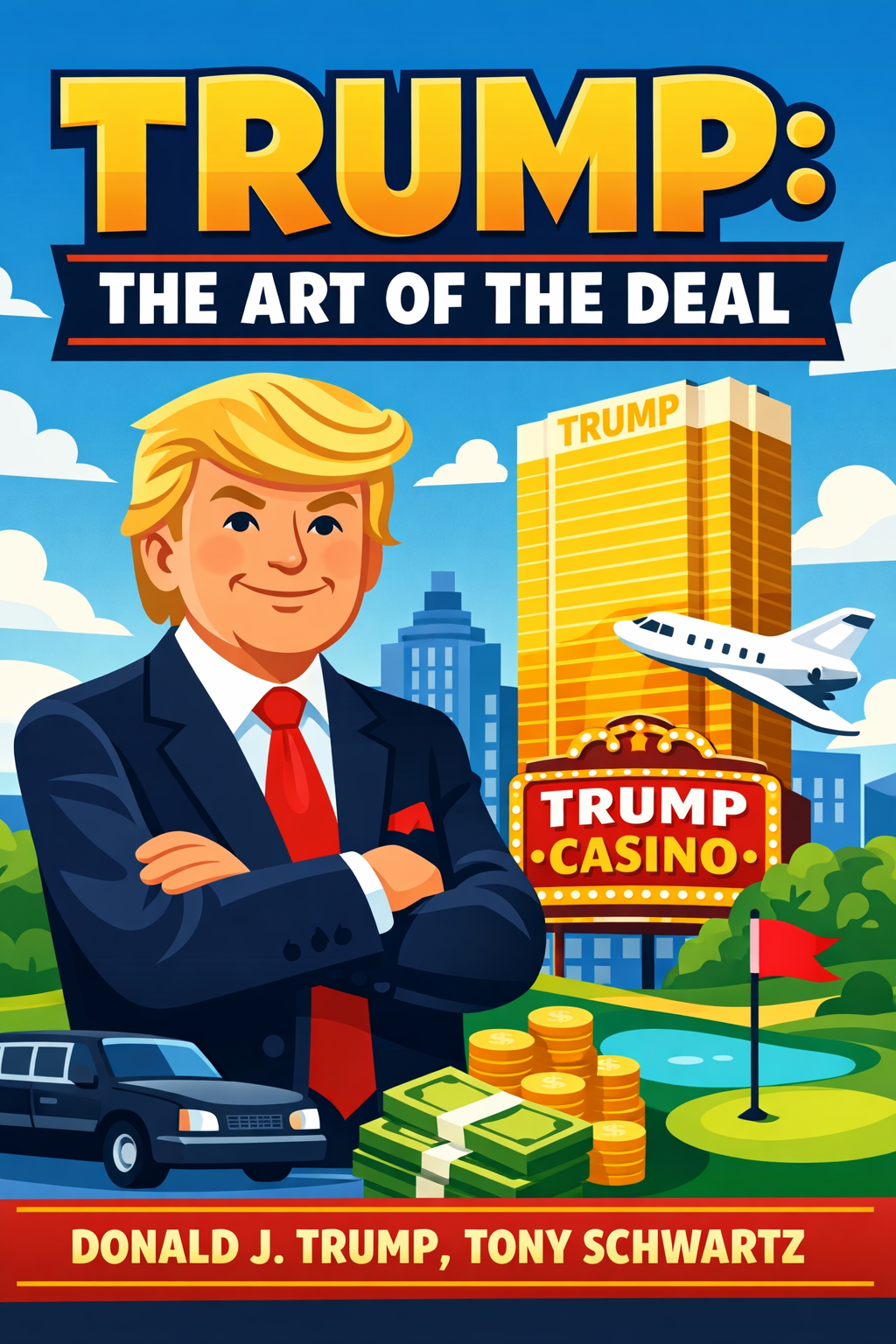
Donald Trump’s first book, written with Tony Schwartz, presents itself as a candid look inside the mind of a brash young real estate developer who took New York City by storm. More than a simple autobiography, it serves as a manifesto for Trump’s particular brand of business, where ambition, showmanship, and relentless pressure are the primary currencies. The narrative weaves together stories of his major projects—from the revitalization of the Commodore Hotel into the Grand Hyatt to the construction of Trump Tower—with a set of guiding principles he claims are essential for success.
At its core, the book argues that deal-making is not a dry financial skill but an art form combining instinct, psychology, and theatrics. Trump portrays the business world as a glamorous but ruthless arena, and he details his approach to navigating it. He emphasizes thinking big, as he believes it is just as easy to think on a grand scale as it is to think small. Protecting one’s interests at all times is paramount, and he advocates for using leverage, fostering competition among counterparts, and always leaving room for strategic retreat. Truthfulness, in his framework, is often presented as a flexible concept; he famously champions “truthful hyperbole,” a form of aggressive promotion that he sees as an innocent and effective way to sell a vision.
The personal stories illustrate these principles in action. He describes the long, complex fight to secure the rights for what would become Trump Tower, showcasing his persistence and his knack for navigating political bureaucracy. He recounts the flashy marketing campaigns, the deliberate cultivation of a larger-than-life public persona, and the strategic use of the media to generate buzz and pressure opponents. His dealings are portrayed as high-stakes battles of will, where he often wins by outlasting and outmaneuvering his rivals. The picture painted is one of a man constantly in motion, seeing potential where others see decay, and bending reality to his will through sheer force of personality and negotiation.
Beyond the deal-making tactics, the book is a study in branding before the term was ubiquitous. Trump understood that his name could be an asset as valuable as any property. He details the conscious effort to associate the Trump brand with luxury, success, and gold-plated quality. This extends to his self-presentation; he presents his flamboyant lifestyle, his high-profile relationships, and even his controversies as tools that enhance his mystique and bargaining power. The deal, in his view, is never just about the bricks and mortar—it is about the story being sold, the perception created, and the value generated from that perception.
The tone throughout is boastful, confident, and unapologetic. Trump positions himself as the ultimate winner in a city of winners, a master builder who transformed the skyline through guts and guile. He offers a glimpse into the world of 1980s New York high finance and development, a world of power lunches, legal maneuvering, and spectacular gambles. While it presents his successes in vivid detail, it naturally glosses over the setbacks and complexities, maintaining a focus on the narrative of inevitable triumph driven by his unique artistry.
Ultimately, the book is a foundational text for understanding Trump’s public identity. It codifies the approach to business—and by extension, to life—that he would carry forward for decades. It argues for the supremacy of instinct over careful analysis, promotion over modesty, and aggressive negotiation over consensus-building. It is less a technical manual and more a philosophical statement, declaring that the world belongs to those who are bold enough to envision grand projects and relentless enough to fight for them, all while mastering the art of the deal.