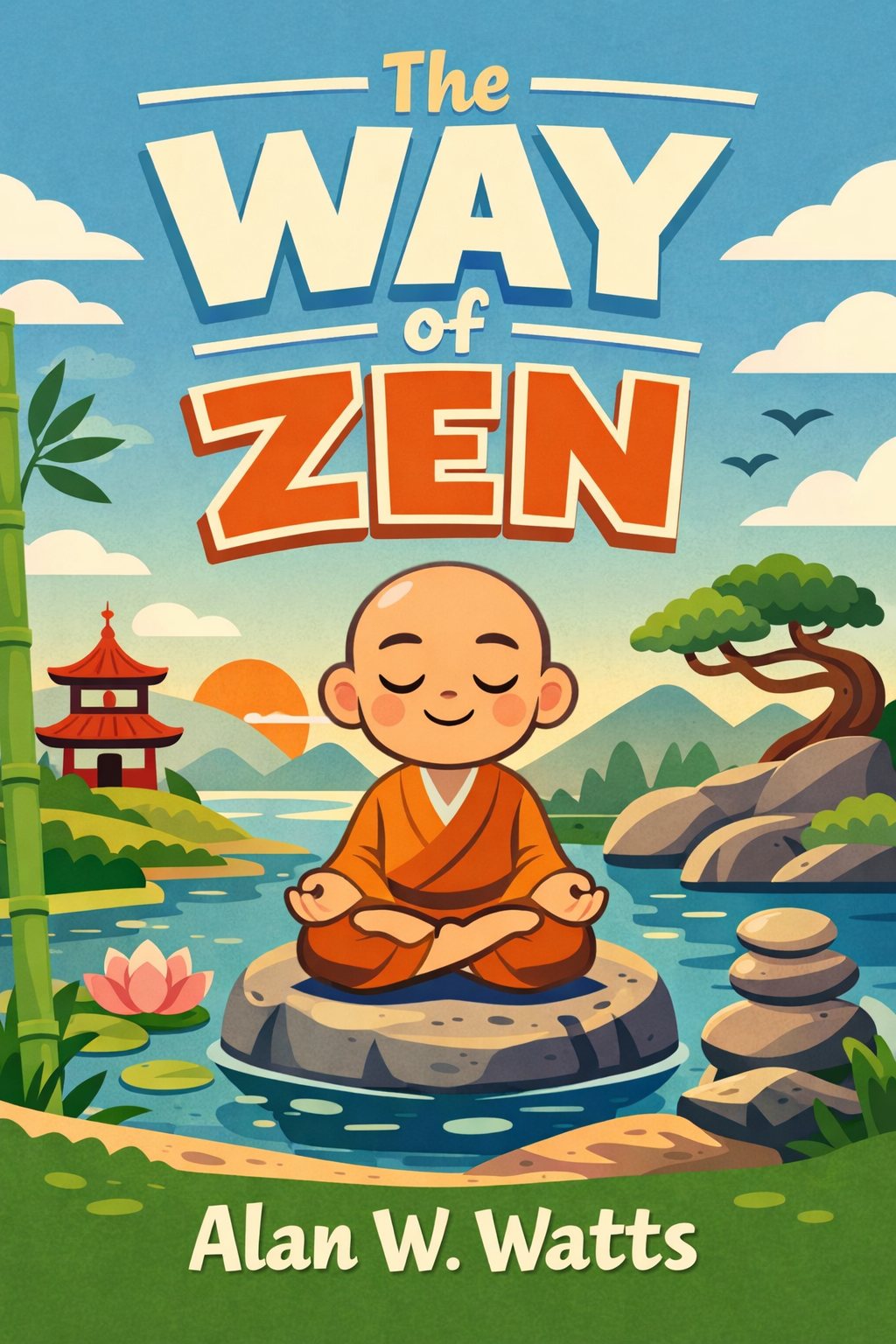
Description
Alan Watts’ exploration of Zen begins by challenging our conventional understanding of knowledge itself. We often equate knowing with factual, intellectual understanding, yet we “know” how to breathe or see without comprehending the underlying mechanics. This intuitive, non-conceptual knowing is central to Taoism, Zen’s Chinese precursor. Taoist philosophy, as found in the ancient *I Ching*, emphasizes harmony with the natural flow of life, the Tao. It suggests that clear-mindedness and trusting one’s innate intuition—rather than endless data gathering—lead to effective action. This foundation of spontaneous, effortless being would become a cornerstone of the Zen attitude.
The philosophical superstructure for Zen was provided by Buddhism, which originated in India with Siddhartha Gautama’s enlightenment. Central to Buddhist thought is the concept of *maya*, or illusion—the idea that the separations and categories we perceive (self/other, beginning/end) are constructs of the human mind, not inherent features of reality. The goal is liberation from this illusion by disentangling one’s identity from temporary roles, thoughts, and the physical body. However, this pursuit leads to a profound psychological puzzle: if the self is an illusion, who is it that seeks liberation?
This conundrum found a creative resolution in Mahayana Buddhism, which diverged from earlier traditions. Mahayana logic leads to a fascinating paradox: if reality is ultimately ungraspable, then enlightenment cannot be a “thing” to be attained. If the individual self is illusory, then there is no separate entity to become enlightened. Therefore, the seeker must already be inherently Buddha-nature. The very effort to “achieve” enlightenment becomes a denial of one’s present, true state. Zen would fully embrace this radical perspective, shifting the focus from attainment to instantaneous recognition.
Zen, as a distinct school, coalesced in China through the work of insightful monks who blended Taoist naturalness with Buddhist insight. While legendary accounts credit the Indian monk Bodhidharma, the philosophical groundwork was laid by thinkers like Seng-chao, who presented a view of time where each moment is complete and independent. The pivotal figure Hui-neng emphasized direct, non-symbolic demonstration of truth (*chih-chih*), often expressed in seemingly irrational dialogues. A master’s casual remark about the weather in response to a deep spiritual question is not evasion, but a spontaneous expression of reality itself, intended to shatter the disciple’s conceptual thinking.
The core practice of Zen aims to dismantle the mental constructs that cloud our perception. The human mind, in its attempt to control experience, creates a dualistic world of good/bad, desirable/undesirable, and self/other. Zen points out the absurdity of seeking only “happiness,” as this very desire implies a resistance to the natural, ever-changing flow of life which includes all experiences. By seeing through this illusion of separateness, one can cease the exhausting struggle against reality.
This leads to the celebrated Zen emphasis on spontaneity and naturalness. To be natural is not to be crude or impulsive, but to act from one’s whole being, without the interference of a self-conscious “controller.” It is akin to the unforced grace of a dancer or the effortless brushstroke of a master painter. The mind in its natural state is like water, reflecting things perfectly and clearly, but never clinging to the images.
The central method for cultivating this awareness is meditation, or *zazen*. Contrary to popular belief, this is not about emptying the mind or achieving a trance state. It is simply about sitting quietly and observing the world—both internal and external—exactly as it is, without judgment or commentary. In this attentive stillness, the artificial boundary between observer and observed begins to dissolve, allowing a direct, unmediated experience of the present moment.
This aesthetic of direct experience profoundly influenced Zen art, from ink paintings to poetry and garden design. Here, emptiness is not a void but a dynamic, pregnant space. The vast blank areas in a sumi-e painting are as crucial as the brushstrokes; they invite the viewer into the scene, making them a participant in the creation of meaning. This art does not describe or symbolize reality—it *enacts* it, using minimal elements to point directly to the suchness of a mountain, a bird, or a single bamboo stalk.
Ultimately, Watts presents Zen not as a doctrine to believe but as a way of seeing and being. It is a gentle yet radical invitation to drop the compulsive storytelling of the mind and to encounter life directly. By tracing its evolution from Taoist and Buddhist roots through its Chinese development, the book reveals Zen as a practical philosophy for disentangling oneself from self-created suffering and resting in the spontaneous, ever-present reality of the here and now.