Description
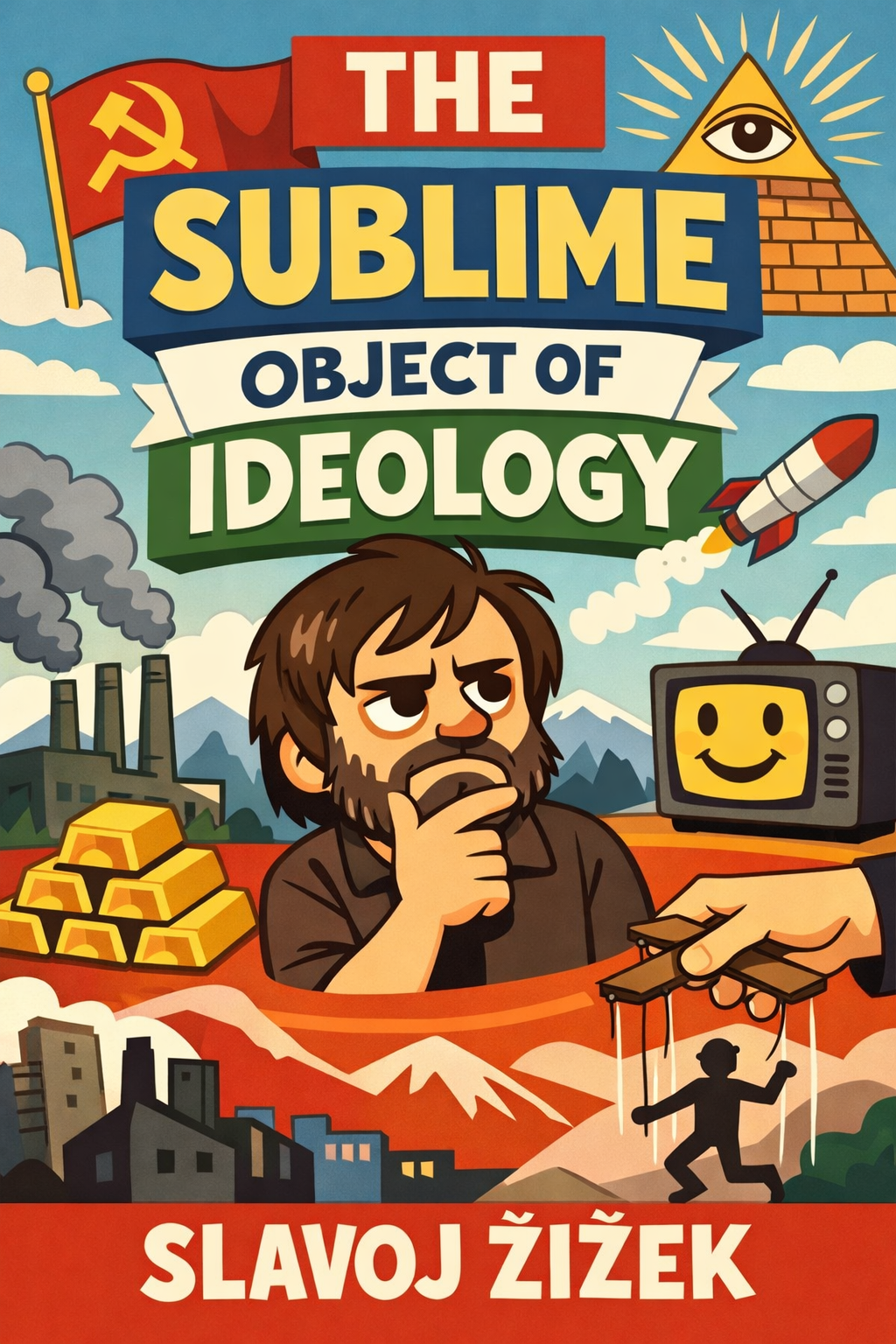
In a world that often declares itself free from grand narratives, Slavoj Žižek presents a provocative counter-argument: ideology is not dead, but has become more pervasive and invisible than ever. It operates not as a set of doctrines we consciously believe, but as the very framework through which we experience reality. This framework is sustained by a powerful, elusive engine—the sublime object. This is not a physical thing, but a conceptual void around which our desires endlessly circle, a promise of ultimate fulfillment that is constitutively out of reach, whether it takes the form of perfect love, social status, or consumerist bliss.
To understand this mechanism, we must venture into the terrain of psychoanalysis, specifically the work of Jacques Lacan. Lacan proposed that our unconscious is structured like a language, a network of symbols and associations that shapes our thoughts and actions beneath our awareness. From this foundation, Žižek builds his analysis of contemporary culture. He argues that our reality is not a simple, objective given but is constructed through three interlocking orders: the Symbolic, the Imaginary, and the Real. The Symbolic is the realm of language, law, and social norms—the rules of the game we are born into. The Imaginary is the domain of images, identifications, and the stories we tell ourselves about who we are. The Real is the most elusive; it is the traumatic, unassimilable core of experience that resists symbolization, the unsettling void that both the Symbolic and Imaginary orders attempt to cover over or make sense of.
Our engagement with ideology is not merely intellectual but is deeply rooted in pleasure and anxiety. We derive a strange enjoyment, or *jouissance*, from participating in its structures, even when they cause us frustration. This is because ideology offers us a coherent world and a place within it. The “sublime object” is the empty center of this system, the mythical prize that justifies our participation. In a Jane Austen novel, it is the ideal union of love and social standing. In late capitalism, it is the next purchase, promotion, or lifestyle upgrade that we believe will complete us. The crucial feature of this object is that it must remain unattainable; its function is to keep us moving within the system, forever chasing a satisfaction that is perpetually deferred.
The cracks in this constructed reality manifest as symptoms. Far from being mere malfunctions, symptoms are meaningful formations. On a personal level, a quirky habit or a recurring dream is a compromise between conscious life and unconscious conflict. On a societal level, symptoms are the points of breakdown—social antagonisms, cultural anxieties, and political deadlocks that the system produces but cannot resolve. A populist leader, a viral conspiracy theory, or a pervasive sense of societal cynicism can all be read as symptoms. They are not alien intrusions but the direct, logical results of the ideological system’s own internal contradictions, the return of the repressed Real in a disguised form.
Ultimately, Žižek’s work is an invitation to a more radical form of critique. It challenges us to look beyond the surface content of our beliefs to examine the hidden structures that make those beliefs possible and desirable. The goal is not simply to replace one set of ideas with another, but to achieve a critical distance from the very framework of desire that ideology provides. This involves confronting the unsettling void of the Real—acknowledging the fundamental lack and contradiction at the heart of our social and psychic lives. By learning to identify the sublime objects that govern us and the symptoms that betray the system’s flaws, we can begin to see the invisible stitches that quilt our world into meaning. The task is not to find a perfect, ideology-free space, which is impossible, but to navigate the ideological landscape with our eyes open to its mechanisms, its pleasures, and its costs.