Description
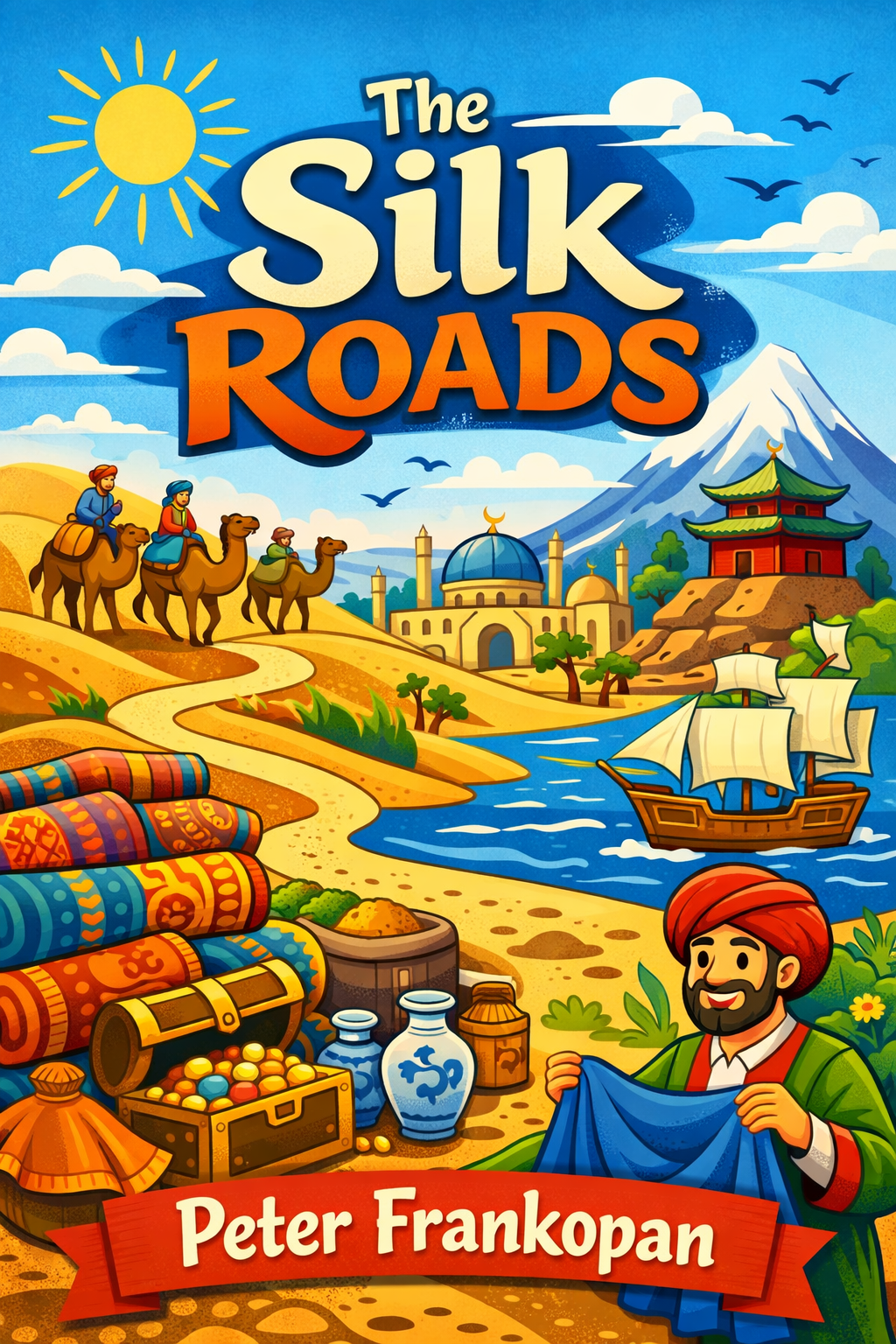
For centuries, the narrative of world history has been told from a narrow, Western perspective, focusing on the rise of Europe and its empires. This book offers a profound correction, arguing that the true axis of global civilization has always been the interconnected network of trade routes linking Asia, the Middle East, and Europe—collectively known as the Silk Roads. By shifting our gaze to this central corridor, we see a dynamic, pulsating heart of the world where goods, ideas, religions, and ambitions have flowed for millennia, dictating the fortunes of empires and shaping the modern age.
Our story begins not in Rome or Athens, but in ancient Mesopotamia and Persia, where the first great empires built the foundational roads that would later stitch continents together. The expansion of China under the Han dynasty pushed these routes eastward, with luxurious silk becoming the ultimate symbol of wealth and a powerful currency of exchange. But these roads carried far more than material treasures. They were conduits for faith and philosophy, allowing Buddhism to travel from India to China and the Greco-Roman pantheon to drift east, while creating the conditions for Christianity’s rapid spread. This early era established a pattern: control over these routes meant control over global wealth and knowledge.
A seismic shift occurred with the rise of Islam in the seventh century. United by a powerful new religious identity, Arab armies swiftly conquered the economic heartlands of the weakened Byzantine and Persian empires. Suddenly, the Silk Roads fell under a single, vast sphere of influence. This ushered in a golden age where the Muslim world, cherishing learning and commerce, became the globe’s intellectual and economic powerhouse. Luxuries like Chinese porcelain flooded in, alongside groundbreaking texts on mathematics, astronomy, and geography. While this civilization flourished, Europe languished in a comparative dark age, its intellectual curiosity often stifled by religious dogma.
Europe’s reawakening began through brutal contact with this wealthy East. A burgeoning slave trade, which supplied the Muslim world with Slavic peoples (from whom the word “slave” derives), funneled silver and gold back into Europe. This wealth fueled a growing obsession with the Orient, culminating in the Crusades. The capture of Jerusalem in 1099 was less a purely religious triumph than a strategic economic coup, shifting trade balances and allowing Italian city-states like Venice and Genoa to grow fabulously rich as intermediaries. Europe was no longer a backwater but a rising, hungry competitor.
Then came the storms of the thirteenth and fourteenth centuries. The Mongols, with terrifying efficiency, forged history’s largest contiguous land empire, brutally unifying the Silk Roads under their rule. Their conquests facilitated unprecedented cultural exchange but also set the stage for catastrophe. Along those very trade routes traveled the Black Death, a pandemic that wiped out a third of Europe’s population. The devastation, however, created paradoxical conditions for renewal: a scarcity of labor empowered survivors, destabilized old feudal orders, and ignited a desperate search for new routes and resources.
This search exploded into the Age of Exploration. European ships, driven by a desire to bypass the established Silk Road intermediaries, set out for the Indian Ocean, Africa, and the Americas. What followed was not mere connection, but the creation of the first truly global economy—forged through conquest, colonization, and immense suffering. The discovery of vast silver mines in the Americas allowed Europe to buy its way into Asian markets, while the transatlantic slave trade powered plantation economies. The world was now encircled by European ambition, and the old Silk Roads, while still important, were now just one part of a planetary system dominated by Western powers.
This dominance played out in successive waves of imperial rivalry, from the Portuguese and Spanish to the Dutch and British, each fighting to control the sea lanes and resources that now constituted the world’s wealth. By the dawn of the twentieth century, the focus of this rivalry zeroed in on a new resource: oil. The great powers, particularly Britain and Russia, made a beeline for the Persian Gulf, drawing new borders and installing puppet regimes to secure the energy that would fuel the modern world. The ancient lands of the Silk Roads were now a chessboard for foreign powers.
The twentieth century’s great conflicts further centered on this pivotal region. Hitler’s drive for Lebensraum targeted the fertile soils and resources of southern Russia and the Caucasus, a campaign whose brutal logic contributed to the horrors of the Holocaust. After World War II, the baton of influence passed to the United States, which worked tirelessly to contain Soviet expansion and secure oil interests in Western Asia, often supporting authoritarian regimes to maintain stability. This Cold War maneuvering laid the groundwork for future conflicts.
Today, the world is witnessing a dramatic rebalancing. The nations along the historic Silk Roads—China, India, Iran, and the resurgent states of Central Asia—are reclaiming their central role. Through massive infrastructure investments and new diplomatic alliances, they are building a new web of connections. As the book concludes, the region that gave birth to global civilization is once again emerging as a powerhouse, reminding us that the center of gravity in human affairs is perpetually shifting, always drawn back to the crossroads of the world.