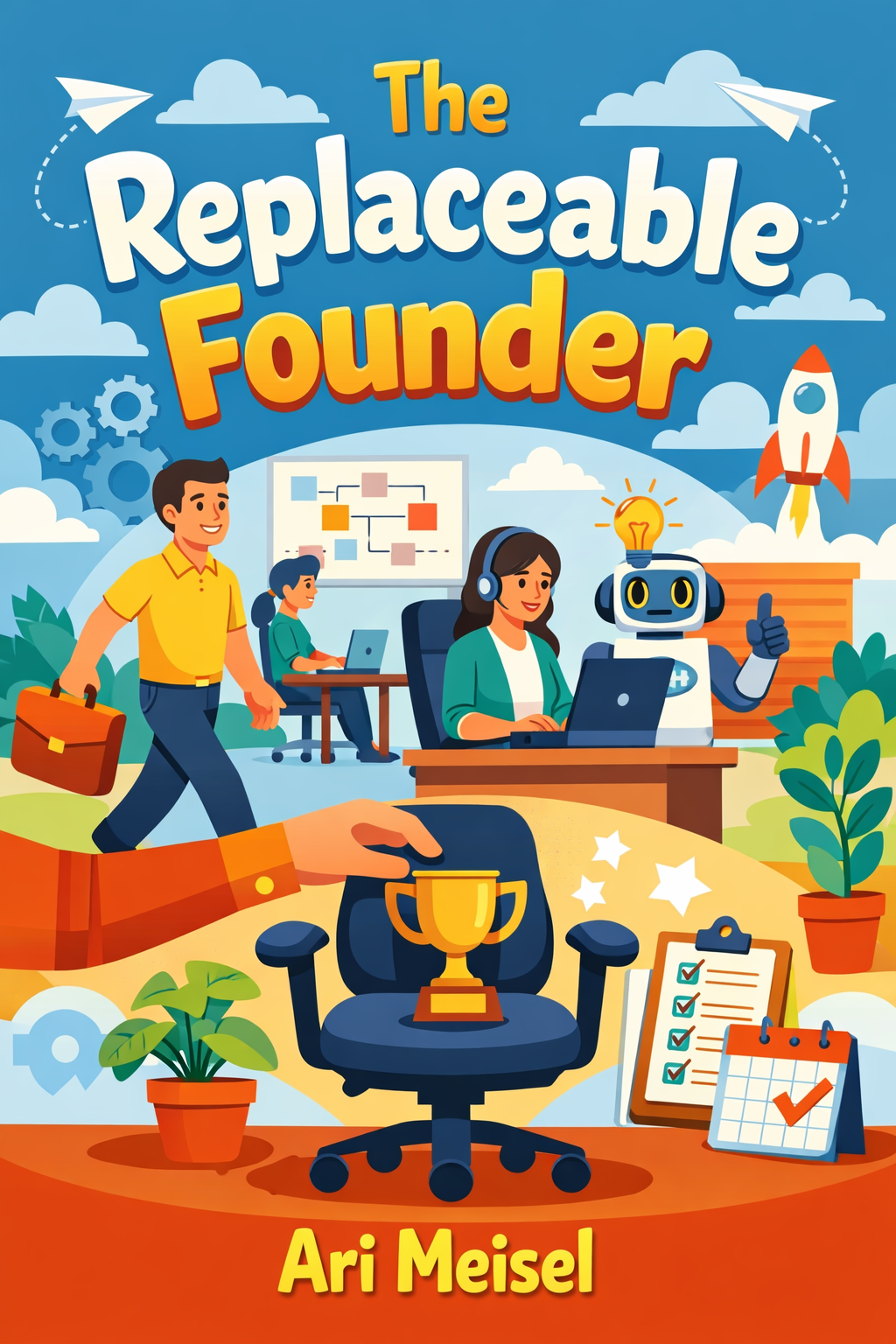
Description
The central challenge for many founders is a paradoxical one: to build something so significant it cannot function without them, yet to construct it so intelligently that it can. This book argues that the ultimate act of leadership is not perpetual control, but deliberate and strategic replaceability. The goal isn’t to make yourself obsolete, but to liberate yourself from the operational grind. By doing so, you transition from being the chief problem-solver to the visionary guide, ensuring the company’s longevity and creating space for you to focus on high-impact growth and strategy.
The journey begins with a fundamental mindset shift. Founders must stop seeing themselves as indispensable puppet masters and start viewing themselves as initiators. Imagine your business as a complex domino setup. Your role is to meticulously place each piece—the right people, processes, and structures—so that once the first domino is tipped, the chain reaction proceeds beautifully on its own. This requires building robust company structures from the outset. It means resisting the urge to dive into every minor crisis, from CRM issues to social media queries, and instead establishing clear organizational frameworks that empower employees to operate autonomously. The story of a CEO who solved an HR crisis by simply enabling a manager to work effectively from home illustrates this perfectly: sometimes, the structural fix is simple, but it requires you to step back and see the bigger picture.
With the right mindset, the practical work of clarity begins. Projects stall and momentum dies when tasks are vague and responsibilities blurred. The antidote is rigorous breakdown and assignment. Every initiative, large or small, benefits from being deconstructed into a sequence of minimal, clear steps. This not only provides a roadmap but also fuels team motivation through the momentum of small wins. To assign ownership clearly, the RACI model (Responsible, Accountable, Consulted, Informed) is an invaluable tool. It ensures that for every task, it is unmistakably clear who is doing the work, who has ultimate authority, who provides expert input, and who simply needs updates. This clarity eliminates confusion, accelerates decision-making, and ensures that energy is directed forward, not wasted on figuring out who should do what.
The natural companion to clear task identification is effective delegation. For founders, delegation is often the hardest skill to master, fraught with the fear of losing control or quality. The book introduces a nuanced framework: the six levels of delegation. This spectrum ranges from Level 1, a simple direct order (“buy this book”), to Level 6, full authority granted to another person to handle a complex matter as they see fit (“acquire a property for the company”). Most founders get stuck delegating only at the lower levels, never truly offloading the mental burden. Understanding these levels allows you to match the delegation style to the task and the team member’s capability. The real growth—for you and the business—happens when you learn to delegate at Levels 5 and 6, entrusting not just tasks, but decision-making authority within defined boundaries.
Of course, you can only delegate effectively if you have a team capable of handling that responsibility. Recruitment, therefore, becomes a critical lever for achieving replaceability. The book advises moving beyond checklists of education and experience. While specific skills are necessary, the focus should expand to a triad: skills, personality, and innate problem-solving ability. Look for proactive individuals who go beyond the assigned task, those with meticulous attention to detail, and crucially, those who can think on their feet. A valuable hiring tactic is to test for problem-solving in real-time—such as asking a writer to quickly improve a flawed piece of text—rather than just reviewing polished portfolios. You are building a team of autonomous problem-solvers, not just order-takers.
As structures solidify and a strong team takes shape, your own role transforms. Your most precious resource is no longer your ability to put out fires, but your focused cognitive capacity. To protect it, you must ruthlessly defend your peak productive hours. Identify the time of day when you are most creative and strategic—your “flow” time—and guard it for high-level thinking, vision work, and deep projects. Do not let it be consumed by administrative trivia or reactive communication.
Two key systems help shield this focus. First, tame the email beast. Implement filters to automatically sort incoming messages and adopt the “Do, Delete, or Defer” rule. Process each email immediately with one of those three actions, preventing a backlog from sapping your mental energy. Second, create an external “brain”—a systematic, reliable place to capture ideas, insights, and to-dos as they arise. This could be a digital note-taking app or a physical notebook. The goal is to get thoughts out of your head and into a trusted system, freeing your mind from the job of remembering everything and allowing it to focus on creating and connecting ideas.
This disciplined approach to your own work extends to scaling the business’s output, particularly in areas like content creation. The key is to identify the unique value you or your core team provides—the special talent—and then build a supportive structure around it. If your strength is big-idea storytelling, design a process where others handle research, editing, and distribution. You become the bottleneck only for the part that truly requires your genius, while the system handles the rest.
Finally, the philosophy of the replaceable founder applies to external growth as well. Attracting customers is about creating smooth, professional points of contact and offering the right kind of “free sample”—a valuable piece of content, a tool, or a consultation—that demonstrates your expertise without giving everything away. And perhaps most importantly, this journey requires the wisdom to sometimes say “no” and slow down. Sustainable scaling is a marathon, not a series of sprints. Strategic pauses for evaluation and integration are not a loss of momentum, but the source of lasting strength.
In the end, becoming replaceable in the day-to-day is the very thing that makes you irreplaceable in the long-term. It is the process of transforming your business from a fragile entity dependent on a single person into a resilient, self-sustaining system. It grants you the ultimate freedom: the freedom to focus on the future, secure in the knowledge that the present is in good hands.