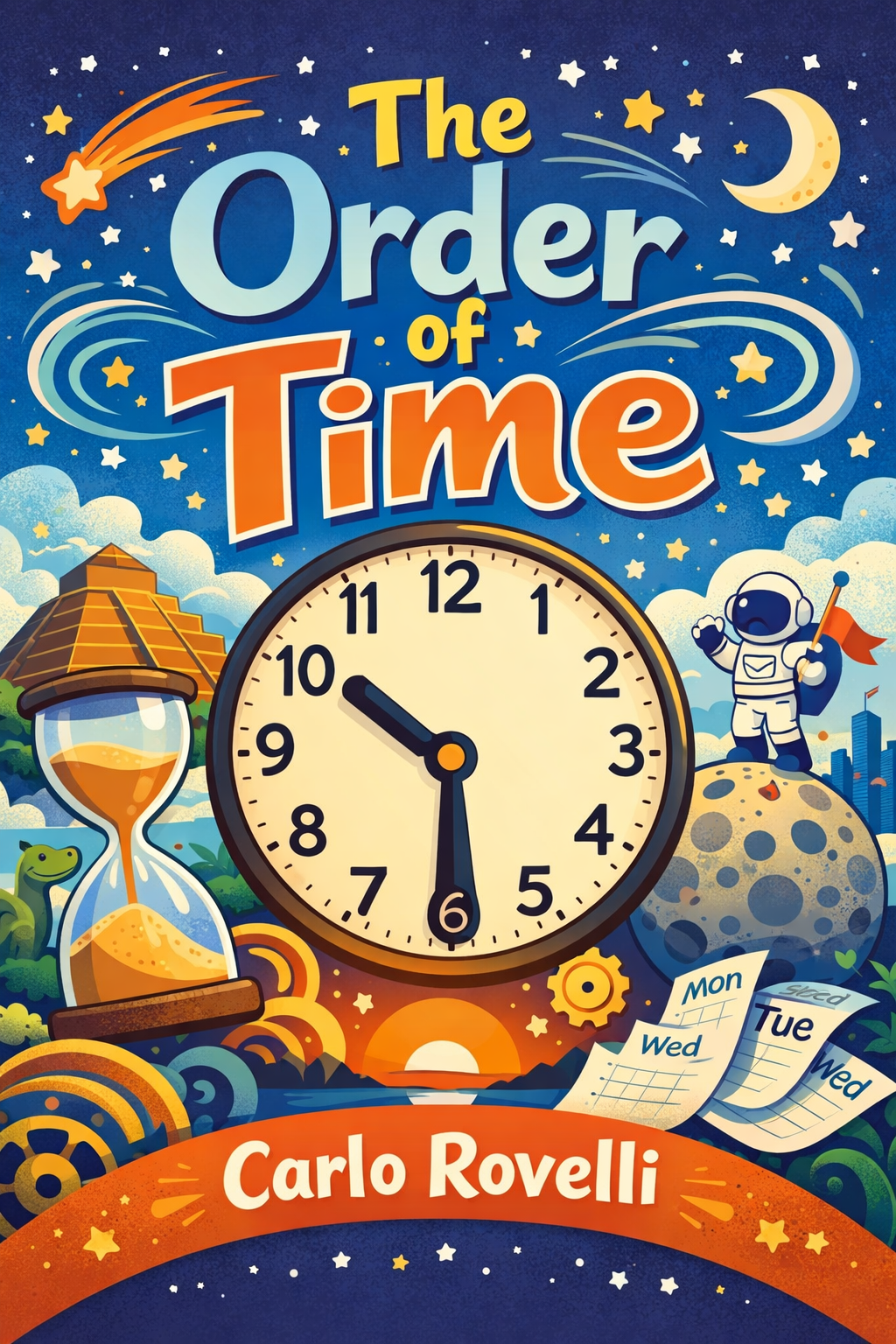
Description
In “The Order of Time,” Carlo Rovelli dismantles our most basic assumptions about time, guiding us through a landscape where common sense fails and profound scientific beauty takes over. We begin with the unsettling revelation that time does not flow uniformly everywhere. A clock on a mountain top ticks faster than one at sea level; a person living at high altitude ages slightly more than their twin at the beach. This is not a defect in the clocks but a fundamental feature of reality, as revealed by Einstein’s theory of general relativity. Time is not a single, universal backdrop against which events unfold. Instead, every place has its own time, and these times are only meaningful relative to each other. Furthermore, the direction of time—its arrow pointing from past to future—is intimately tied to the concept of heat. Heat always moves from hotter objects to colder ones, increasing disorder. It is this irreversible increase in disorder, not some intrinsic property of time itself, that allows us to distinguish a remembered past from an unknown future.
Einstein’s revolution went further, weaving time and space into a single fabric: spacetime. He showed that time also slows down for objects moving at high speeds. This shatters the idea of a single, shared “now” across the universe. Consider a friend on a distant planet. What they are doing “right now” is a question without a definite answer; your “now” is not the same as theirs. There is no privileged present moment that encompasses the entire cosmos. The universe is better described as a block of events in spacetime, where “before” and “after” can depend on one’s perspective. This leads physics to a view called eternalism, where past, present, and future all equally exist. The comforting, flowing “now” of our daily experience is absent from the fundamental equations of the world.
Delving deeper into the microscopic realm of quantum mechanics reveals even more radical truths. At this scale, time appears granular, not smooth. It is composed of tiny, indivisible units so short they are almost incomprehensible. The world is also fundamentally indeterminate; we cannot precisely predict the evolution of particles, only speak in probabilities. Most importantly, reality is relational. Properties of objects, including temporal ones, only manifest through interactions with other objects. This perspective shifts our view of the world from one made of “things” to one made of “events.” A stone seems like a permanent thing, but over eons, it is a slow event—a temporary knot in a network of relations between particles. The universe is a web of happenings, not a collection of static entities.
So, if time in its familiar form—uniform, flowing, and directional—is not found in the basic laws of physics, where does it come from? Rovelli proposes that our experience of time is an “emergent phenomenon.” It arises from our particular, limited perspective within the world, much like the concept of “wetness” emerges from the collective behavior of water molecules, though no single molecule is wet. Our perception of time emerges from the fact that we see the world in a blurred, macroscopic way. We are made of parts that are themselves part of the world, and we only interact with a small subset of the universe’s variables. From this partial view, a particular order emerges, creating the illusion of a universal present and a flowing time. Our memory, our consciousness, and our very structure are products of this thermodynamic gradient, this arrow of increasing disorder.
Ultimately, the book is a meditation on our place in the cosmos. The sun, as the ultimate source of low-entropy energy, drives the processes that make life and history possible. Our experience of time—with its past, present, and future—is a gift of our biological and cognitive structure, a narrative we weave to make sense of the world. It is what makes us human. Rovelli concludes not with a cold, scientific dismissal of time, but with a poignant affirmation of its human value. Time is precious because we are finite. Our transient, time-bound nature is the source of our identity, our poetry, and our longing. By understanding its illusory nature at the fundamental level, we can appreciate the profound beauty of our temporal experience all the more deeply. We are not outside the universe, measuring time; we are processes within it, and our moment of existence is a rare and fleeting event in the vast, timeless network of relations that is reality.