Description
We navigate the world with a deep-seated faith in our own perceptions and judgments, believing ourselves to be attentive, rational, and in control of our memories. “The Invisible Gorilla” reveals this faith to be a comforting illusion. The book systematically explores the gap between how we think our minds work and how they actually function, demonstrating that our intuition is not a mystical guide but a flawed cognitive shortcut often leading us astray.
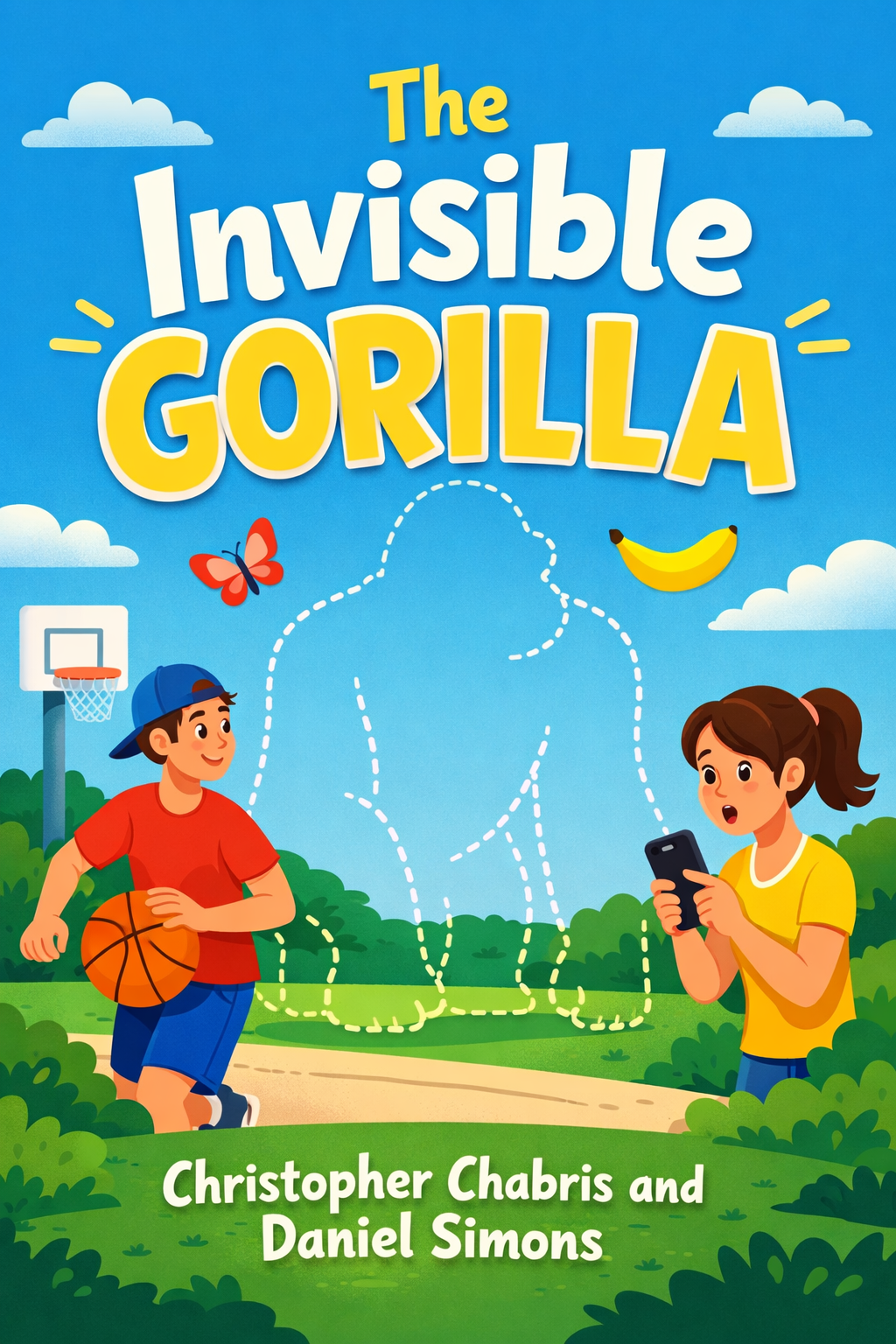
The journey begins with a powerful challenge to our basic awareness. We assume we see and notice everything important in our environment, but a now-famous experiment proves otherwise. When asked to count basketball passes in a video, roughly half of viewers completely miss a person in a gorilla suit walking through the scene. This “inattention blindness” shows that when we focus intently on one task, we can become blind to the unexpected, even if it is glaringly obvious. This isn’t just a laboratory curiosity; it explains real-world tragedies, like a police officer missing a brutal assault happening feet away because his attention was locked on a pursuit. Our vision is not a comprehensive camera but a selective spotlight, and we consistently overestimate its breadth.
If our perception is unreliable, our memory is even more so. Most people believe memory works like a video recorder, faithfully storing events for accurate playback. The truth is far messier. Memory is reconstructive, not reproductive. We often fill in gaps with plausible details, confuse the source of a story, or even adopt someone else’s vivid recollection as our own. The book shares the curious case of a man who vividly “remembered” dining with a famous actor, a memory that was actually borrowed from a friend’s anecdote. Our memories are not static files but living narratives, constantly edited and rewritten, making them poor witnesses to our own pasts.
These flaws in perception and memory are compounded by a pervasive overconfidence in our own abilities. A vast majority of people believe they are smarter and more skilled than the average person, a statistical impossibility known as the “above-average effect.” This confidence is not tied to actual competence; in fact, the less skilled a person is, the more they tend to overestimate their abilities, a phenomenon called the Dunning-Kruger effect. We also mistakenly interpret the confidence of others as a sign of expertise, trusting a doctor who acts decisively over one who double-checks a diagnosis, even though the latter is demonstrating greater care.
This illusion of knowledge extends beyond self-assessment to our understanding of how things work. We confuse familiarity with comprehension. Most people feel they understand a bicycle, yet when asked to draw one from memory, they make critical errors that would render it non-functional. We know what things do, but not why they work. Furthermore, an overload of information can create an illusion of knowledge that impairs decision-making. Investors who receive frequent updates on their portfolios often make more reactive, poorer choices than those who review their investments less often, mistaking data for wisdom.
Our minds are also pattern-seeking engines that often find connections where none exist. We readily believe that ice cream sales cause drownings, or that weather changes cause arthritis pain, when these are simply coincidences or correlations without causation. We are drawn to simple, compelling narratives of cause and effect, leading us to superstitions and misguided beliefs. Similarly, we fall for the “illusion of potential,” believing that hidden talents—like the supposed 90% of unused brain power—are waiting to be unlocked with a simple trick. This seductive idea ignores the hard work and specialized training truly required to achieve expertise.
Ultimately, “The Invisible Gorilla” is not an indictment of human intelligence but a crucial guide to its limitations. By understanding these everyday illusions—of attention, memory, confidence, knowledge, cause, and potential—we can cultivate a healthier skepticism toward our gut feelings. We can learn to pause, seek evidence, and question our assumptions. The book argues for a mindset of intellectual humility, where we recognize the gaps in our perception and the fallibility of our intuition, enabling us to make better decisions, understand others more clearly, and navigate a complex world with clearer eyes. The first step to thinking more clearly is to see the gorillas we’ve been missing all along.