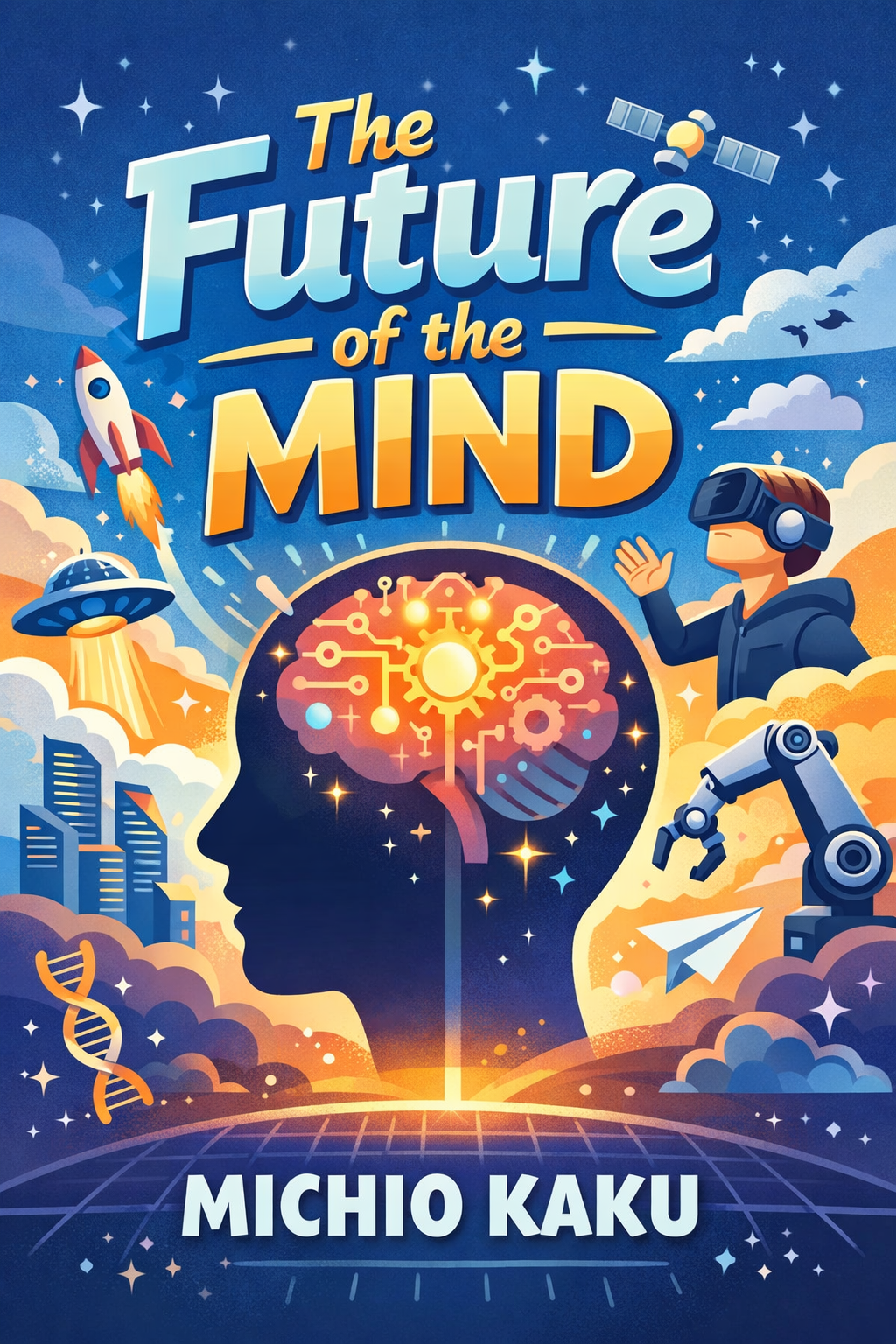
Description
The human mind, long considered the final frontier of science, is gradually yielding its secrets to relentless investigation. This book presents a sweeping and accessible tour of the cutting edge of neuroscience and physics, charting a course from what we currently understand to the breathtaking possibilities that lie ahead. It begins by grounding the reader in the fundamental mechanics of the brain, explaining how the intricate dance of neurons gives rise to the rich tapestry of thought, memory, and emotion that defines our inner world. The author meticulously dismantles the myth of the brain as a static organ, revealing instead a dynamic, plastic entity constantly rewiring itself in response to experience.
One of the most profound explorations centers on the nature of consciousness itself. The text tackles the “hard problem”—how subjective experience arises from objective matter—reviewing leading theories from integrated information to quantum mind hypotheses. It doesn’t shy away from the philosophical implications, pondering whether consciousness is a mere byproduct of computation or a fundamental force of the universe. This foundation sets the stage for a discussion on the mapping of the mind. The ambitious goal of creating a comprehensive “connectome,” a full wiring diagram of the brain’s billions of neurons and trillions of connections, is presented as a monumental but achievable task. The potential applications are staggering, from decoding mental imagery and dreams to creating a true backup of a person’s memories and personality.
The narrative then ventures into realms that sound like science fiction but are increasingly the subject of serious laboratory work. The concept of telepathy, for instance, is re-framed through the lens of modern technology. Experiments where individuals control machines or transmit simple thoughts to one another via brain-computer interfaces are detailed, showing how “synthetic telepathy” is already a nascent reality. Similarly, the idea of telekinesis is explored not as mystical power, but as the direct neural control of external devices, from robotic arms to entire environments, offering newfound freedom to those with physical limitations.
A significant portion of the book is devoted to the augmentation of the human mind. It surveys the pharmacological, genetic, and electronic methods being developed to enhance memory, accelerate learning, and boost cognitive capacity. The ethical quandaries are laid bare: will these tools create an unbridgeable gap between the enhanced and the natural? The conversation seamlessly extends to artificial intelligence, examining the path toward creating a conscious machine. The author differentiates between specialized AI, which excels at specific tasks, and the theoretical general intelligence that would mimic human adaptability. The potential for a symbiotic future is explored, where human brains are integrated with AI to form a new, hybrid consciousness.
Perhaps the most speculative and thrilling chapters deal with the ultimate destiny of the mind. The concept of “brain net”—a future internet directly connecting human minds—is proposed as a successor to today’s digital network, enabling the direct sharing of thoughts, emotions, and experiences. This leads to the radical idea of mind uploading, where a consciousness could be transferred from its biological substrate to a digital or alternative physical form, raising profound questions about identity, mortality, and what it means to be human. Could a copied mind be considered the same person? If a consciousness can exist in a machine, does it have rights?
Throughout this journey, the author maintains a careful balance between wonder and rigor. The tone is not one of unbridled techno-optimism, but of measured excitement tempered by serious ethical consideration. Each potential breakthrough is examined for its societal impact, risks of misuse, and philosophical ramifications. The book argues that we are at a unique inflection point in history, where for the first time, we are developing the tools not just to study the mind, but to fundamentally alter its parameters and expand its horizons. It concludes that the future of the mind is not a predetermined path, but a landscape of choices. The decisions we make today about research, regulation, and ethics will shape whether this new knowledge leads to a golden age of cognitive liberty and understanding, or to new forms of inequality and control. It is an invitation to ponder not just what the mind can become, but what we, as a species, have the wisdom to make of it.