Description
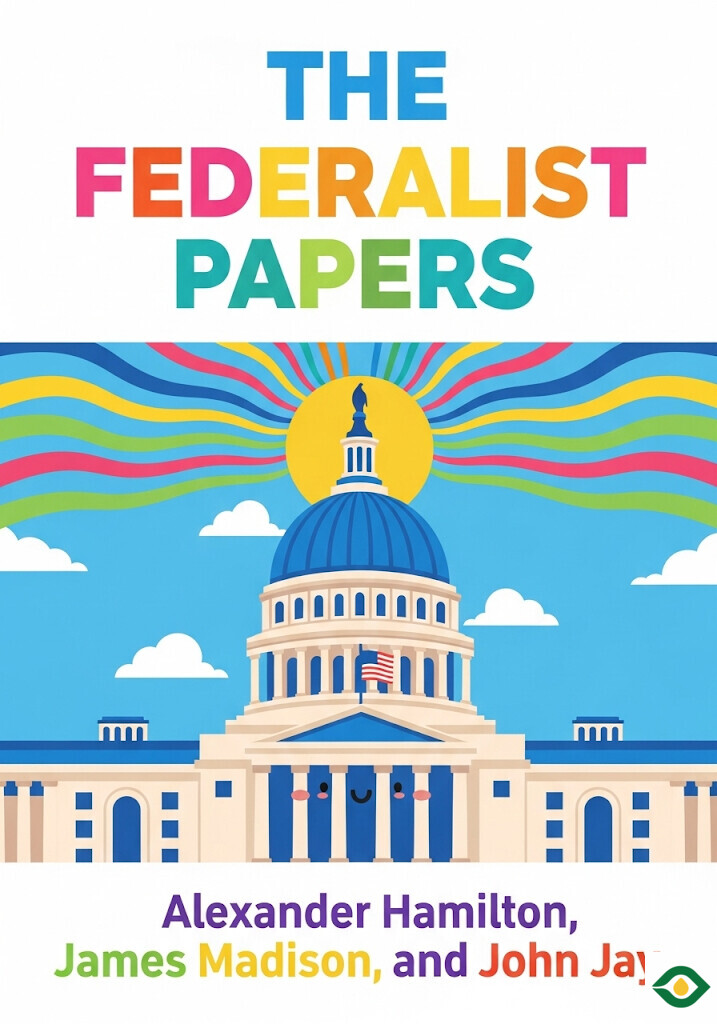
The Federalist Papers are a collection of essays written between 1787 and 1788 by Alexander Hamilton, James Madison, and John Jay. They used the shared name “Publius” to publish their arguments in newspapers. Their purpose was simple but urgent: they wanted Americans to support the new Constitution that would guide the young nation. At the time, the United States was fragile. Thirteen states had won independence from Britain, but now they had to decide how to govern themselves. Would they stay united as one country, or would they drift apart into separate nations? The Federalist Papers were written to answer this question and to show why the Constitution offered the best path forward.
One of the most important themes in these essays was unity. The writers believed that if the states broke apart, each would be too weak to defend itself against powerful nations like Britain, France, or Spain. Alone, a single state might struggle to survive. Together, the states could form a nation strong enough to protect itself and to command respect. Unity also meant peace among the states. Without a shared system, states could easily become rivals, fighting over trade, land, or resources. A united America, however, could resolve disputes fairly and avoid destructive conflicts.
Closely tied to unity was the idea of a strong central government. The writers explained that if each state acted like a separate country—making its own foreign policies, armies, and trade laws—the result would be chaos. Treaties would fall apart, enemies would take advantage, and businesses would suffer. A central government could bring stability by setting consistent laws and representing the whole nation on the world stage. The key point was balance: the central government needed enough power to be effective, but not so much that it became oppressive.
This concern led to one of the most famous ideas from the Federalist Papers: the separation of powers. The authors knew the dangers of tyranny. They had fought a revolution against a king who held too much authority. To prevent this from happening again, they argued that government should be divided into different branches—legislative, executive, and judicial. Each branch would have its own role, and each could limit the others. This way, no single group or leader could take complete control. Madison summarized this by saying that “ambition must be made to counteract ambition.” In other words, human desire for power could be used as a safeguard if balanced properly.
Another key idea was federalism. This meant dividing power between the national government and the states. Federalism allowed states to keep authority over local matters like schools, taxes, and community laws. At the same time, the national government could handle issues that affected everyone, such as defense, foreign trade, and national unity. This structure gave citizens the benefits of both local control and national strength. It also provided another layer of protection against tyranny, since neither the states nor the federal government could dominate completely.
The Federalist Papers also emphasized the importance of protecting property rights. The authors argued that government exists not only to protect people but also to protect what people own—their land, businesses, and ideas. Secure property rights encouraged people to work, build, and invest because they knew their efforts would not be stolen or destroyed. This was essential for creating a stable economy and a free society. When citizens trusted that their property was safe, they were more likely to support and trust their government in return.
A related safeguard was the independence of the judiciary. The writers argued that courts must be free from influence by politicians. If judges depended on the president or lawmakers, they might bend the law to please them. Instead, judges needed independence to declare when laws violated the Constitution. This principle later became known as “judicial review,” where courts can strike down laws that go against the Constitution. Without this safeguard, the balance of power would collapse, and individual rights could easily be ignored.
The essays also wrestled with the difficult problem of balancing liberty and power. Too much power in the hands of government could lead to oppression. Too much liberty, with no rules or structure, could lead to chaos. The authors believed the Constitution offered a careful balance. Government had enough authority to keep order, but it was limited by checks, balances, and the rule of law. They also addressed the issue of factions—groups of citizens united by specific interests. Madison explained that factions were natural and could not be eliminated without destroying liberty. The solution was not to silence factions but to control their effects. A large republic, with many representatives and diverse voices, would make it hard for any single faction to dominate.
All these ideas—unity, a strong central government, separation of powers, federalism, protection of property, judicial independence, and balance between liberty and power—fit together into one vision. The authors believed this vision was the best chance for the United States to succeed. They wanted a government strong enough to survive in a dangerous world, but limited enough to protect freedom.
In the years that followed, the Federalist Papers helped shape how Americans understood their Constitution. The ideas they presented became guiding principles for democracy, not just in the United States but around the world. Even today, people read these essays to understand how governments can balance freedom with order, and how nations can stay united without crushing individual rights.
The Federalist Papers remain one of the most important collections of political writing ever produced. They were born out of urgent debate during a fragile moment in history, but their lessons continue to inspire. They remind us that democracy requires careful design, constant balance, and a deep respect for both liberty and responsibility.