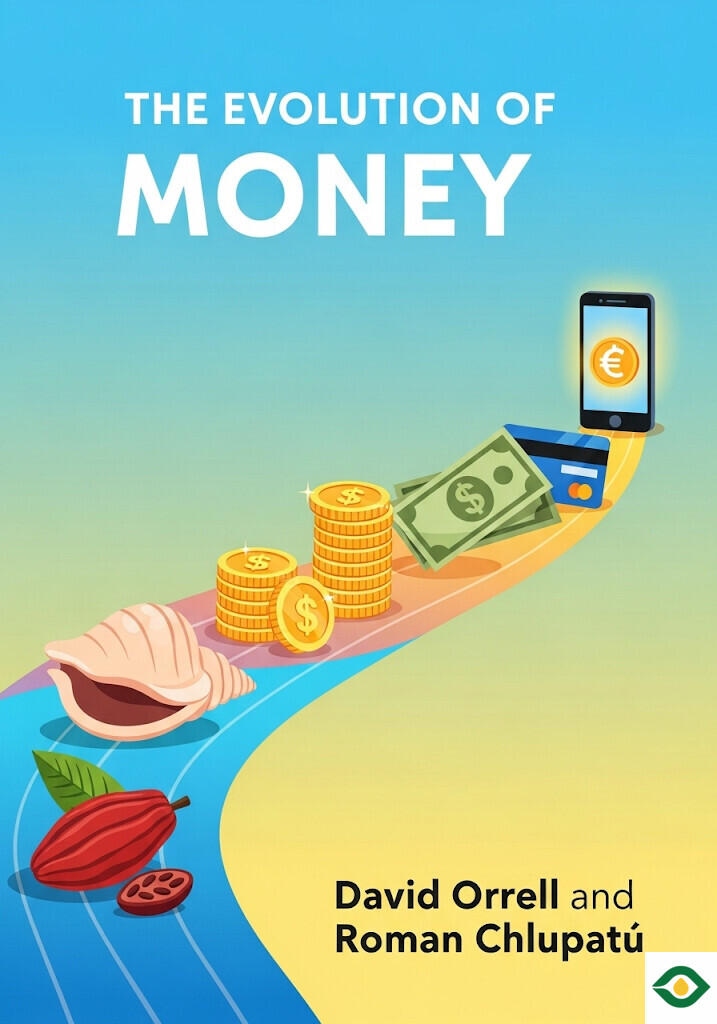
Description
Money is one of the most fascinating inventions of human history. At first glance, it looks so ordinary—coins in a pocket, bills in a wallet, numbers glowing on a phone screen. But behind this simplicity is a story that stretches back thousands of years. It is a story of power, trust, greed, imagination, and survival. Money has never been just about wealth. It has always been about what people believe in, how societies work, and how the world connects.
For a long time, people believed that money came about to replace bartering. The story goes like this: in the past, if one person had cattle and another had grain, they would swap to meet their needs. But this was awkward and limiting. How could you carry ten cows to trade for shoes? That is why, according to old thinkers, people invented money. It was more efficient. Yet historians later showed that this version is mostly a myth. Evidence from ancient civilizations, like Sumer in Mesopotamia, suggests that people already had forms of money alongside barter. They used items like salt, beads, silver bars, and even recorded debts on clay tablets. Coins eventually appeared in the kingdom of Lydia around the seventh century BC, and soon Greek city-states created their own. So, money wasn’t simply born to replace trade; it was born because people needed trust, stability, and a common measure of value.
The value of money has always been puzzling. Is it the metal it’s made of, or the number stamped on it? Sir Isaac Newton, better known for his laws of physics, also had a major role here. As warden of the Royal Mint in England, he connected the weight of coins to gold. This became the gold standard. A “pound” was tied to a pound of silver, and its worth linked to gold. But money is never just about its physical form. It is both real and abstract. The note in your hand is paper, yet it carries a value people agree on. Economists often compare this to quantum physics—something that can be two things at once. The worth of money can shift depending on who trusts it, what it buys, and what the market decides. That’s why a single dollar can mean very different things depending on time and place.
Debt is another key invention. While most of us think of debt as something stressful, it was crucial for building modern economies. Debt became possible once people started using negative numbers and bookkeeping. Ancient Mesopotamia introduced promissory notes, and medieval Europe developed double-entry systems, making it easier to track credit and error. Loans allowed towns to build cathedrals, merchants to buy ships, and kings to fund wars. Venice and Florence grew into financial centers, while moneylenders organized themselves into guilds—the ancestors of today’s bankers. Soon, heavy coins became impractical for international trade. Letters of exchange appeared: written promises that a banker abroad would pay on someone’s behalf. This innovation made trade across continents far more efficient.
The discovery of the Americas shook the world’s economy. Spain, after conquering the Aztecs, found itself flooded with gold and silver. At first, this seemed like a dream. Between 1500 and 1800, Spain imported massive amounts of precious metals. But the effect was disastrous: inflation. Too much gold made each coin worth less. Prices rose, debts piled up, and Spain defaulted many times. Yet this flood of metal allowed more coins to circulate in Europe, even among common people. Other nations, like Britain, turned aggressive, seeking their own share of wealth. Britain’s East India Company minted coins and expanded influence across the world. Money now drove global empires.
Paper money added another twist. In the 1700s, France experimented with banknotes under economist John Law. At first, it worked; paper was cheap to produce and easy to circulate. But over-issuing bills quickly caused inflation and collapse. Pennsylvania in America, however, found a smarter approach. By tying bills to land and future taxes, they issued notes in balance with real growth. This stabilized their economy. Later, Abraham Lincoln in the United States worried about private banks competing with federal ones. The Federal Reserve was eventually formed to supervise banks and bring stability. While crises still happen, this system created a backbone for modern finance.
Economic thought evolved, too. Adam Smith argued that value came from labor, but this theory had flaws. Later, Irving Fisher proposed that movement mattered more—the speed of money flowing through the economy. In the twentieth century, psychology entered the scene. Daniel Kahneman and Amos Tversky showed that people do not act rationally with money. We often spend emotionally, take risks based on bias, and value immediate rewards more than future ones. This gave rise to behavioral economics, proving that money is deeply tied to human psychology.
When economies crash, nations search for solutions. Some ideas have been bold. In 2008, Australia gave every taxpayer to encourage spending. It worked—they avoided recession. Others tried quantitative easing, where central banks buy assets to inject money into the system. Iceland recovered this way after its banking collapse. In times of crisis, some countries even changed their currency. Russia in 1922 reintroduced gold coins to stabilize the ruble. During the Great Depression, communities experimented with stamp scrips—notes that lost value unless spent quickly, forcing people to keep money moving. These creative fixes show how flexible money can be when survival is at stake.
In the twenty-first century, digital currencies have entered the story. Bitcoin, created in 2008, was designed as money outside the control of banks or governments. It came from distrust in the global financial system after the 2007 crisis. Bitcoins are “mined” by computers solving complex problems. At first, they were seen as a novelty, but soon real purchases began. Famously, one programmer spent 10,000 Bitcoins on two pizzas—worth millions today. Digital currencies are challenging traditional systems, offering both hope and risk.
The future of money is uncertain. Our world still depends on constant growth, often at the cost of the planet. Inequality is extreme, with vast gaps between the richest and poorest. Environmental destruction continues. Some believe new forms of money, or even a global currency, may help reset the system. Others fear deeper crises are ahead. What is clear is that money will continue to evolve. From shells and beads to digital coins, it always reflects more than just trade—it reflects our beliefs, our power structures, and our hopes for the future.
In the end, money is a story that humans keep writing. It is both fragile and powerful, simple and complex. It can build cities, topple empires, spark wars, and create dreams. And as history shows, money is never just about coins or paper—it is about the way people live together, trust each other, and shape the world.