Description
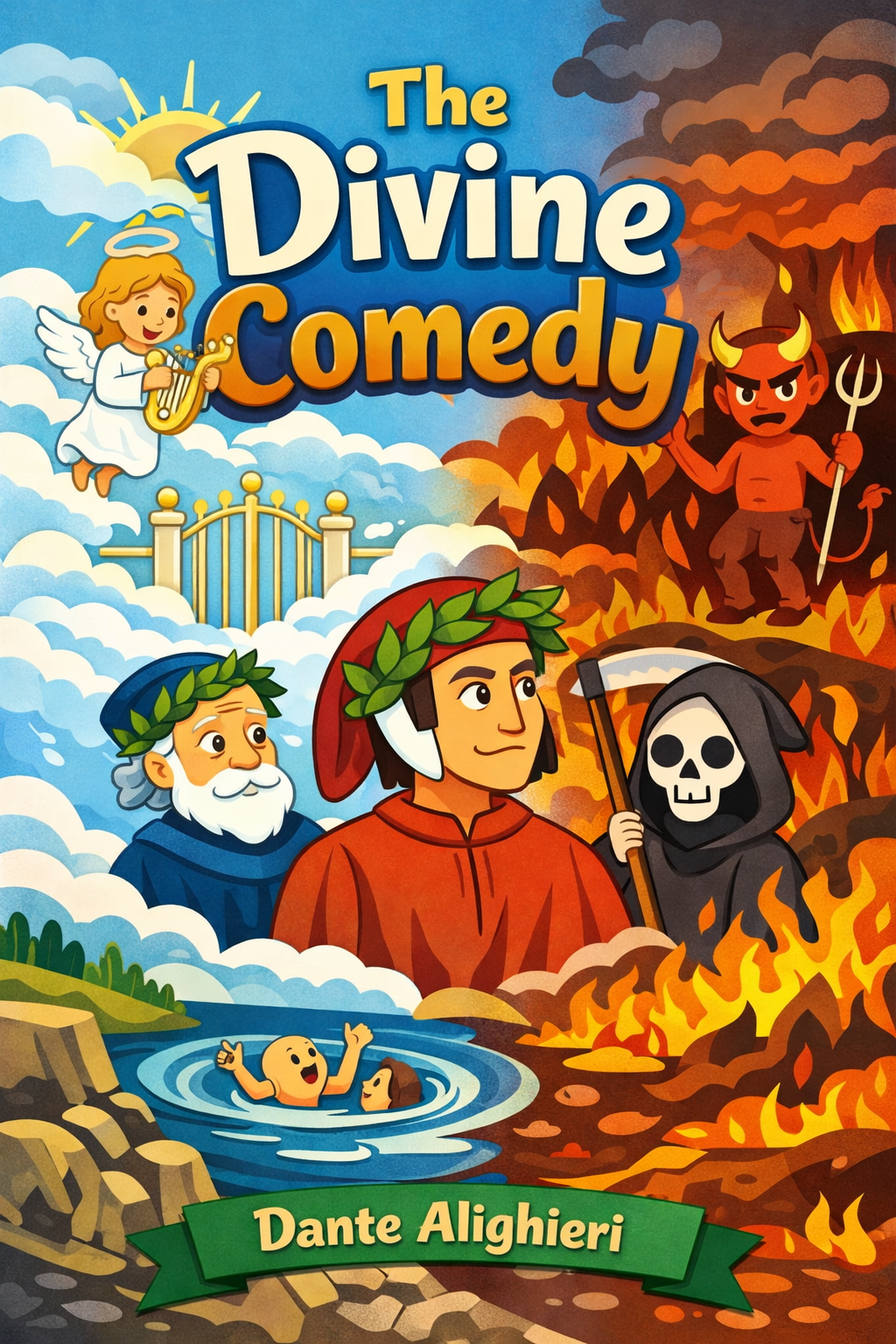
In the middle of his life, the poet finds himself lost in a dark wood, a profound metaphor for spiritual confusion and despair. He is besieged by symbolic beasts representing his own flaws—lust, pride, and greed—and sees no path forward. His salvation arrives in the form of the ancient Roman poet Virgil, who explains he has been sent on a divine mission. Dante’s beloved Beatrice, watching from Heaven, has interceded for him. To find peace and reach the divine light, Dante must first undertake a harrowing voyage through the afterlife, beginning in the pit of Hell.
Their descent is a masterclass in divine justice. Hell is not a chaotic pit but a meticulously organized realm where punishment perfectly mirrors the sin. They pass the infamous gate urging all hope to be abandoned and cross into a world of escalating torment. In the upper circles, they witness souls overcome by human weakness: the lustful, swept by eternal storms; the gluttonous, mired in filth; the greedy, pushing great weights. Dante often feels pity, but Virgil chastises him, teaching that compassion for divine justice is misplaced. As they go deeper, the sins become more willful and malicious. They enter the city of Dis, where heretics burn in tombs, and descend into lower circles reserved for violence and fraud. Here, the landscape shifts to a grim region of rock and darkness, where souls are whipped by demons or afflicted by grotesque, fitting torments. Dante encounters corrupt popes and politicians, forever punished for betraying their sacred trusts. The journey culminates in a shocking transition from fire to ice. At the very bottom of creation, in a frozen lake, resides Lucifer himself, a monstrous, three-faced being eternally chewing on history’s ultimate traitors: Judas, Brutus, and Cassius. The ice represents the absolute absence of love and connection. Climbing past this horror, Dante and Virgil emerge to see the stars again, a moment of profound relief and spiritual rebirth.
But the journey is only partly done. The next stage is Purgatory, a towering mountain on an island in the southern hemisphere. This is not a place of punishment, but of hopeful cleansing. Here, souls willingly undergo hardship to purify themselves of the residual stains of their repented sins. The atmosphere is entirely different: there is suffering, but it is temporary and undertaken with joy, for every step brings them closer to God. The mountain is terraced into seven cornices, each dedicated to cleansing one of the seven deadly sins. Dante and Virgil climb from the prideful, bent low under heavy stones, to the envious, whose eyes are sewn shut, to the wrathful, walking through acrid smoke. At each level, they hear hymns, see instructive carvings, and learn that the pains here are medicinal. A key lesson of Purgatory is the power of community and prayer. Souls eagerly ask Dante to carry their names back to the living, so that prayers might hasten their ascent. This contrasts sharply with Hell’s eternal, solitary fixity. As they near the summit, Virgil, representing human reason, declares his work complete. Dante must now be guided by a higher faculty.
At the peak of the mountain, in the Earthly Paradise, Dante is reunited with Beatrice. This is a moment of overwhelming emotion and severe judgment. She rebukes him for straying from the virtuous path after her death, forcing him to confront his failings through a painful but necessary confession. After he is immersed in the River Lethe to forget his sins, and the River Eunoe to remember his good deeds, Beatrice becomes his guide for the final, most sublime ascent. They rise into the celestial spheres of Heaven, a realm of pure light, music, and intellectual joy. Here, physics is transcended by theology. Heaven is structured around the planets and stars, each a fitting abode for different kinds of blessed souls: warriors of faith in Mars, contemplative thinkers in the Sun, lovers in Venus. In each sphere, Dante learns a new facet of divine order, his understanding expanding as he ascends. He meets saints and theologians who resolve his lingering doubts about faith, predestination, and free will. The light grows ever more intense, the music more beautiful, until they pass beyond the physical universe entirely into the Empyrean, the true home of God.
This final vision is beyond human language. Dante sees the blessed arranged in a vast, rose-shaped amphitheater of light, a manifestation of divine love and order. Beatrice takes her place among them, and Saint Bernard becomes his final guide, urging him to pray for the grace to behold God directly. In a fleeting, transcendent moment, Dante’s mind is finally aligned with divine love. He perceives the universe as a single volume bound by love, all its scattered pages finally united. He sees the mystery of the Trinity—three circles of light of one color but different dimension—and his own desire, aligned with divine will, is finally stilled. The poem ends not with a description of God, but with the overwhelming experience of the love that moves the sun and the other stars. His journey, which began in confusion and fear, concludes in the harmony of understanding and the peace of being wholly embraced by that love.