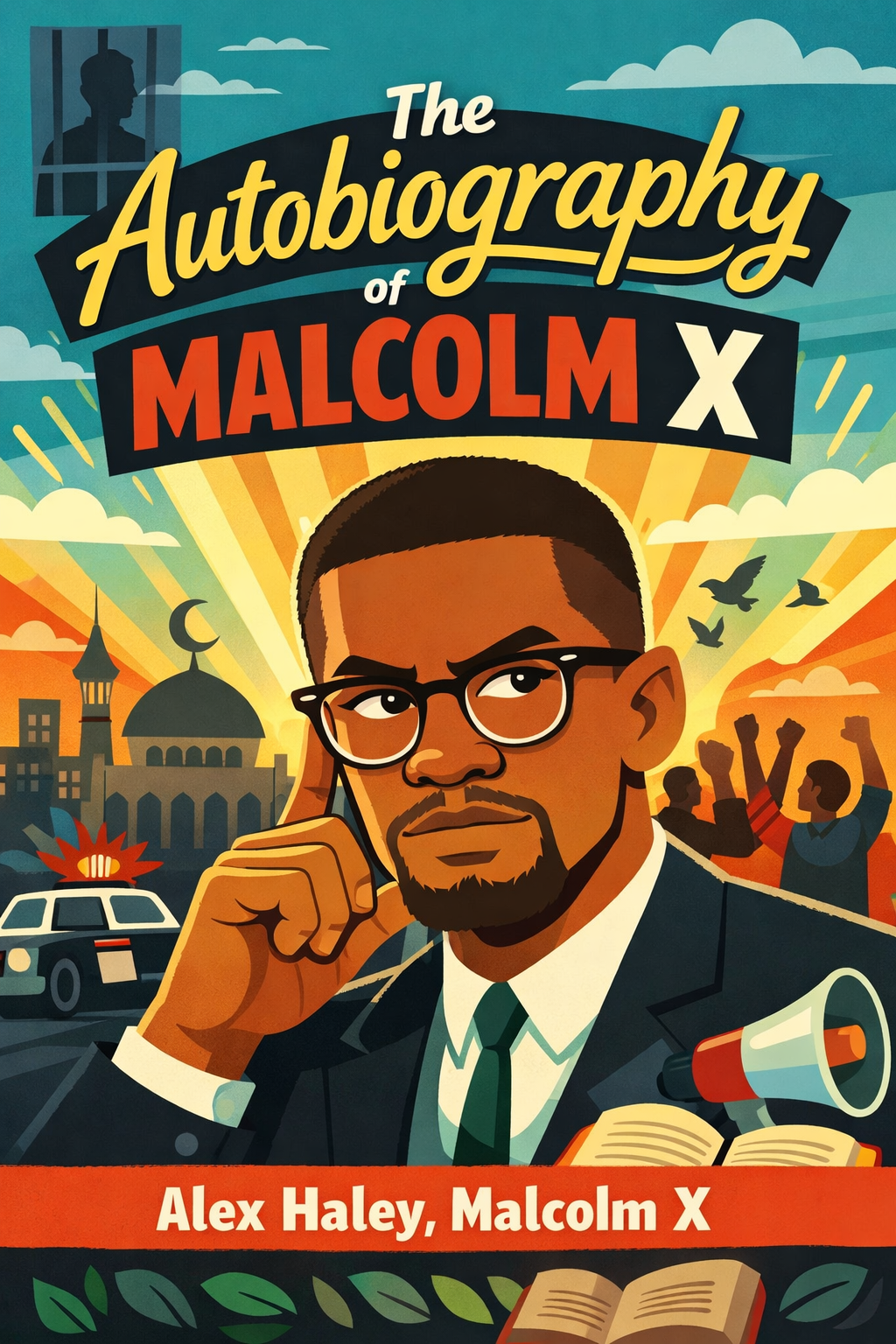
Description
Born Malcolm Little in 1925, the man who would become Malcolm X entered a world defined by racial terror. His early life was scarred by the violent death of his father, a Black nationalist preacher, and the subsequent breakdown of his family under the strain of poverty and systemic oppression. These formative experiences planted seeds of deep-seated anger and a profound distrust of white society. As a bright student discouraged by a teacher who told him his dream of becoming a lawyer was “no realistic goal for a nigger,” Malcolm retreated from a system that had already rejected him. He moved to Boston and later Harlem, diving headlong into the underworld of 1940s America. He became “Detroit Red,” a sharp-dressed hustler navigating the realms of drugs, gambling, and burglary. This period was not one of glamour but of survival and slow self-destruction, a rebellion against a world that offered him no legitimate path to dignity or success.
His reckless life culminated in a prison sentence in 1946, a turning point that he would later call his mental emancipation. Prison, far from breaking him, became his university. In the solitude of his cell, he embarked on a ferocious campaign of self-education, devouring books on history, philosophy, and religion. This intellectual awakening was given direction and fervor by his introduction to the Nation of Islam through his siblings. The teachings of Elijah Muhammad resonated powerfully with Malcolm’s lived experience. The Nation’s doctrine—that white people were literal devils, that Black Americans were a lost tribe of Asiatic origin, and that separation was the only path to true freedom—provided a coherent framework for his rage and a new identity. He shed “Little,” a surname he saw as a slave master’s brand, and took the symbolic “X,” representing his lost African name. Upon his release in 1952, Malcolm X was a new man, a fiery, disciplined evangelist for the Nation.
With brilliant oratory and uncompromising rhetoric, Minister Malcolm X became the Nation of Islam’s most potent voice. He preached Black pride, self-reliance, and self-defense with a potency that captivated and terrified America. He famously contrasted the “field Negro” and the “house Negro” to explain the difference between revolutionary fervor and complacency, and declared that freedom should be attained “by any means necessary.” While the mainstream Civil Rights Movement, led by figures like Martin Luther King Jr., advocated for integration and nonviolent protest, Malcolm X championed a philosophy of separation and dignified resistance. He did not seek a seat at the white man’s table; he sought to build his own table, in his own house. His message gave voice to the anger and frustration of millions in Northern urban ghettos who saw slow, legislative change as an insufficient answer to daily brutality and economic oppression.
However, the very certitude that fueled his rise began to fracture. Tensions grew between Malcolm and the Nation’s leadership, fueled by jealousy over his national prominence and his private disillusionment upon discovering Elijah Muhammad’s moral failings. A pivotal pilgrimage to Mecca in 1964 shattered the foundational racial cosmology of his beliefs. In the holy city, he saw Muslims of all colors—blue-eyed blonds to Black Africans—worshipping together as equals. He wrote of a transformative “spiritual rebirth,” recognizing the possibility of brotherhood beyond race. This experience led him to break definitively with the Nation of Islam and found his own organizations, the Muslim Mosque, Inc. and the secular Organization of Afro-American Unity. His philosophy evolved from Black separatism to a more inclusive, yet still fiercely radical, Pan-Africanism and human rights advocacy. He began to frame the struggle not as a domestic civil rights issue, but as a global human rights issue, connecting the plight of Black Americans to anti-colonial movements in Africa and Asia.
This evolution made him dangerous to more people than ever before. He was now a threat to the white establishment he had always criticized, to the slow-moving civil rights orthodoxy, and to the Nation of Islam he had left behind. Death threats became a constant companion. In February 1965, just as he was beginning to articulate this new, complex vision, he was assassinated by gunmen associated with the Nation of Islam while speaking at the Audubon Ballroom in New York City. His life was cut brutally short at the age of 39, leaving his story powerfully unfinished. *The Autobiography*, crafted through extensive interviews with writer Alex Haley, stands as his final, monumental testament. It is the raw, unflinching story of a man in perpetual motion—from degradation to discipline, from hatred to a nascent understanding of universal brotherhood, from a narrow nationalism to an internationalist perspective. It remains not a closed doctrine, but an enduring challenge: a demand for truth, self-respect, and the relentless pursuit of personal and collective liberation.