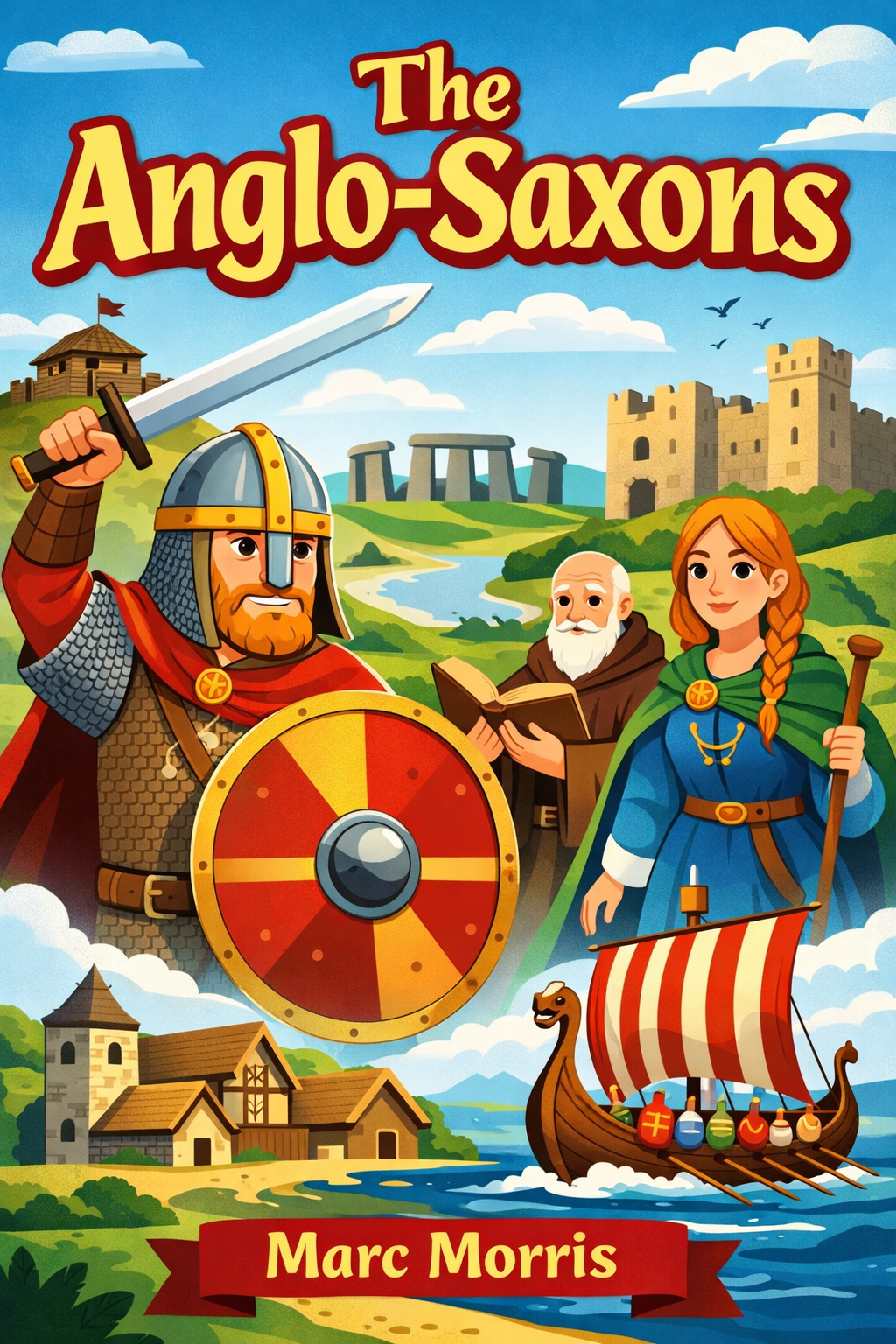
Description
The story of England begins not with a unified nation, but with the crumbling of an empire. For centuries, Britain was a prosperous Roman province, characterized by orderly cities, a network of roads, and a complex economy linked to the continent. This civilized world, however, depended entirely on the might of the Roman legions to maintain its peace. As the empire frayed at its edges in the late fourth century, troops were withdrawn to defend the heartlands, leaving Britain vulnerable. The collapse was swift. With the army gone, the economy shattered, and the promise of security broken, the Roman order dissolved by 410 AD, plunging the island into an uncertain new era.
Into this power vacuum came new peoples from across the North Sea. Contemporary Roman observers saw them as nothing but bloodthirsty pirates, yet the Angles, Saxons, and Jutes were also pioneers. Their arrival, possibly initially as mercenaries hired by local British kings, turned into a wave of settlement. They brought with them a culture utterly alien to the Roman world. Unlike the Franks who conquered Gaul and adopted its Latin language and urban life, the Anglo-Saxons showed little interest in the ruins they found. Roman cities like London were largely abandoned; the Latin language and Christianity faded. In their place arose a new, Germanic way of life, reflected in a new language—Old English—that bore almost no trace of the Celtic tongues of the native Britons.
The world these settlers built was harsh and violent, organized around warrior kings and their loyal retinues. Power was demonstrated through battle, treasure, and lavish burials, as seen in the spectacular ship-grave of King Rædwald at Sutton Hoo. This was a pagan society of many gods, whose names still echo in our days of the week. Yet this world was not destined to remain isolated. A second wave of Roman influence arrived, not with legions, but with missionaries. Beginning with Augustine’s mission in 597, Christianity slowly returned, weaving itself into the fabric of Anglo-Saxon society. Monasteries became centers of learning and wealth, bishops helped revive trade in old Roman towns, and a new, unifying faith began to connect the patchwork of competing kingdoms.
A fragile golden age of learning and artistic flourish emerged in the eighth century, but it was shattered by a new storm from the north: the Vikings. Their ferocious assaults from the 790s onward nearly destroyed the Anglo-Saxon kingdoms. In this crisis, one king emerged to change the course of history: Alfred of Wessex. His genius was twofold. First, he stemmed the Viking tide through military cunning and fortification, buying his kingdom a crucial respite. His second act was even more profound. Alfred launched a cultural and political revolution, promoting English literacy, translating key texts, and reforming laws and defense. He framed his struggle not just as Wessex’s fight, but as a fight for all Christian English people, consciously forging a concept of a unified English nation.
Alfred’s successors built on this foundation, eventually conquering the Viking-controlled north to create a single kingdom of England. This unified state, with its shires, sheriffs, and sophisticated coinage, was a powerful entity. Yet its very strength attracted new conquerors. The final act saw a Danish king, Cnut, ruling a North Sea empire from the English throne, followed by the last Anglo-Saxon king, Edward the Confessor, whose death triggered the fateful crisis of 1066. When William the Conqueror triumphed at Hastings, he did not conquer a barbaric backwater. He seized a wealthy, complex, and administratively advanced kingdom—the enduring creation of the Anglo-Saxon era. The foundations of England, from its language and landscape to its very sense of self, were laid in these six centuries of migration, conversion, war, and renewal.