Description
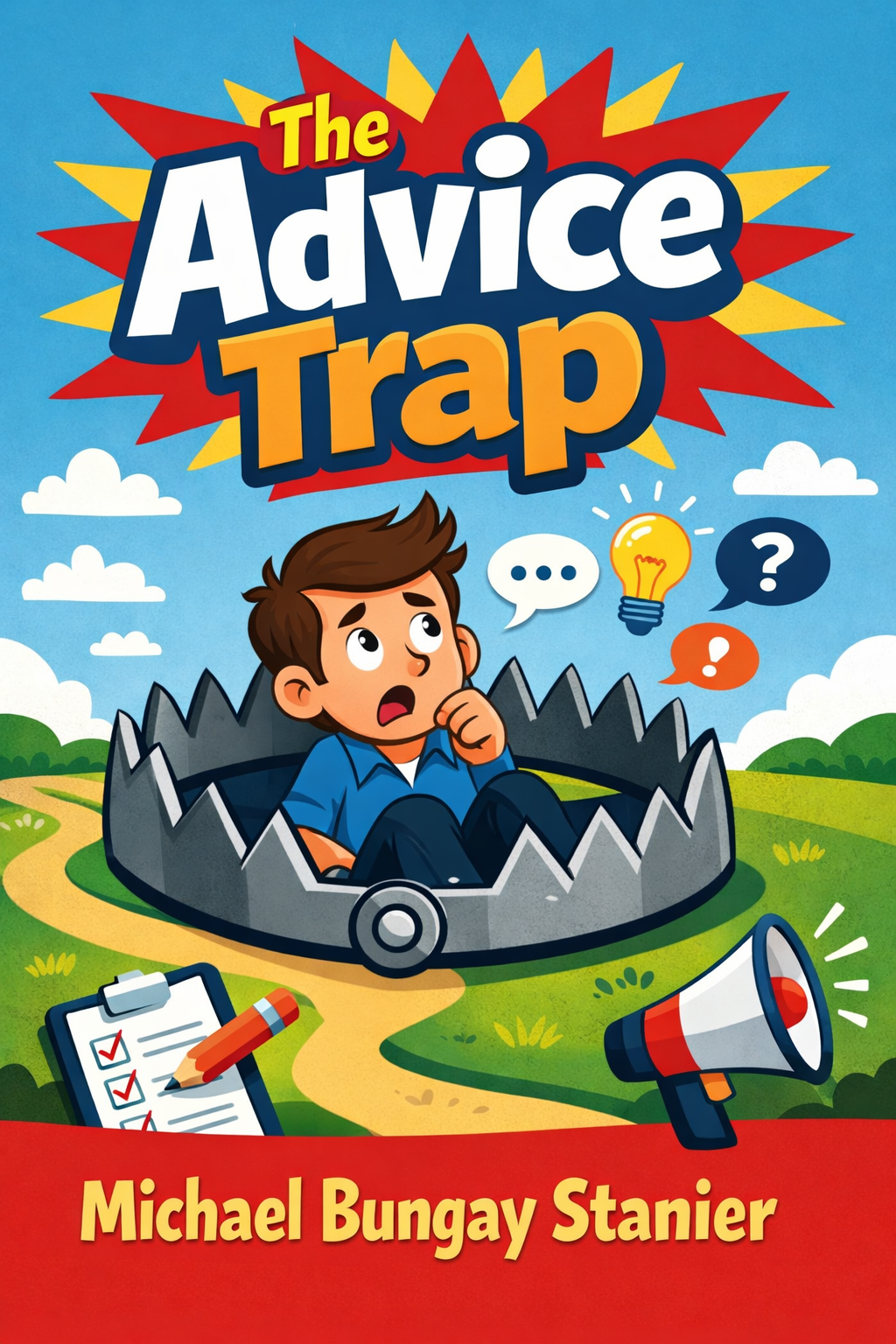
We live in a culture that celebrates having the answer. Success is often equated with decisiveness, expertise, and the ability to solve problems on the spot. This conditioning creates what the author calls the “Advice Monster,” a compulsive inner voice that leaps to provide solutions, opinions, and direction the moment a challenge arises. While well-intentioned, this monster ultimately undermines true leadership and connection. *The Advice Trap* is a practical guide to recognizing this impulse, disarming it, and replacing it with a more powerful and transformative skill: the art of staying curious.
The core argument is that our default “tell-it” mode—offering advice, giving instructions, or sharing our perspective—is a seductive trap. It makes us feel smart, in control, and helpful in the short term. But it carries a heavy cost. It disempowers others, stifles their growth and creativity, and places the entire burden of problem-solving on the leader. It assumes we have the best (or only) answer, which is rarely true for complex, modern challenges. The person with the problem often holds the seeds of the solution within them; our job is not to implant our own ideas but to help them uncover their own wisdom.
The alternative is to “be curious,” a deceptively simple phrase for a profound behavioral shift. Being curious means choosing to ask questions instead of making statements. It means listening to understand, not to reply. It requires a fundamental belief in the capability of the other person. This is not about being passive or abdicating responsibility; it is the hard work of active, disciplined facilitation. The book provides a robust framework for this work, centered on what the author terms “Catalytic Questions.” These are not leading questions disguised as advice, nor are they generic, open-ended queries. They are precise, incisive questions designed to break through assumptions, create new awareness, and build momentum.
For instance, instead of saying “Here’s what you should do,” a leader might ask, “What’s the real challenge here for you?” This simple pivot forces clarity and ownership. Other questions might include: “What do you want?” “What are you avoiding?” or “How can I support you?” The power of these questions lies in their focus on the other person’s agency. They move the conversation from a transactional exchange of solutions to a transformational exploration of possibilities. The leader’s role shifts from expert to thinking partner, from solution-giver to insight-miner.
Taming the Advice Monster is not a one-time event but a daily practice of self-management. The book delves into the psychology of why we jump to advice—our need for control, our desire to be valued, our impatience, our ego. It offers tools to notice the monster’s trigger: the physical sensation, the urgent thought, the familiar script about to play out. With this awareness, we can create a tiny but crucial gap between stimulus and response, and in that gap, choose curiosity. This might mean taking a breath, staying silent for three seconds longer than feels comfortable, or literally biting your tongue.
Implementing this approach transforms team dynamics and organizational culture. Meetings become shorter and more productive because time is spent on the actual issue, not on debating the leader’s proposed solution. Team members grow more confident and competent as they practice solving their own problems. Innovation increases because diverse ideas are surfaced, not silenced by the first proposed answer. Trust deepens because people feel heard and respected, not managed and directed. The leader, freed from the exhausting burden of having to have all the answers, can focus on the true work of leadership: building capacity, shaping culture, and navigating strategic complexity.
Ultimately, *The Advice Trap* is a call for a quieter, more potent form of influence. It argues that the most impactful thing a leader can often do is to say less and ask more. By resisting the siren call of the Advice Monster, we build people who can think for themselves, teams that are resilient and adaptive, and organizations that learn and grow from the inside out. The journey is challenging—it requires humility, patience, and a willingness to be uncomfortable—but the reward is a more sustainable, human, and effective way to lead and live.