Description
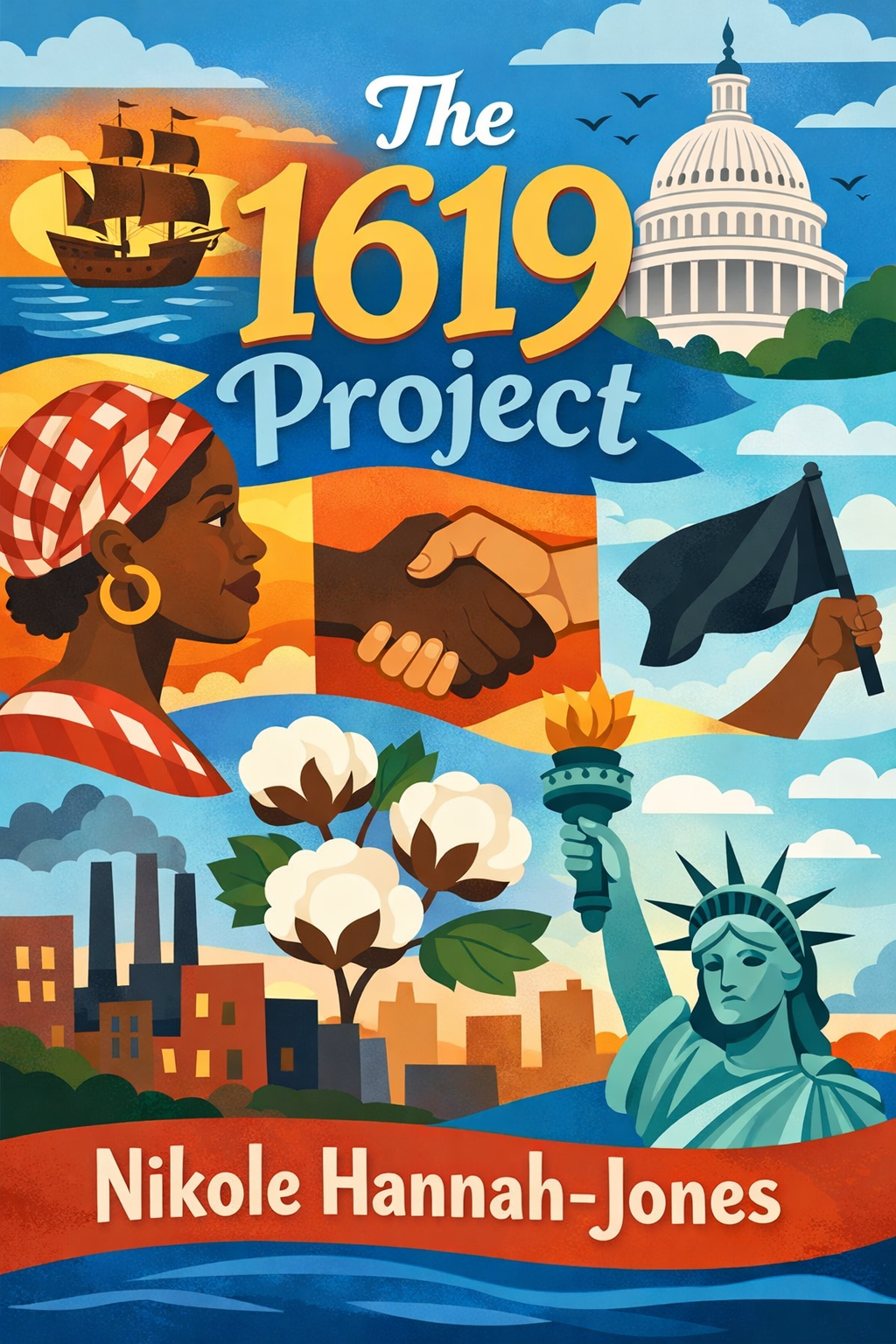
The year 1619 marks a pivotal, yet often obscured, origin point for the United States. It was in August of that year that a ship, the White Lion, arrived at Point Comfort in the Virginia colony carrying more than twenty enslaved Africans. This moment inaugurated the system of racialized slavery that would become the brutal engine of American prosperity. The 1619 Project challenges the traditional narrative that America began solely with the 1776 Declaration of Independence, arguing instead that the nation’s true founding is inseparable from the arrival of those first enslaved people and the centuries of institutionally sanctioned exploitation that followed. This work seeks to reframe the country’s history by demonstrating how the needs and consequences of slavery have shaped fundamental aspects of national life, from its political ideals to its economic power, and how its legacy continues to define modern American society.
The personal journey of the creator, Nikole Hannah-Jones, frames this historical exploration. She recalls her childhood confusion over her father’s unwavering display of the American flag, a symbol he maintained with pride despite having endured the harsh realities of racism in Mississippi and beyond. As a teenager, she saw his patriotism as a form of acquiescence. This feeling was compounded in a school classroom, where an assignment to draw the flag of her ancestors’ homeland forced a painful confrontation with the historical erasure experienced by descendants of slavery. She, like many Black Americans, could not trace a lineage to a specific nation, only to the continent of Africa and the institution that severed those connections. This experience underscored a pervasive national silence: the systematic omission of Black Americans from the story of the nation’s building, relegating them to passive roles in a history dominated by white figures. Her father’s flag, she later understood, was not a blind salute to a country that had rejected him, but a complex claim of belonging and a testament to the Black struggle that had actually fortified American democracy.
Conventional history celebrates 1776 as the birth of American freedom. However, a closer examination reveals that the very declaration that “all men are created equal” was drafted by men who held hundreds of their fellow humans in bondage. Thomas Jefferson, who penned those immortal words, was attended by an enslaved man, Robert Hemings, and his wealth was entirely dependent on the forced labor camp he operated at Monticello. This hypocrisy was not an incidental flaw but a core contradiction enabled by a legal and social framework that defined enslaved Africans as property, not people. Slave codes across the colonies denied them basic humanity—the rights to marry, learn to read, keep their families intact, or seek legal redress. The ideal of universal liberty was, from the start, reserved for a select few. More critically, the drive for independence itself was deeply intertwined with the preservation of slavery. Many American colonists feared that British moves toward abolition threatened their economic survival, as their fortunes were built on crops like tobacco and, later, cotton, harvested by enslaved people. Thus, the fight for liberty was also, for a powerful segment of the revolutionaries, a fight to preserve the right to enslave.
The economic might of the United States was literally built by enslaved labor. Enslaved people cleared the land, cultivated the staple crops that fueled global trade, built the infrastructure, and possessed technical knowledge, such as rice cultivation, essential for colonial survival. The cotton picked by enslaved hands became the nation’s most valuable export, financing industrialization and embedding the country into the world economy. This uncompensated toil generated immense wealth that flowed to Northern bankers, Southern planters, and European manufacturers alike, creating a vast network of complicity and benefit. After emancipation, this pattern of economic exclusion continued through Jim Crow laws, discriminatory policies like redlining, and the systemic exploitation of Black labor. The racial wealth gap of today is not a result of individual failings but a direct outcome of centuries of policy designed to prevent Black Americans from accumulating and passing on assets. The fight for racial justice is, therefore, inextricably linked to the fight for economic justice. Systems that create poverty in Black communities are not broken; they are functioning as they were historically designed to do.
Given this documented history of theft and sanctioned discrimination, the project argues that reparations are a necessary step toward reckoning and repair. Reparations are not merely about a financial transaction but about a national acknowledgment of the specific, enduring harm caused by slavery and its aftermath. They represent a moral and practical imperative to address the compounded disadvantages faced by Black Americans. This concept is framed not as a handout but as a settling of a long-overdue debt, similar to reparations paid to other groups who have suffered state-sanctioned injustice. A true commitment to American democracy requires confronting this foundational inequity. Black Americans have consistently been the prophets of democracy, forcing the nation to live up to its stated ideals through relentless activism, from the abolitionist movement to the Civil Rights era to the present day. The story of America is not one of a steady march toward freedom granted by benevolent powers, but a story of freedom won through the struggle of those who were most denied it. Understanding 1619 is not about assigning guilt, but about achieving clarity. It is about seeing the deep roots of present-day disparities in health, housing, incarceration, and policing. Only by honestly confronting this past can the nation begin to build a more just and equitable future, finally fulfilling the promise of democracy that Black Americans have always fought to expand for everyone.