Description
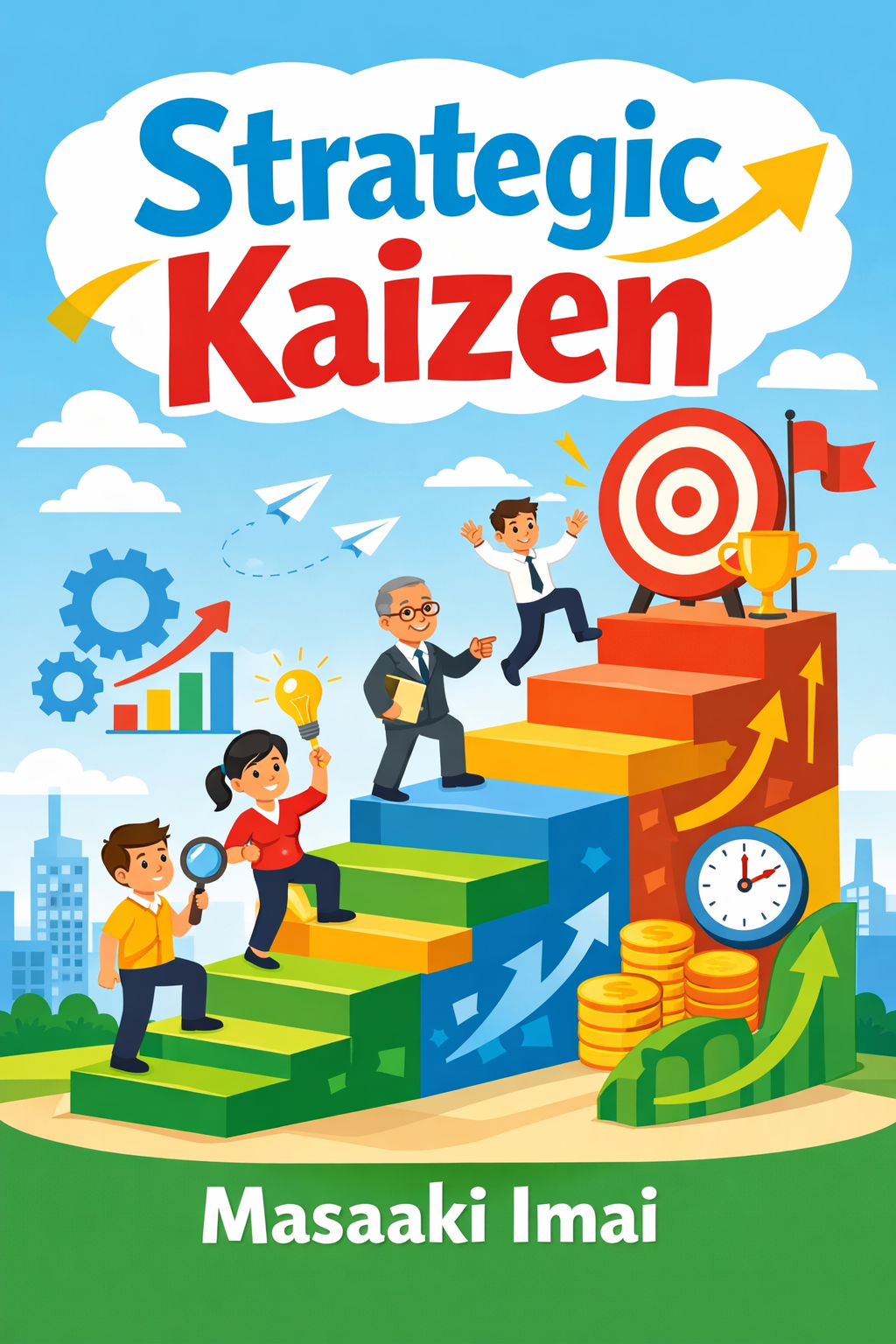
Strategic Kaizen presents a transformative philosophy that bridges the gap between grand corporate strategy and the daily reality of the shop floor. At its core, the book argues that traditional, top-down strategic initiatives often fail because they feel disconnected from the people who must execute them. Conversely, classic continuous improvement programs, while engaging frontline workers, can become aimless and fail to move the needle on key business objectives. Strategic Kaizen is the synthesis of these two worlds—a disciplined yet human-centric framework for making small, incremental improvements that collectively and directly advance the organization’s most critical strategic aims.
The methodology dismantles the notion that strategy is the exclusive domain of the executive suite. Instead, it proposes that strategic intent must be translated into a clear, compelling “True North”—a set of overarching, measurable goals like zero defects, 100% on-time delivery, or absolute safety. This True North is not a vague mission statement but a concrete destination that guides every action. The revolutionary step is then to empower those closest to the work—the operators, technicians, and line supervisors—to identify and eliminate the daily obstacles that prevent the organization from moving toward that True North. In this model, a janitor’s idea for a safer chemical storage method is as strategically valuable as a CFO’s new pricing model, provided both are authentically linked to the defined goal.
The book meticulously outlines a practical, cyclical process for embedding this thinking. It begins with strategic clarity: leaders must define and communicate the True North with unwavering consistency. Next comes the development of key performance indicators that act as a compass, showing in real-time whether daily activities are pulling the organization in the right direction. The heart of the process is the “Kaizen burst,” where cross-functional teams are formed to tackle specific, strategically-aligned problems. These are not lengthy projects but focused, rapid events, often lasting just a few days, aimed at implementing a countermeasure and verifying its impact against the strategic KPIs.
A profound insight of Strategic Kaizen is its focus on the elimination of waste, not just as an economic exercise, but as a strategic imperative. Waste—in the form of waiting, unnecessary motion, defects, or overprocessing—is re-framed as the very barrier that stands between the company’s current state and its True North. Therefore, every act of waste removal is a deliberate step toward strategic achievement. The book provides robust tools for visualizing this waste, from value-stream mapping that reveals process bottlenecks to daily performance boards that make problems impossible to ignore. This creates a culture where problems are not hidden but are seen as opportunities for strategic improvement.
Crucially, the philosophy is built on respect for people. Strategic Kaizen fails if it is wielded as a tool for demanding more from employees without engaging their minds. The system requires leaders to act as coaches and facilitators, not commanders. They must create an environment of psychological safety where speaking up about problems is rewarded, and where employees are given the time, training, and authority to solve them. The book argues that the most sustainable competitive advantage comes from a workforce that is constantly thinking, learning, and aligning its creativity with the company’s direction. This transforms employees from passive executors of tasks into active problem-solvers and strategy contributors.
The long-term vision presented is one of a self-correcting, learning organization. As the cycle of identify-plan-do-check-act becomes ingrained in the daily rhythm, the company develops a dynamic resilience. It can adapt to market shifts not through chaotic, disruptive overhauls, but through the steady accumulation of small, strategic adjustments. The organization learns to sense deviations from its True North faster and respond to them more effectively, turning operational excellence from a project into a perpetual state of being. Ultimately, Strategic Kaizen is more than a set of tools; it is a leadership paradigm that makes strategy a living, breathing part of everyone’s job, every single day.