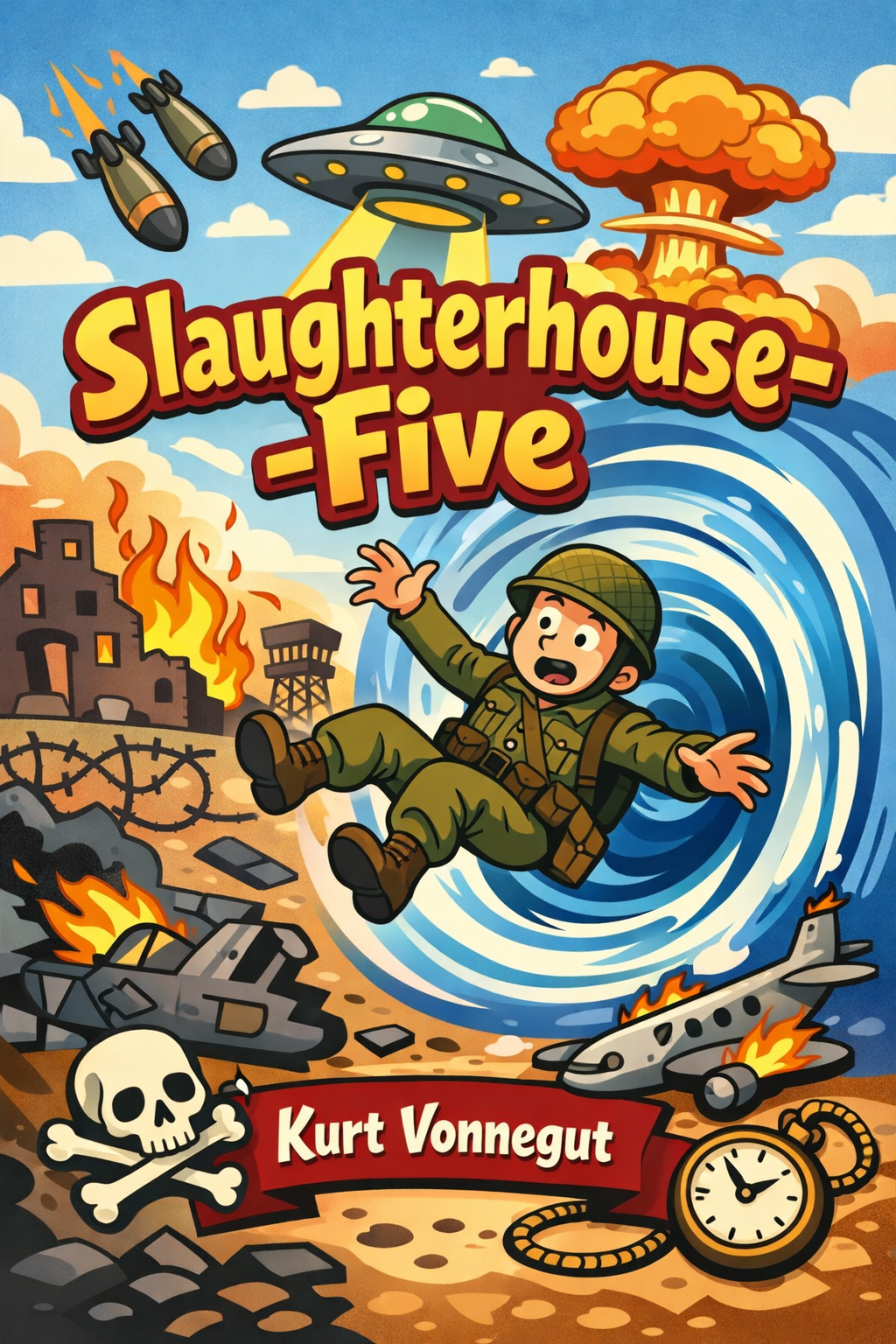
Description
The narrative begins not with its protagonist, but with the author’s own struggle. He wrestles for decades with a memory too vast to contain: the Allied firebombing of Dresden, a beautiful German city filled with civilians and prisoners of war, which was reduced to ashes. He promises to tell the story not as a tale of heroes, but as a chronicle of children, unprepared and terrified. This personal vow frames the fractured, haunting story of Billy Pilgrim.
Billy Pilgrim, an optometrist from Ilium, New York, is a man who has come “unstuck in time.” He does not travel through time willingly, but is flung randomly across the landscape of his own life. One moment he is a clumsy, despondent soldier in the frozen confusion of the Battle of the Bulge in 1944. The next, he is a middle-aged husband and father in the 1960s. Then he is a senile old man in the far future, or a young boy learning to swim. His existence is a collage of moments, with the terror and absurdity of war serving as the relentless anchor point to which he is forever pulled back.
As a soldier, Billy is a portrait of helplessness. He is captured by the Germans and, along with other American prisoners, endures a brutal journey in a locked boxcar before arriving in Dresden. They are housed in a former slaughterhouse, Schlachthof-fünf. The city is a Baroque marvel, seemingly untouched by the war, a haven of civilization. Then, in a single night of apocalyptic fire, the city is obliterated. Billy and his fellow prisoners survive deep underground in the meat locker of the slaughterhouse. The morning reveals a moonscape of destruction. Their surreal task in the aftermath is to excavate the ruins for bodies, which are then burned in massive pyres. The experience is one of incomprehensible scale and silence.
Interspersed with these wartime memories are episodes from Billy’s postwar life. He marries the wealthy, unattractive Valencia, becomes a successful optometrist, and has children. Yet this life is hollow, a performance of normalcy. His wife dies in a tragic accident. His daughter believes he is senile. The trauma of Dresden has severed him from linear existence, leaving him passively adrift. He provides the explanation for his condition during a public speech: he was abducted in 1967 by aliens from the planet Tralfamadore.
According to Billy, the Tralfamadorians are beings who perceive time not as a sequential line but as a constant landscape where all moments—past, present, future—exist simultaneously. To them, a human life is like a mountain range, seen all at once. Death is merely a bad moment in a generally pleasing pattern. Their philosophy is one of resigned fatalism. When a being dies, they simply say, “So it goes.” They have seen the end of the universe, caused by an accidental experiment, and accept it with calm indifference. On their world, Billy is displayed in a zoo with a movie star named Montana Wildhack, where he is meant to mate and demonstrate human life. This bizarre captivity is, in its own way, as structured and inexplicable as his wartime imprisonment.
The Tralfamadorian worldview seeps into Billy’s psyche, offering a chilling comfort. It provides a framework to accept the horrors he has witnessed. If every moment is fixed and unchangeable, then grief, guilt, and rage are pointless. The bombing of Dresden was always going to happen, just as his own death, foretold by a bitter fellow soldier named Paul Lazzaro, is a fixed point in his timeline. This philosophy strips life of free will and moral consequence, reducing it to a series of images to be observed. Billy attempts to spread this gospel, believing it will bring peace, but it mostly renders him a peculiar and distant figure.
The novel’s structure mirrors this philosophy. It is a collection of vivid, often jarring scenes—a man executed for stealing a teapot in the rubble of Dresden, a backward-played war movie where bombs are sucked back into planes, a optometry office slogan promising to “fit you in,” the constant refrain “so it goes” following every mention of death, from a bottle of champagne to a mass massacre. There is no traditional plot suspense, only the deepening pattern of a life defined by catastrophe. The horror of war is not presented through gory heroics, but through its sheer, mundane absurdity and its permanent fracture of the human soul.
In the end, the story circles back to the author in Dresden, long after the war, looking at the rebuilt city. The birds, he notes, are singing “Poo-tee-weet?” The question hangs in the air. After all the philosophical musings, the time travel, and the alien zoo, there are no words of wisdom adequate for the horror. There is only a meaningless, birdsong question mark. Billy Pilgrim, having lived his life out of order and foreseen his own assassination, remains forever in his constellation of moments—a prisoner of war, a husband, a zoo exhibit, a witness to fire. The book itself stands as his testament: a jumbled, beautiful, and devastating image of a life unstuck, and a world where the only coherent response to destruction is a quiet, resigned acknowledgment that it simply was, and so it goes.