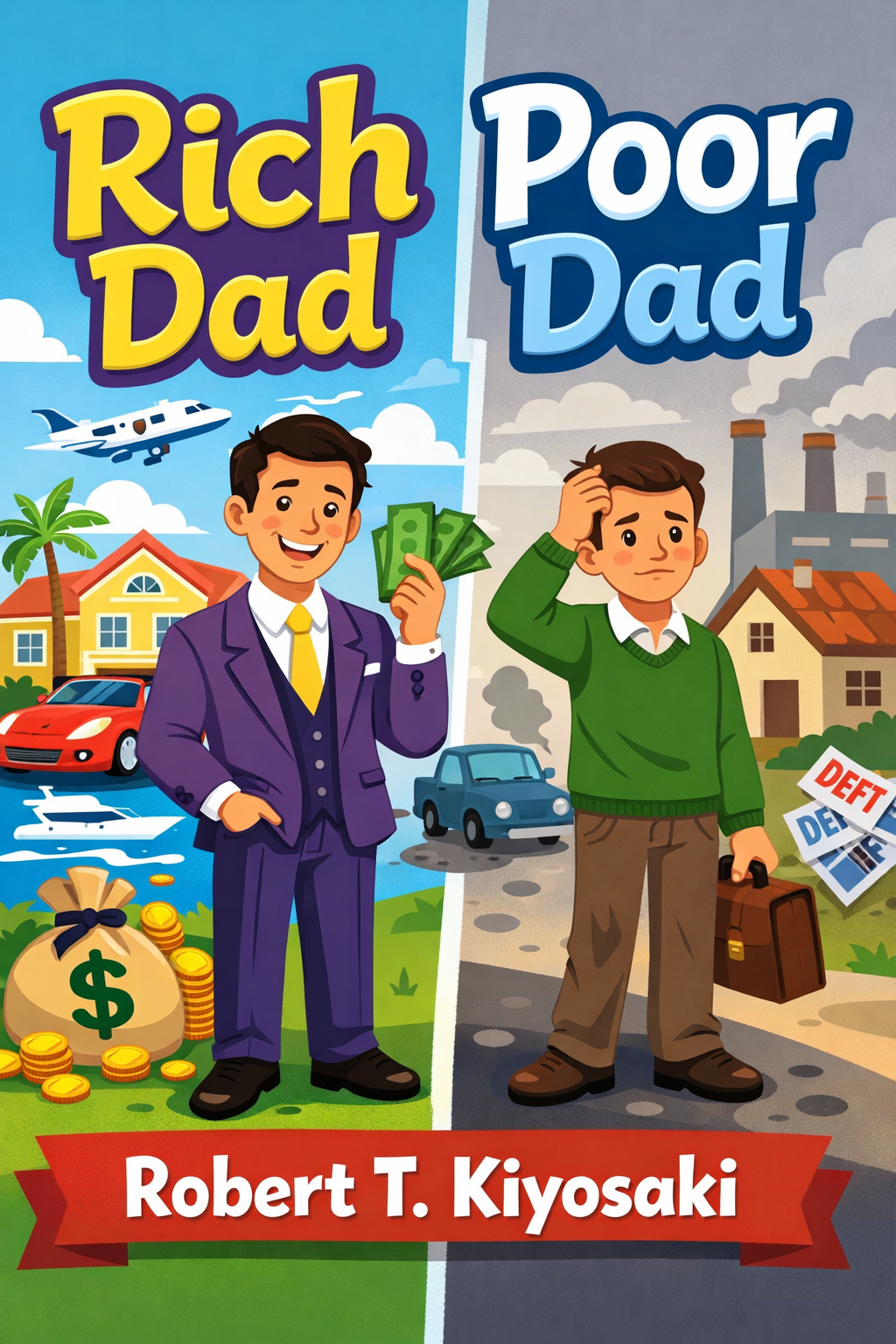
Description
The book presents a powerful personal narrative built around the author’s childhood, where he was guided by two father figures with diametrically opposed views on money. His biological father, the highly educated but perpetually struggling “Poor Dad,” embodied the traditional path: study hard, get a good job, work for a secure salary, and avoid financial risks. The other, his best friend’s father—the “Rich Dad”—was a self-made entrepreneur who had little formal education but a masterful understanding of how money truly works. Through a series of practical lessons drawn from his youth, the author illustrates why the conventional wisdom espoused by his Poor Dad is a recipe for a lifetime of financial mediocrity and insecurity.
The core philosophy begins with a fundamental shift in perspective: the rich do not work for money; they make money work for them. The author recounts his first job working for Rich Dad for pennies, a frustrating experience designed to teach him that trading hours for dollars leads to a cycle of earning and spending, controlled by fear and desire. The escape from this “rat race” lies not in a higher salary, but in the acquisition of assets. The book provides a crucial, simple definition: an asset is anything that puts money in your pocket, while a liability is anything that takes money out. The author argues that most people, especially the middle class, spend their lives accumulating liabilities they mistake for assets, such as a large mortgage on a primary residence, car loans, or consumer debt.
This leads to the vital concept of “minding your own business.” Your profession is what you do to pay your bills, but your business is centered on building your column of assets. The author encourages readers to keep their day jobs but to use their income strategically—keeping expenses low—to acquire income-generating assets like rental properties, stocks, bonds, or intellectual property. The goal is to have your assets generate enough passive income to cover your living expenses, thereby freeing you from the need to work for a paycheck.
The book further delves into the structural advantages the wealthy understand and utilize. It explains how a sophisticated knowledge of tax laws and corporate structures allows the rich to legally minimize their tax burden and protect their wealth. Unlike an employee, who is taxed first and then spends what’s left, a corporation earns, spends its expenses, and is only taxed on the profit. This, combined with legal protections that shield personal assets from business liabilities, forms a system that those working solely for a salary cannot easily access. The author posits that the modern tax system ultimately burdens the middle class, not the truly wealthy who know how to navigate it.
Ultimately, the book is a call for a new kind of education—financial education. It argues that traditional schooling prepares people to be good employees, not financially independent individuals. This self-education involves developing financial intelligence, which is a blend of accounting, investing, understanding markets, and the law. The author emphasizes that it is not necessarily a high income that makes one rich, but a high financial IQ applied with courage. True wealth is measured not by the size of a paycheck, but by the number of days one can sustain their desired lifestyle without working. By shifting focus from earned income to portfolio and passive income, anyone can begin constructing a path out of the rat race and toward genuine financial freedom.