Description
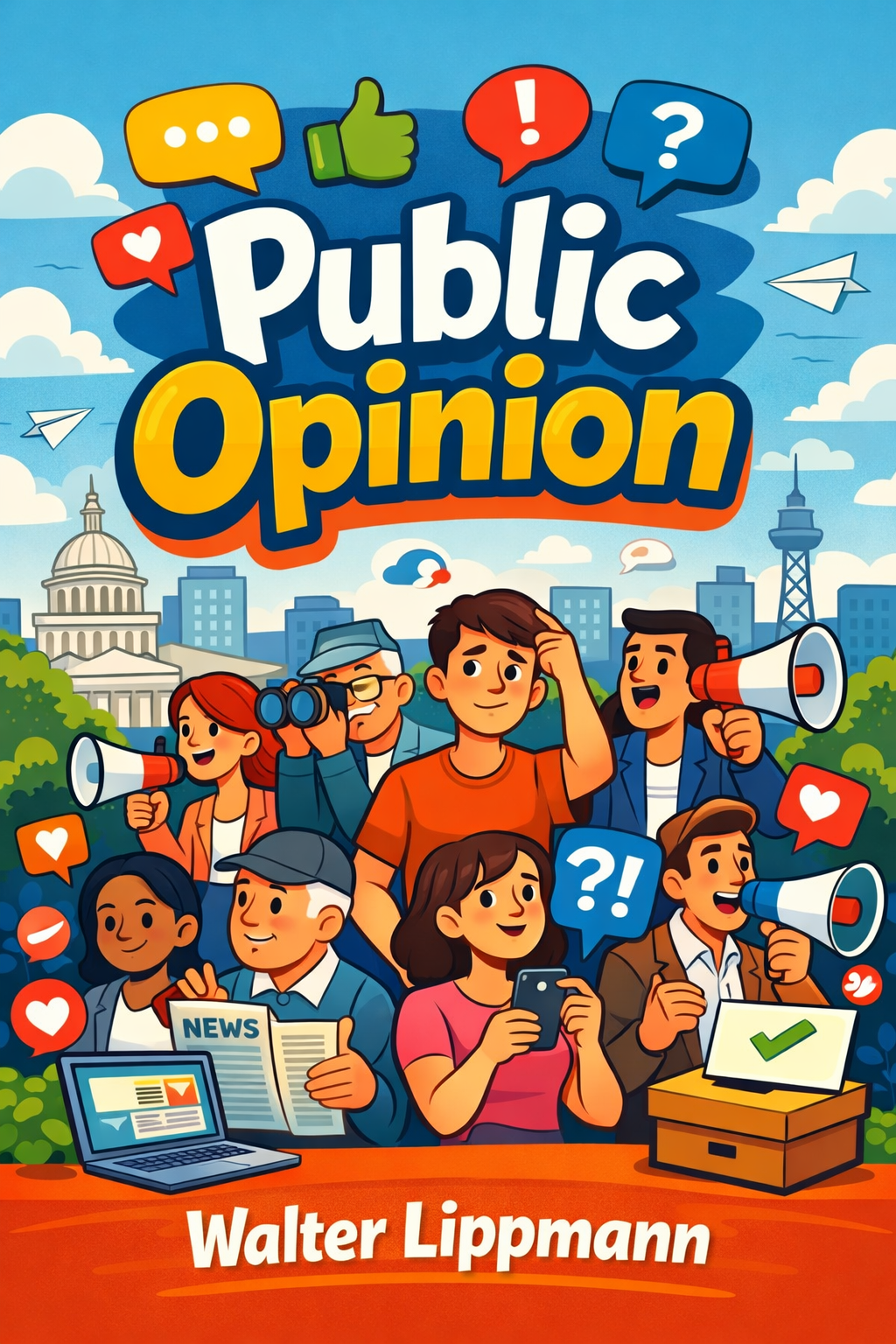
Walter Lippmann’s seminal work delves into the complex space between the world as it truly exists and the world as we perceive it. He begins with a powerful allegory: an isolated island in 1914 where English, French, and German citizens live in harmony, utterly unaware that their home nations are at war. Without newspapers or radio to inform them, they have no reason to turn on their neighbors. This, Lippmann argues, illustrates the fundamental human condition. We do not operate in the real environment directly, but instead within a “pseudo-environment” constructed from news reports, cultural narratives, and our own limited experiences. This mediated reality is what we react to, and it is often a profound distortion of the truth.
Our ability to grasp objective reality is hindered by numerous barriers. Censorship is not merely a government imposition; it is a natural human tendency. We self-censor to protect privacy and avoid discomfort, creating a selective presentation of facts. Furthermore, our direct experience of the world is vanishingly small. Most people live within a narrow geographic and social circle, relying entirely on second-hand sources—news, rumors, hearsay—for information about distant events. This indirect contact breeds distorted perceptions. Compounding this is the sheer scarcity of time and attention. We possess limited cognitive resources, forcing us to rely on mental shortcuts to process the overwhelming complexity of modern society. Even newspapers, in condensing vast events into digestible articles, inevitably strip away nuance and context, feeding us a simplified, and often superficial, version of the world.
This reliance on shortcuts leads directly to the powerful and pervasive role of stereotypes. These simplified mental pictures are necessary tools for navigating a complex existence, providing a framework to quickly categorize new information. However, they come at a steep cost. Stereotypes ossify, turning fluid realities into rigid caricatures. We see foreigners as monolithic groups, either exotic or threatening, based on scant evidence and media tropes. Crucially, stereotypes also function as a psychological defense, shielding us from the discomfort of challenging our own beliefs. During conflicts, nationalistic stereotypes reinforce a sense of righteous identity, making it easier to dehumanize the “other.” While a natural cognitive function, unchecked stereotypes become engines of prejudice and social division, blinding us to the rich diversity of human experience.
Our perceptions and opinions are further steered by our personal interests. We are not dispassionate logic machines; our economic, social, and emotional investments powerfully filter what we see and believe. This human truth is expertly manipulated by those seeking influence. Politicians frame campaigns around pocketbook issues, advertisers tap into desires for status or security, and movements unite individuals by translating private grievances into shared causes, sometimes by inventing a common enemy. This appeal to interest often trumps logical argument. Furthermore, public discourse, especially in democracies, frequently reduces intricate issues to oversimplified, binary choices—yes or no, this candidate or that one. This distortion obscures the true spectrum of public will and allows leaders, whether cynically or sincerely, to frame debates in morally simplistic terms of good versus evil. The result is a often passive public, dependent on leaders and institutions to interpret the world for them.
This brings Lippmann to a sobering critique of democracy itself. The ideal of a citizenry engaged in reasoned debate for the common good clashes with the reality of self-interested actors. Voters may support policies beneficial to their own group but harmful to the whole. This fragmentation is exacerbated by “self-contained communities,” where isolation from differing perspectives reinforces local biases and a skewed understanding of national issues. Real power dynamics further corrupt the process, as wealthy individuals and organized groups exert disproportionate influence on elections and policy, sidelining the public good. For democracy to function effectively, Lippmann suggests, it requires a recognition of these limits and a move toward systems where the majority’s interest holds more sway than the minority’s concentrated power.
A primary architect of our pseudo-environment is the media. In Lippmann’s era, this meant the press, but his analysis extends seamlessly to modern platforms. The media does not simply report events; it selects, edits, and narrates them, creating a symbolic representation of the world. This process is inherently subjective, shaped by deadlines, space constraints, editorial biases, and the need to capture audience attention. The public, therefore, is not reacting to events, but to the media’s curated version of them. This grants tremendous, often unexamined, power to media institutions to set the public agenda and shape societal priorities simply by choosing what to highlight and what to ignore.
Despite this somewhat pessimistic diagnosis, Lippmann does not abandon hope for an informed citizenry. The path forward lies in improved systems of communication and education. We must develop what he calls “intelligence systems”—institutions dedicated not to persuasion, but to the clear, objective reporting of facts. This requires a conscious effort to transcend stereotypes through education and deliberate exposure to diverse viewpoints. It also demands a public cultivated to be more critical and self-aware of the forces shaping its perceptions. The goal is not an impossible direct knowledge of all things, but a wiser recognition of our own limitations. By understanding the barriers between ourselves and reality, we can begin to correct for them, fostering a public opinion more grounded in evidence and less susceptible to manipulation, thus creating the possibility for a more genuine and functional democratic life.