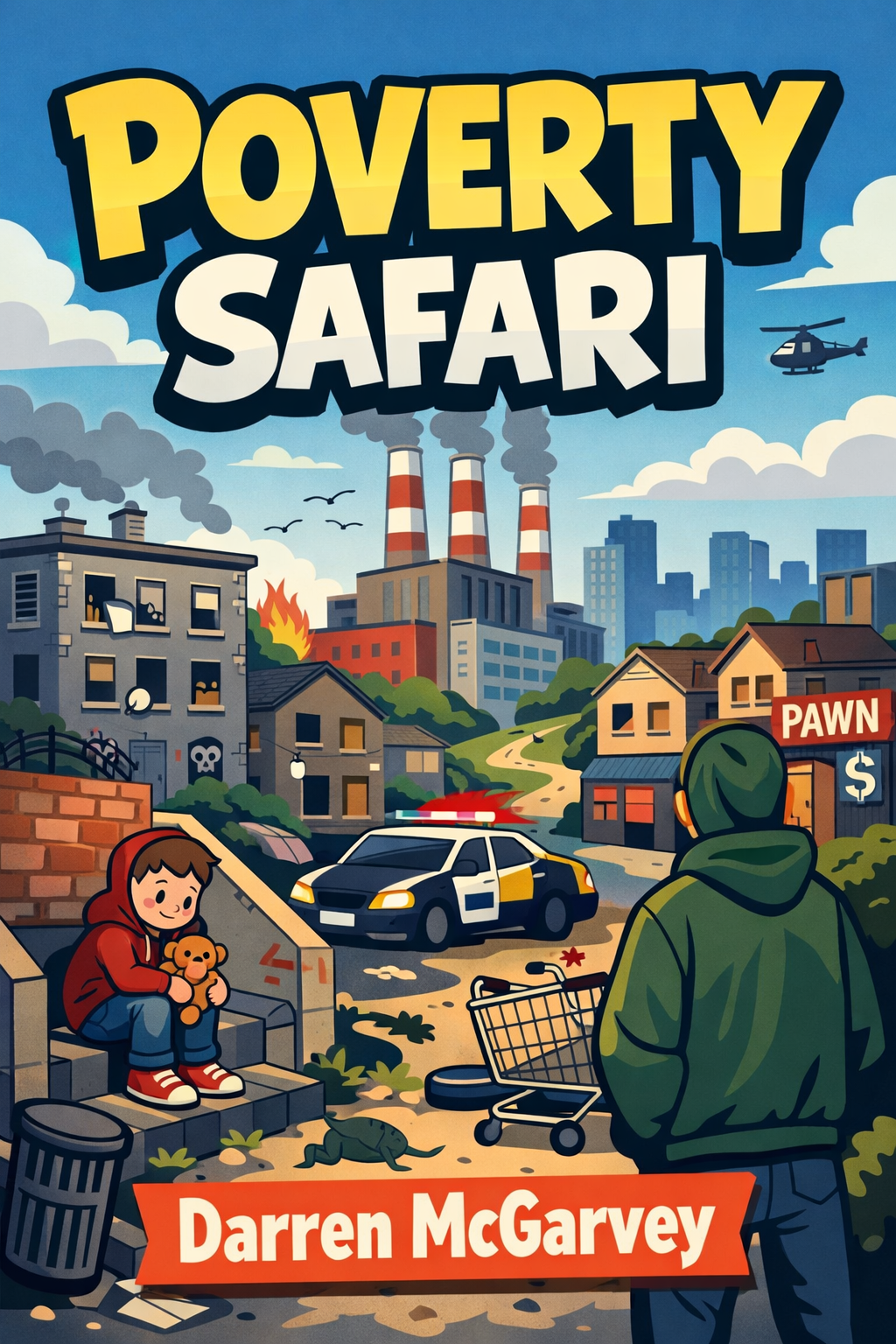
Description
Darren McGarvey’s Poverty Safari is an unflinching exploration of life at the sharpest edges of British society, framed through his own turbulent upbringing in the deprived Pollok estate in Glasgow. It is a work that defies easy categorization, weaving together visceral autobiography, penetrating social analysis, and a challenging polemic on the state of political discourse. McGarvey refuses to offer a simplistic narrative, instead holding a mirror up to both the systemic forces that trap communities and the self-destructive behaviors that flourish within them.
The book opens a window into a world where violence is not an aberration but a constant, ambient threat—a survival mechanism born from economic desperation and profound insecurity. McGarvey recounts a childhood dominated by his mother’s devastating alcoholism, painting scenes of chaos and terror that became his normal. In this environment, interests like art or politics were liabilities, and a hardened exterior was essential armor. This personal history grounds his broader argument: that poverty is not merely a financial condition but a psychological trauma, shaping every facet of perception and behavior. It creates a state of perpetual alertness, where anxiety dictates action and the future is an unimaginable abstraction.
From this intimate starting point, McGarvey widens the lens to scrutinize how social inequality is etched into the very landscape of Britain. He dissects the failed promise of post-war urban planning, where the demolition of slums led not to liberation but to the isolation of impersonal tower blocks. These structures, symbols of a bankrupt optimism, became warehouses for a population abandoned by the collapse of industry. He argues that society then demonizes the people it has corralled into these spaces, a process reinforced by a media and political class obsessed with middle-class concerns while ignoring the brutal realities of welfare cuts and decaying infrastructure. The result is a deep, simmering resentment, a feeling that the world is engineered to exclude you.
Yet, McGarvey is equally critical of the well-intentioned forces that claim to represent these communities. He exposes the paradox of urban “regeneration,” where shiny new developments alienate long-term residents and upscale cafes with punny names signal their impending irrelevance. He scrutinizes the social sector, where well-funded NGOs and charities often operate with a paternalistic, top-down approach, more accountable to distant grant-makers than to the people they serve. This “poverty industry,” he suggests, can inadvertently perpetuate dependency, offering temporary relief but seldom the tools for genuine self-determination. The working class, he contends, is constantly spoken for but rarely listened to.
This leads to the book’s most provocative and essential thread: the confrontation with personal responsibility. McGarvey traces his own spiral into homelessness and drug addiction, detailing how the very support systems meant to help him also introduced him to destructive influences. He describes a moment of crystalline horror, offered crack cocaine at a party, recognizing it as a point of no return. His path to sobriety forced a painful reevaluation of his entire identity. He argues that while systemic injustice is real and powerful, an ideology of pure victimhood is a dead end. The left, he claims, often fails the working class by refusing to acknowledge the role of poor decision-making, instead offering a politics of grievance that provides catharsis but no agency. True empowerment, he discovered, began not with blaming the world, but with mastering his own impulses and emotions.
Ultimately, Poverty Safari is a call for a more honest and complex conversation. McGarvey demands that the chattering classes—politicians, journalists, academics, activists—stop parachuting into deprived areas with pre-packaged solutions and start genuinely listening. He advocates for a politics that bridges the gap between acknowledging structural oppression and championing individual agency. It is a journey from the suffocating anger of his youth toward a harder-won understanding. The book is not a manifesto with easy answers, but a challenge: to look at poverty in all its tangled, uncomfortable fullness, and to recognize that liberation must be both collective and deeply, painfully personal.