Description
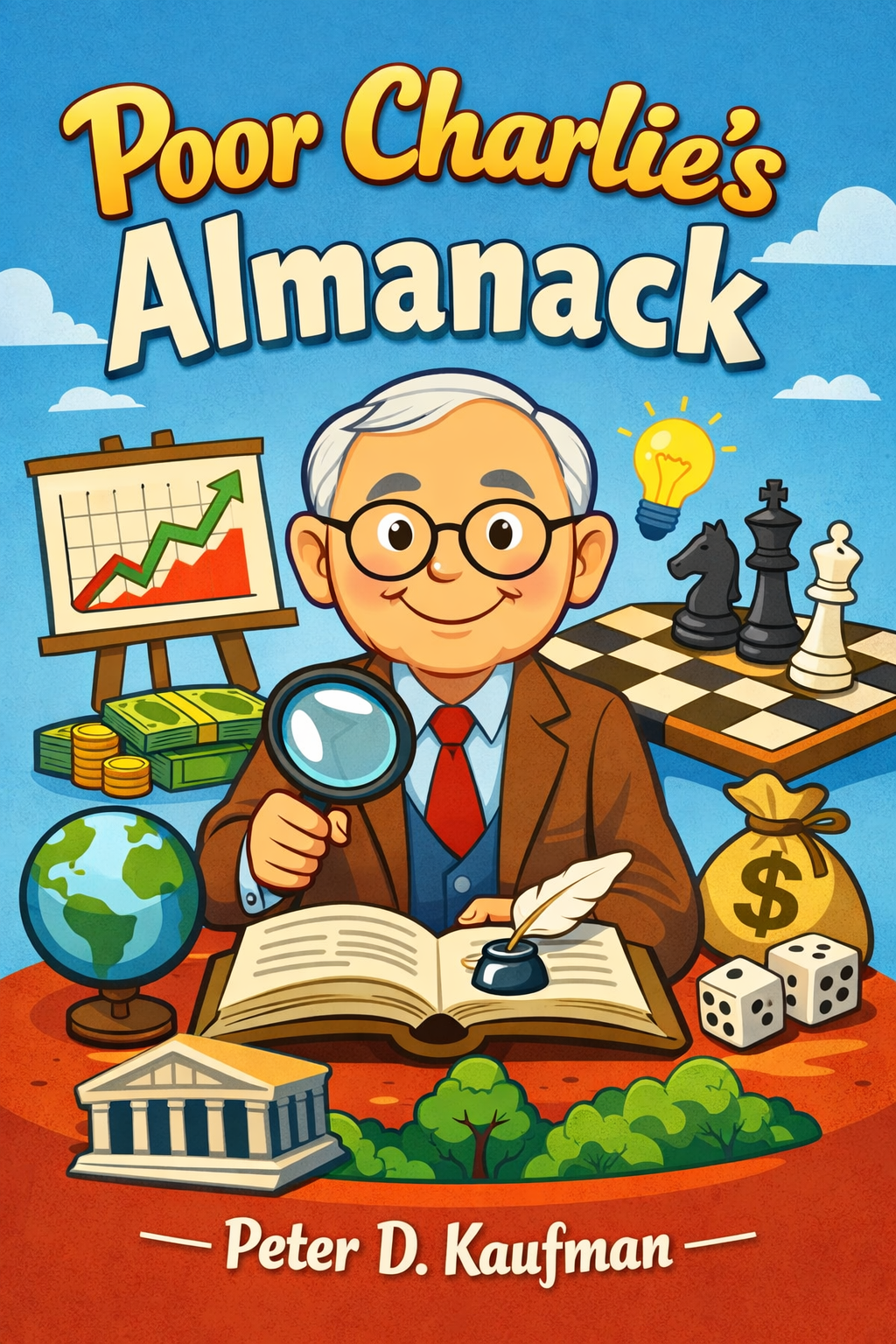
Within the pages of this collection lies the accumulated wisdom of Charlie Munger, the revered partner of Warren Buffett. Far more than an investment guide, it is a masterclass in clear thinking, built upon a lifetime of voracious reading and cross-disciplinary study. Munger argues that the world cannot be understood through a single lens, such as economics or psychology alone. Instead, true wisdom comes from constructing a “latticework of mental models” drawn from a wide array of fundamental disciplines—including psychology, physics, biology, history, and mathematics. This framework allows one to analyze problems from multiple angles, avoid blind spots, and make better decisions in business and in life.
The core of Munger’s philosophy is a set of powerful, recurring mental models. He frequently invokes the concept of “inversion,” which involves thinking backward: instead of asking how to achieve success, one should ask what would guarantee failure, and then diligently avoid those pitfalls. He emphasizes the profound influence of psychological biases on human judgment, cataloging a series of common “tendencies” that lead to faulty reasoning, from incentive-caused bias to social proof. Understanding these innate flaws, he insists, is crucial for anyone seeking rationality. Another cornerstone is the search for “worldly wisdom,” which is practical knowledge about how things really work, combined with the patience to wait for the right opportunity.
His investment principles flow directly from this broader worldview. He advocates for a focused, patient approach, waiting for a few exceptional opportunities where the odds are overwhelmingly in your favor—what he terms sitting on your ass. This requires immense discipline and a temperamental advantage over the crowd. The ideal investment is in a wonderful business purchased at a fair price, not a fair business purchased at a wonderful price. He stresses the importance of a “circle of competence,” advising individuals to operate only within areas they truly understand, and to constantly work to expand that circle through relentless learning. For Munger, investing is not merely a financial exercise but a rigorous test of character and intellect.
Beyond finance, Munger offers robust advice on how to live a life that leads to both success and satisfaction. He is a staunch advocate for integrity, reliability, and lifelong learning. He believes in acquiring wisdom not for its own sake, but as a practical tool for navigating the world. His concept of the “multidisciplinary approach” is a plea for intellectual breadth in an age of specialization. He champions the old-fashioned virtues of hard work, preparation, and intellectual curiosity, arguing that the best way to succeed is to deserve success. A recurring theme is the avoidance of toxic people and disastrous situations, which he considers far more important than seeking brilliant maneuvers.
The book is also rich with Munger’s sharp wit and contrarian perspectives. He dismisses complex financial formulas and modern portfolio theory as often being more precise than accurate, favoring robust, simple principles over elegant complexity. He critiques the narrowness of academic silos and the folly of relying on a single tool or idea. His speeches and writings are filled with memorable anecdotes, historical references, and quotes from a pantheon of thinkers he admires, from Benjamin Franklin to Albert Einstein. This creates a tapestry of wisdom that feels both ancient and urgently relevant.
Ultimately, this volume is not a quick-fix manual but an invitation to build a richer, more effective mind. It teaches that the quality of one’s decisions depends on the quality of one’s thinking. By assembling a broad arsenal of mental models, rigorously checking one’s own biases, and cultivating patience and moral character, one can navigate a complex world with greater clarity and resilience. Munger’s almanac is a testament to the power of compounded wisdom, demonstrating that the best investment one can make is in the development of one’s own reason and judgment. It is a guide for those who seek not just wealth, but a deeper understanding of the fundamental principles that govern outcomes across all fields of human endeavor.