Description
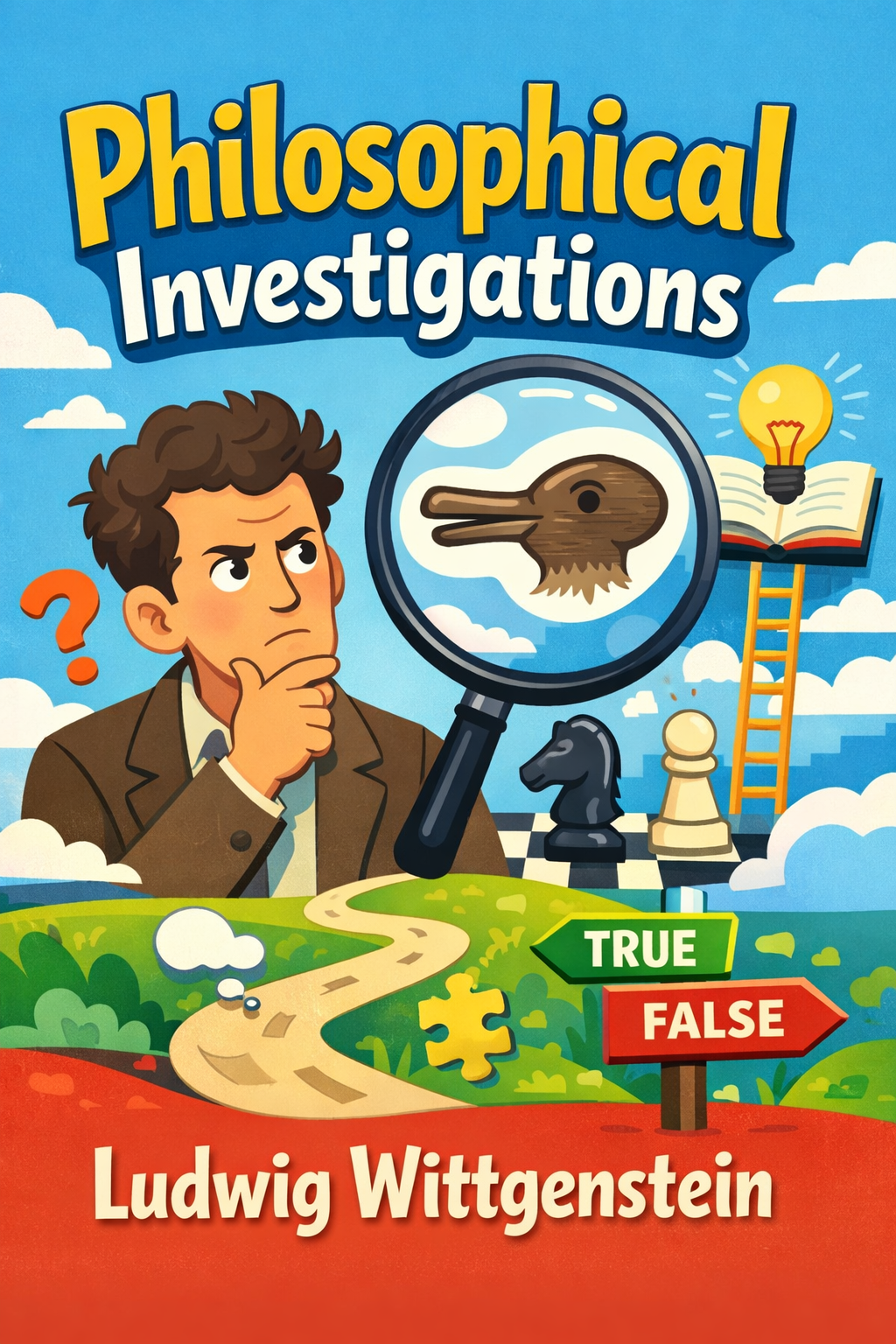
In this profound and unconventional work, the author invites us on a radical re-examination of the foundations of philosophy. He begins by critiquing a simplistic, picture-like theory of language, where words are seen as mere labels for objects and sentences as static representations of reality. This view, he suggests, traps us in a cage of our own making, leading to philosophical confusion and puzzles that seem profound but are ultimately born from a misunderstanding of how language actually functions in the stream of human life. The book argues that we must look not for abstract, perfect definitions, but to the everyday use of words to grasp their meaning.
The core of the investigation introduces a powerful new concept: language is not a single, monolithic system but a tapestry of countless activities, each with its own rules and purposes. The author compares words to tools in a toolbox, where a hammer, a screwdriver, and a ruler all have vastly different functions despite being tools. Similarly, the meaning of a word is its use within a specific form of life, a shared human activity like giving orders, speculating about events, telling a joke, or solving a problem. To understand a word, we must see it at work in its natural habitat, not isolate it under a philosophical microscope.
This leads to a deep exploration of rule-following and what it means to understand something. Is understanding a private, mental event? The author famously argues against the possibility of a truly private language, a language that only one person could ever understand. Pain, for instance, is not defined by a private sensation we point to inwardly, but by our natural, shared expressions of pain—our winces, cries, and words—and the responses they elicit within a community. Our inner experiences are given shape and significance through the public language games we participate in. This dismantles the idea of a solitary self, cut off from the world, directly inspecting its own private objects of consciousness.
A major theme is the rejection of the search for essences. We often ask, “What is time?” or “What is knowledge?” expecting a single, defining answer. The author suggests this is a mistake. Instead, we should look for family resemblances. Consider the concept of a “game.” What single feature do all games share? Not competition, not rules, not entertainment. Games form a family where we see a network of overlapping similarities—some share rules, others share a playful spirit, others share a field of play. Words like “number,” “language,” and “thought” function in the same way. They are held together not by a rigid core but by these crisscrossing threads of resemblance.
The style of the book is itself a lesson. It is not a linear argument building to grand conclusions, but a series of remarks, questions, thought experiments, and dialogues. It reads like a conversation, often with an imagined interlocutor, mimicking the way philosophical confusion arises and can be dissolved. The author shows that many philosophical problems are not puzzles to be solved with a clever theory, but knots in our thinking to be untangled by careful attention to how we speak. The goal is not to build a new philosophical system, but to achieve a kind of peace—a quieting of the questions that arise when “language goes on holiday,” detached from its practical use.
Ultimately, the work is a therapeutic endeavor. It aims to cure us of the intellectual bewitchment caused by our own language. By bringing words back from their metaphysical to their everyday use, we can see the world with greater clarity. The book does not offer answers so much as a new method: a patient, descriptive attention to the rough ground of ordinary human practice. It suggests that the solutions to our deepest philosophical anxieties lie not in digging deeper for hidden explanations, but in looking around at the complex, messy, and perfectly functional ways we already live and talk with one another. It is a transformative call to stop theorizing and start seeing.