Description
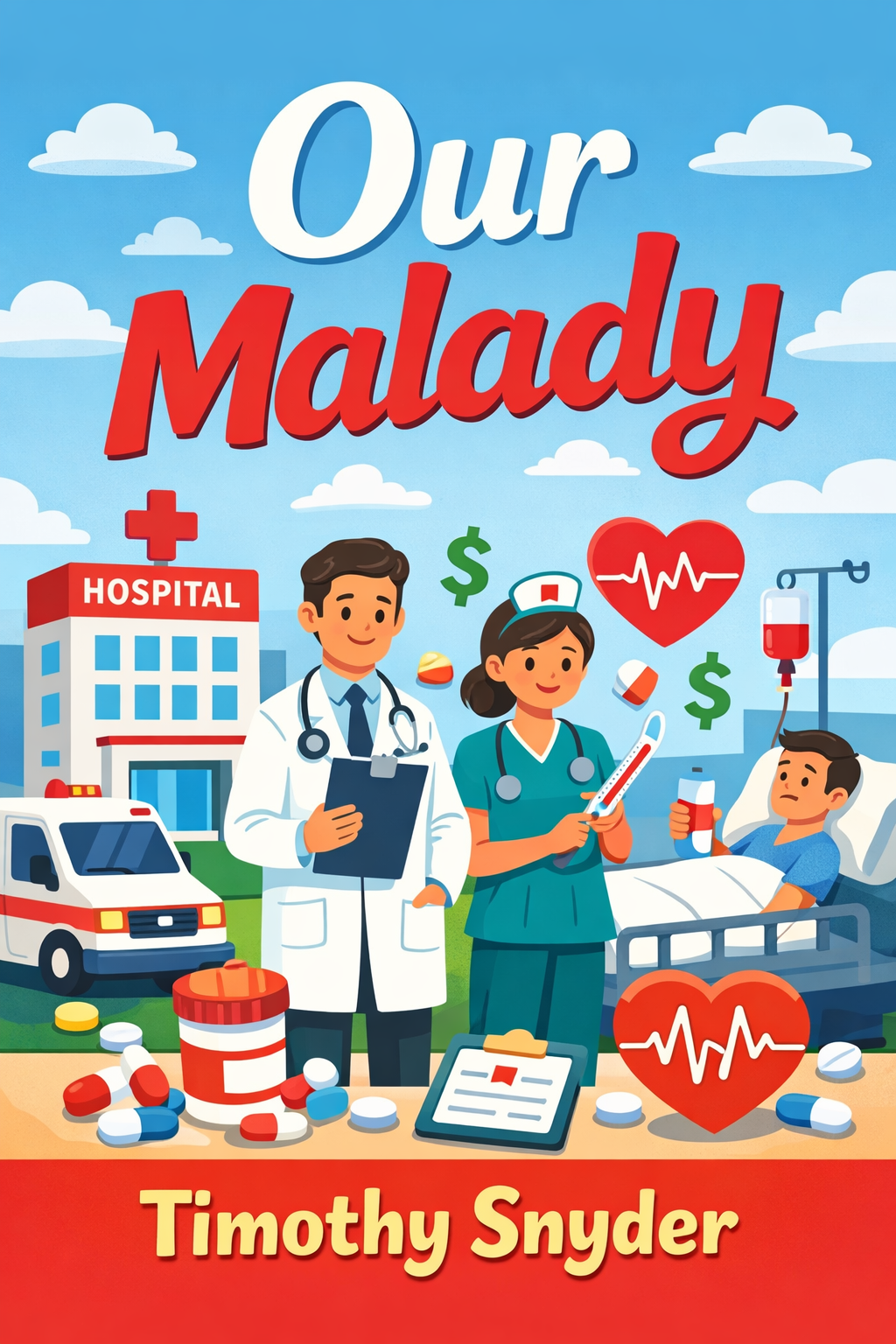
Timothy Snyder’s “Our Malady” begins not in a library or lecture hall, but in a hospital emergency room. On a cold December night, the celebrated historian found himself fighting for his life, not from a mysterious new illness, but from a cascade of preventable failures within the American medical system. A botched communication about a liver lesion, agonizing delays, and dismissive staff nearly killed him from sepsis. This personal catastrophe becomes the launching point for a profound and urgent examination of a nation that, despite its immense wealth and technological prowess, is fundamentally sick. Snyder argues that health is the bedrock of all other freedoms—political, economic, and personal—and that America’s systematic denial of healthcare as a human right is a betrayal of its own democratic ideals.
The book dismantles the myth of American medical excellence by confronting a simple, damning fact: life expectancy is declining. Citizens of the United States now die younger, on average, than people in other wealthy nations, and even in some significantly poorer countries. Snyder contends this is not a mystery of biology but a direct result of a system designed for profit rather than care. The COVID-19 pandemic, unfolding as he wrote, served as a brutal stress test, exposing and amplifying these flaws. Where other nations mobilized public health infrastructure, America’s fragmented, commercialized approach led to catastrophic loss of life, exacerbated by political leadership that prioritized image over truth. Snyder draws a stark line from the hospital bed to the body politic, showing how a society that neglects the health of its people ultimately corrupts its own foundations.
Snyder reaches beyond contemporary politics to explore the deep historical and philosophical connections between health and humanity. He examines how authoritarian regimes, from the Nazis to the Soviet Gulags, deliberately used the denial of medical care as a tool of dehumanization and control. By contrast, the post-war Universal Declaration of Human Rights, which American diplomats helped draft, explicitly enshrines healthcare as a fundamental right. America’s failure to honor this commitment, Snyder suggests, creates a form of sanctioned inequality, where pain and sickness are moralized. He points to the opioid crisis, concentrated in politically conservative areas, as a tragic symptom: in the absence of a caring system, people are funneled toward solitary chemical relief for pains that are often social and economic in origin.
The vision for a healthier society, Snyder proposes, must begin at the very beginning of life. He contrasts his own experience of expecting a child in Austria—where generous, state-supported parental leave and prenatal care are the norm—with the anxiety and scarcity facing American families. This is not mere generosity, but smart social policy. A child who receives consistent, attentive care in its earliest years develops the emotional regulation needed to become a resilient, empathetic, and free-thinking adult. By forcing parents back to work prematurely and failing to support childhood development, America cultivates a population more prone to fear, binary thinking, and poor health outcomes. Investing in children is not a cost, but the most profound investment in a nation’s future stability and freedom.
Ultimately, “Our Malady” is a treatise on truth. Snyder draws a powerful analogy to Tolkien’s Gandalf, a bearer of bad news scorned by those who prefer comfortable ignorance. He argues that a functional democracy depends on an informed citizenry capable of confronting hard realities, especially about their own bodies and their collective well-being. When politicians actively undermine medical expertise, silence scientists, and spread misinformation—as was starkly evident during the pandemic—they do not just cause public health disasters. They attack the very epistemology of democracy, leaving people unable to make choices that protect their lives. The book concludes that the fight for a right to health is inseparable from the fight for truth and self-governance. To heal the nation, America must first recognize and cure the malady in its system, rebuilding a society where care is a collective promise, not a market commodity.