Description
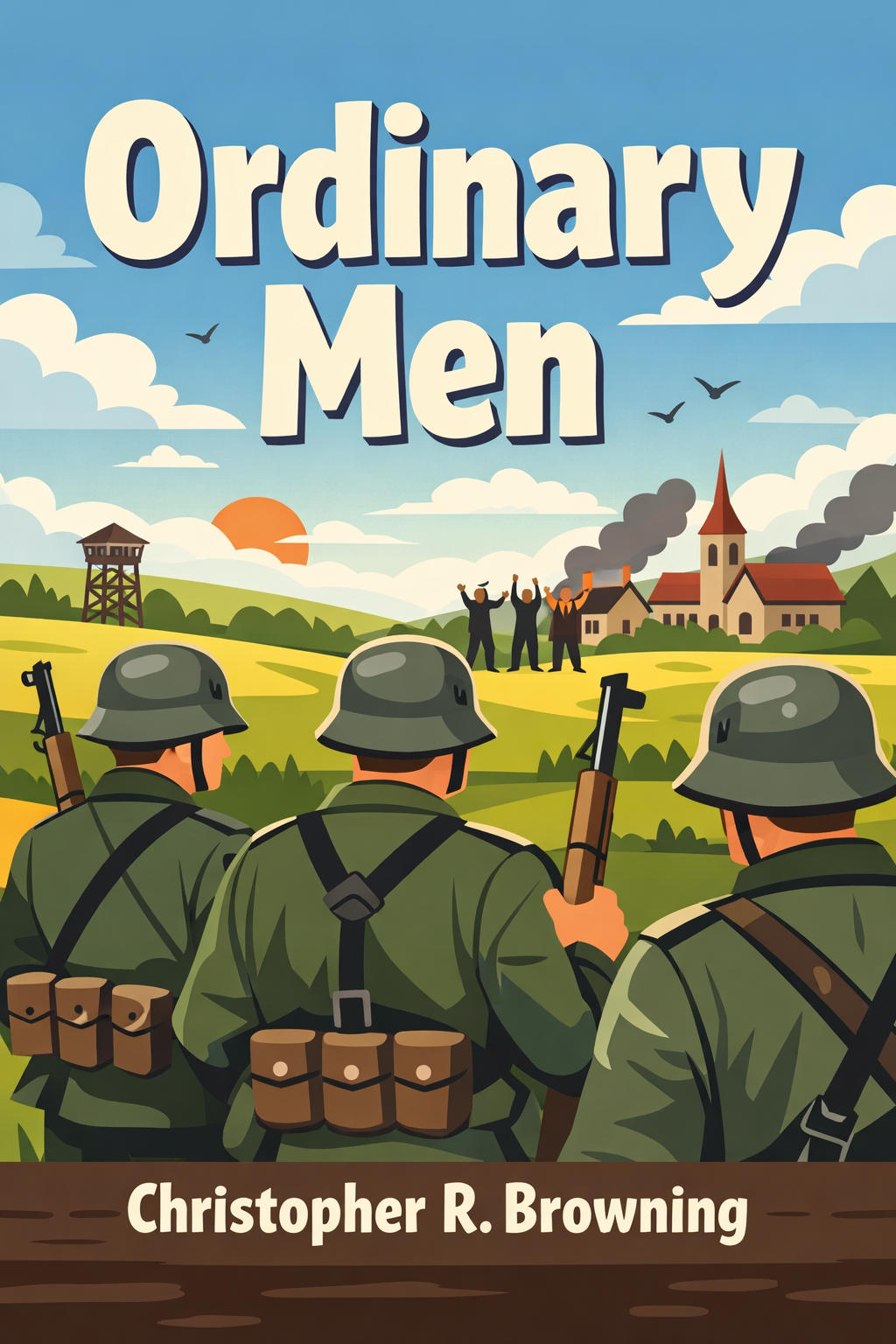
Christopher R. Browning’s profound and unsettling work delves into the history of Reserve Police Battalion 101, a unit of the German Order Police. Composed not of fanatical young Nazis but of ordinary, middle-aged men from working-class Hamburg backgrounds, these individuals were, by most measures, unlikely candidates for mass murder. Yet, between 1942 and 1943, they were directly responsible for the deaths of at least 38,000 Jews and the deportation of 45,000 more to extermination camps. The book meticulously reconstructs their transformation from reluctant reservists into efficient perpetrators of genocide, posing a deeply troubling question about human nature and the capacity for evil within seemingly normal people.
The narrative begins on a hot July morning in 1942, as the battalion is transported to the Polish village of Józefów. Their commander, Major Wilhelm Trapp, addresses them with tears in his eyes, explaining they have been ordered to round up the village’s Jewish population. The men are to separate out young men for labor camps and shoot everyone else—women, children, and the elderly—on the spot. In a moment of extraordinary, if fleeting, conscience, Trapp offers any man who does not feel up to the task the chance to step aside. Only about a dozen out of nearly 500 men accept this offer. The rest proceed with the massacre, though many are visibly distressed, some intentionally missing their targets, and others finding ways to slip away during the long, horrific day. The action leaves the men shaken, drinking heavily and unable to speak of what they have done.
Browning then explores the context that placed these men in this position. The battalion was part of the Order Police, an institution that expanded rapidly during the war and became a convenient tool for implementing the “Final Solution.” As the Nazi regime faced logistical bottlenecks in deporting Jews to camps, they turned to units like Battalion 101 to begin direct shootings. The men, largely conscripted reservists who expected guard duty, were suddenly thrust into the heart of the genocide. The initial massacre at Józefów represents a critical breaking point. The psychological burden was immense, but the structure of the situation—obedience to orders, peer pressure, and the gradual escalation of tasks—began to erode their resistance.
Following Józefów, the battalion’s methods evolved to ease the psychological strain on the men. They shifted primarily to “ghetto clearings,” where they rounded up Jews for deportation to death camps, thereby outsourcing the actual killing. They also began working with *Hiwis*, auxiliaries recruited from Soviet POWs known for their brutality, who would often carry out the most violent aspects of the operations. This diffusion of responsibility proved effective. In subsequent actions, like the one at Łomazy, the dynamic changed. Commanders like Lieutenant Hartwig Gnade exhibited overt sadism, and the opportunity to opt out, once explicitly offered by Trapp, was no longer presented. The choice to avoid participation became harder to make, requiring active and conspicuous dissent. Consequently, fewer men stepped away.
The battalion’s descent continued with the so-called “Jew hunts,” where they tracked down Jews who had escaped and gone into hiding. These small-scale, repetitive actions further normalized murder, turning it into routine police work. The men were no longer facing large, traumatic massacres but were engaged in a grim, ongoing hunt. Through this process, the battalion’s composition and character solidified. The few who consistently refused were marginalized or transferred out, while the majority adapted. They built a social framework that justified their actions through a warped sense of duty, the dehumanization of their victims, and the gradual acceptance of atrocity as normal.
Browning’s analysis rejects simple explanations. These were not inherently evil men, nor were they merely helpless cogs in a machine. Instead, he points to a confluence of factors: the crushing power of conformity and group solidarity, the gradual “slippery slope” of escalating commitments, the authority of the state and military hierarchy, and the potent ideology of antisemitism that, even if not deeply held initially, provided a ready-made justification. The men’s transformation was a process, not an event. They became killers step by step, action by action, each decision making the next one easier.
The book’s chilling conclusion is that the men of Battalion 101 were, indeed, ordinary. They were not monsters from a different species but human beings placed in a specific, terrible set of circumstances. Browning argues that their story is a warning. It suggests that the line between civilized society and mass atrocity is thinner than we like to believe, and that social and psychological pressures can lead ordinary people to commit extraordinary evil. The history of Reserve Police Battalion 101 forces us to confront a disturbing possibility: that under the right combination of pressure, ideology, and incremental steps, such a transformation could happen anywhere, to people very much like us. It is a sobering study not of German guilt, but of human vulnerability.