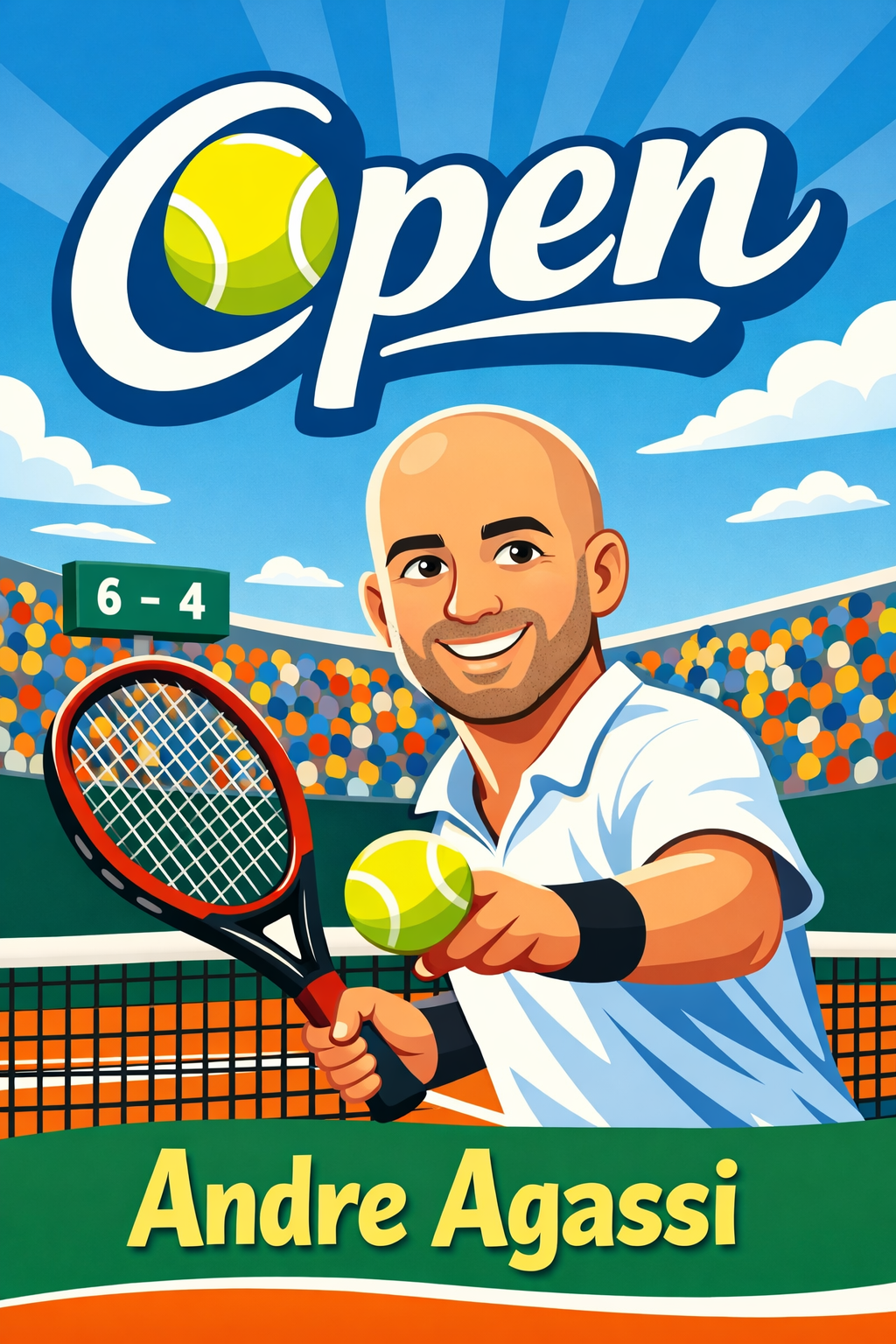
Description
From the outside, Andre Agassi’s life looked like a storybook tale of sporting glory. He was the flamboyant champion with the explosive forehand and the rock-star image, a man who claimed all four Grand Slam titles and Olympic gold. But behind the iconic visor and the flowing hair was a soul in torment, a boy who never chose his path and a man who spent decades running from the very thing that defined him. His journey is not a simple chronicle of matches won and lost, but a profound exploration of identity, rebellion, and the arduous search for meaning under the immense weight of external expectation.
Agassi’s destiny was not his own. It was forged in the Las Vegas backyard by a father whose own Olympic boxing dreams were transferred, with ferocious intensity, onto his youngest son. From the age of seven, Andre faced a ball machine nicknamed “The Dragon,” firing thousands of balls daily under his father’s relentless gaze. This was not practice; it was survival. The childhood he describes is one of fear and compulsory labor, where love felt conditional on athletic performance. His escape to a Florida tennis academy proved to be a different kind of prison, a Spartan boot camp where he first acted out his rebellion through punk hairstyles and defiance. He turned professional at sixteen with a paradoxical reality: he possessed a sublime, natural talent for a sport he actively despised. Every victory felt hollow, every paycheck a chain that bound him tighter to a life he never wanted. He was a walking contradiction—the shy, insecure young man behind the loud, image-is-everything persona crafted for the cameras, a persona that only deepened his self-loathing.
His early career was a blur of confusion and brilliant, unfulfilling success. He bought sports cars with tournament winnings but felt empty. Commentators dismissed him as “a haircut and a forehand,” a critique that stung because it mirrored his own fears of being a fraud. The turning point began not with a trophy, but with people who saw the man behind the athlete. Gil Reyes, a strength trainer with the build of a grizzly bear and the heart of a guardian, became his physical and emotional anchor. Reyes built up Agassi’s fragile body and, more importantly, offered unwavering loyalty and a sense of family. Simultaneously, a spiritual advisor named J.P. helped Andre untangle the knots of his upbringing, teaching him that his worth was not contingent on perfection or victory. This foundation of genuine support allowed a more authentic self to emerge, culminating in his cathartic 1992 Wimbledon win. On the grass he hated, he finally earned the respect he craved, yet the internal conflict persisted.
Personal life offered no sanctuary. His storybook romance and marriage to actress Brooke Shields unraveled under the pressures of fame, mutual misunderstanding, and Agassi’s own spiraling lack of self-worth. He describes this period with unflinching honesty, including his experimentation with crystal meth and the subsequent lie to tennis authorities to avoid a suspension. He hit a profound rock bottom, ranked 141st in the world, his body aching, his spirit broken. It was in this abyss that he began a grueling, improbable comeback, not for fame or his father, but as a personal act of defiance against his own decline. This journey back to the top, culminating in a late-career resurgence that stunned the sports world, was fueled by a new clarity and a transformative partnership with coach Brad Gilbert, who taught him to win with his mind as much as his talent.
The true victory, however, was not another trophy. It was the founding of a charter school for at-risk children in his hometown of Las Vegas. This endeavor gave his struggle a purpose beyond himself. For the first time, his fame and wealth became tools to give others the choices he never had. This sense of purpose bled into his personal life, leading him to a quiet, profound love with fellow tennis legend Steffi Graf. With her, he found a partner who understood the unique pressures of his world without needing to be at its center. His final years on tour were his most peaceful, played with nothing left to prove, cheered on by the family he built for himself. He retired not as a man who learned to love tennis, but as a man who made peace with it, understanding that the game, however hated, was the unlikely crucible that forged his true character. His story is ultimately one of redemption—not in the eyes of the public, but in his own. It is a powerful reminder that the most grueling battles are often fought within, and that winning your own life can be the greatest triumph of all.