Description
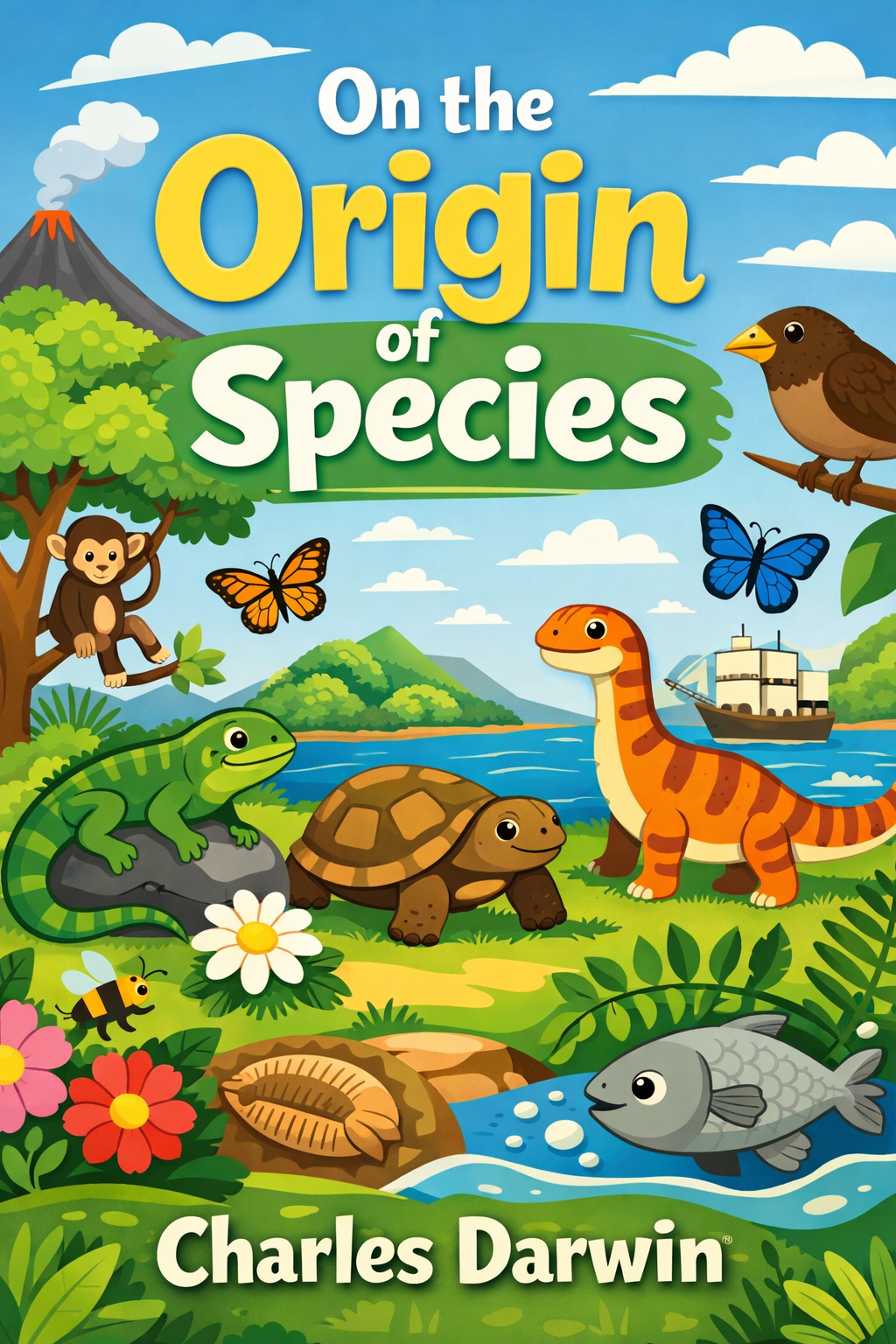
Charles Darwin’s On the Origin of Species is one of the most important works in the history of science. It changed forever how we understand life on Earth. Before Darwin, many people believed that every animal and plant was created separately and had remained unchanged throughout history. Darwin introduced a powerful new idea: all living things are connected by descent, and over long periods of time, they change through a process he called natural selection.
Darwin first noticed that humans themselves can influence how animals and plants develop. Farmers and breeders had long practiced “artificial selection.” They would choose animals with certain traits—like cows that produced more milk or pigeons with unusual feathers—and breed them. Over time, this would produce new breeds with very distinctive features. Pugs, bulldogs, or fantail pigeons are all results of such selective breeding. If humans could create dramatic changes in a few generations, Darwin asked, what might nature accomplish over thousands or even millions of years?
This question led him to natural selection. In nature, every species produces more offspring than can survive. Food, shelter, and space are limited, so there is a constant struggle for life. Within each species, individuals are slightly different. Some may have harder beaks, sharper claws, longer legs, or better camouflage. These small differences, which Darwin called variations, can mean survival or death. If a bird has a stronger beak, it might be able to open seeds that others cannot. That bird will live long enough to reproduce and pass on the stronger beak trait to its chicks. Over generations, the advantage becomes more common. Eventually, the species itself changes.
This gradual process is what Darwin described as “descent with modification.” Every species alive today is the result of countless generations of modifications, each shaped by the environment. Given enough time, these small differences can build up into entirely new species. For example, an ancestral quadruped that once roamed the land could, through modification, become an otter adapted for water or a sloth suited for the trees.
Another factor Darwin explored was sexual selection. Survival is not the only competition in nature—animals also compete for mates. Traits that help an animal attract a partner, even if they seem impractical, can become exaggerated over time. Think of the bright feathers of peacocks or the wattles of turkeys. Female choice and male rivalry shape these traits, which then become fixed in a species.
Darwin also observed how nature balances itself. No species can grow endlessly, because all life is connected in a web. If rabbits multiply rapidly, predators like foxes will also increase, keeping the rabbit population under control. Ecosystems are a balance of plants, animals, climate, and countless interactions. Species that cannot adapt to this balance eventually go extinct. In this way, nature continuously prunes the tree of life, removing some branches while allowing others to grow.
Variation itself comes from many sources. Some traits are influenced by climate. Mammoths in colder periods grew thick fur, but when the climate warmed, animals with less hair thrived. Some traits emerge because body parts are no longer used. The ancestors of ostriches may have flown, but those that relied more on running eventually lost their flight ability. Other variations occur together because of what Darwin called the correlation of growth—if one trait develops, another may follow. For example, certain unusual teeth appear alongside unusual skin in armadillos.
Darwin anticipated criticisms of his theory. Some objected that we do not see all the “in-between” forms of species alive today. But Darwin explained that nature works slowly and selectively. Transitional forms usually disappear as newer, better-adapted species replace them. Fossil evidence, while incomplete, offers enough clues to support his ideas. The fossil record is like a broken book with many missing pages, but the fragments we do have show patterns of gradual change, extinction, and emergence of new forms.
He also addressed complex organs like the eye, which critics thought could never evolve gradually. Darwin argued that even very simple light-sensitive spots could offer survival advantages, allowing their bearers to sense movement or changes in brightness. Over time, slight improvements could accumulate into complex eyes. The existence of many types of eyes in nature today—ranging from simple to advanced—supports this gradual path.
Instincts, too, can be explained by natural selection. Birds that instinctively built stronger nests gave their chicks better survival chances. Over generations, nest-building instincts became more refined. Honeybees with efficient hive-building behaviors prospered. Even instincts, Darwin argued, evolved by the same natural process as wings, claws, and bones.
Darwin also noticed that crossing different species often results in sterile offspring, like mules. This sterility was not directly chosen by nature but was a by-product of how reproductive systems diverged as species separated. Over time, these differences prevent species from blending back together, keeping lines distinct.
Geography also played a key role in Darwin’s thinking. He observed that animals on islands often resembled species from the nearest mainland, yet were still unique. Australia, cut off from the rest of the world, developed its own marsupials, like kangaroos. South America, though similar in climate to Africa, had very different species. These patterns made sense if species had spread, adapted, and diversified within their environments, but they were difficult to explain under the belief that each species had been created separately.
Finally, Darwin pointed to deep similarities among animals in the same class. Humans, bats, and moles have very different lives, yet their limbs are built from the same underlying bone structure. The hand of a person, the wing of a bat, and the digging paw of a mole share the same basic blueprint. The simplest explanation, Darwin argued, is that all mammals descended from a common ancestor with a primitive version of that structure. Over time, natural selection modified it for different purposes.
The overall picture Darwin painted was that life is like a branching tree. Each twig represents a species. Some branches grow, split, and flourish. Others wither and die. The tree has grown for millions of years, shaped by the forces of survival, reproduction, and chance. Today’s living species are just the newest twigs on this vast tree.
The impact of Darwin’s book was enormous. It challenged old beliefs and offered a new way to see the natural world. It explained why species are suited to their environments, why fossils show a history of change, why animals share similar structures, and why instincts and behaviors differ. The theory of evolution by natural selection gave science a unifying explanation for the diversity of life.
Darwin’s work reminds us that life is not fixed or predetermined. It is a constant process of change, shaped by struggle, adaptation, and time. Every species, including humans, is part of this ongoing story. From common ancestors, through countless generations, nature has produced the astonishing variety of life we see around us today.