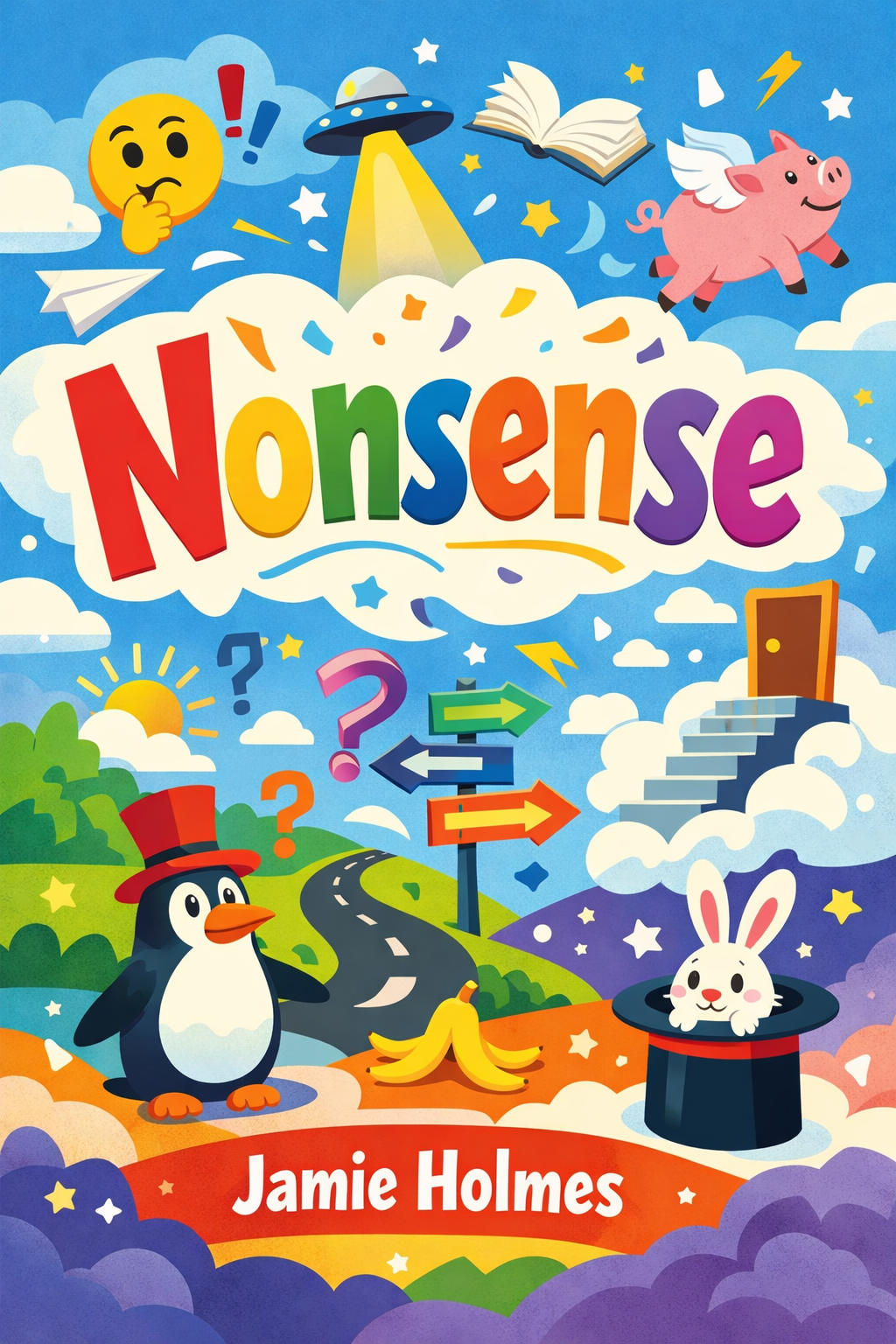
Description
In a world increasingly obsessed with optimization, data, and linear logic, the book presents a compelling and joyful case for the opposite: nonsense. It argues that our instinct to dismiss the absurd, the silly, or the seemingly pointless is a profound mistake. Nonsense is not merely the absence of sense; it is a vital cognitive territory, a playground for the mind that operates by its own rich and necessary rules. By cordoning off nonsense, we impoverish our imagination, stifle innovation, and blind ourselves to alternative ways of understanding reality. The book serves as both a field guide and a manifesto, inviting readers to step off the paved path of conventional reason and wander into the fertile, chaotic woods of the irrational.
The journey begins by dismantling the assumption that nonsense is useless. Through a tapestry of examples from Lewis Carroll’s Wonderland to the Dadaist art movement, the author illustrates how nonsense acts as a pressure valve for society. It disrupts stale patterns, mocks unexamined authority, and questions the very foundations of our “sensible” systems. A perfectly logical world, the book suggests, would be a sterile and terrifying one, devoid of humor, surprise, and the possibility of change. Nonsense is the grit in the oyster, the unexpected mutation, the cognitive glitch that forces systems to adapt and evolve. It is the “what if” that logic alone can never conceive.
Delving into psychology and neuroscience, the text explores how our brains engage with nonsense. When confronted with something that defies established categories—a talking teapot, a sentence that grammatically unspools, a painting where clocks melt—our neural pathways are forced into novel configurations. This mental stretch is not a failure but an exercise. It strengthens cognitive flexibility, the ability to shift perspectives and hold contradictory ideas simultaneously. The state of playful confusion induced by good nonsense is shown to be remarkably similar to the creative flow state experienced by artists and scientists at their breakthrough moments. In essence, practicing nonsense is a workout for innovative thinking.
The book then examines the social and communicative power of nonsense. It looks at the role of inside jokes, whimsical rituals, and shared cultural absurdities in building group cohesion. These are languages of belonging that operate on a frequency separate from practical discourse. Furthermore, nonsense can be a powerful tool for critique and subversion. Political satire, surrealist protest art, and absurdist theatre use the illogical to expose the deeper illogic of corrupt power structures, war, and bureaucracy. By refusing to engage on the terms of “sensible” debate, nonsense can sometimes deliver a more piercing and memorable truth than any straightforward argument.
A significant portion of the work is dedicated to the practical application of nonsense. It is not merely something to appreciate but something to do. The author provides playful exercises designed to cultivate a “nonsense mindset.” These might involve inventing useless machines, writing poems with arbitrary constraints, having conversations where every statement must be a non sequitur, or deliberately seeking the most absurd interpretation of a mundane event. The goal is not to abandon logic, but to develop a healthy partnership with its chaotic counterpart. Logic builds the house; nonsense dreams up the wild, wonderful furniture that goes inside.
Ultimately, the book arrives at a surprising and poignant conclusion: nonsense is deeply connected to meaning. In our relentless search for purpose and explanation, we often overlook the fact that meaning is not always unearthed through sober analysis. Sometimes, it is woven from threads of mystery, paradox, and delight. The comfort of a childhood nursery rhyme, the awe before an abstract painting that “doesn’t represent anything,” the catharsis of laughing until we cry at something utterly ridiculous—these are experiences of meaning generated through channels that bypass conventional sense. Nonsense, in its purest form, re-enchants the world, reminding us that not everything needs to be solved, optimized, or understood to be valuable.
By the final pages, the reader is left with a transformed view. The silly, the absurd, and the illogical are no longer distractions to be tolerated but essential nutrients for a full human life. The book makes a convincing argument that embracing nonsense is an act of intellectual courage and a source of resilience. In a complex and often grim world, the ability to find levity, to imagine the impossible, and to dance with irrationality is not a sign of frivolity, but a profound strategy for staying creative, connected, and authentically human. It is an invitation to reclaim the liberating and transformative power of pure, unadulterated play.