Description
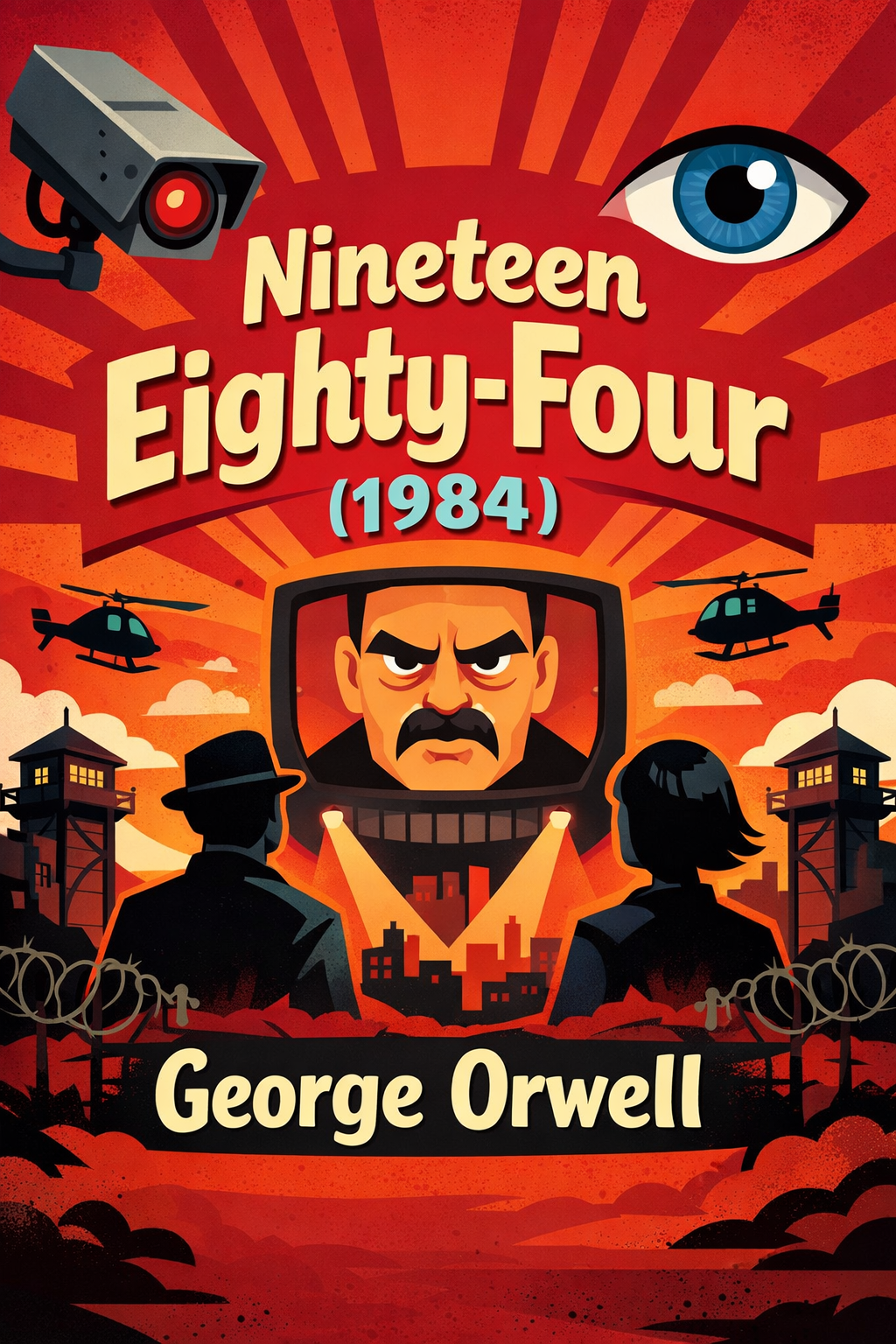
George Orwell’s Nineteen Eighty-Four imagines a dark future set in the year 1984. The world has been divided into three massive, warring super-states. The story takes place in London, which is now a bleak city in the state of Oceania. This nation is ruled by a single, all-powerful group known as The Party. The mysterious leader of The Party is a man known only as Big Brother, whose face is on posters everywhere with the warning: “BIG BROTHER IS WATCHING YOU.” This is not just a slogan; it is a fact. Every home and public space is equipped with a “telescreen,” a device that broadcasts non-stop propaganda while also watching and listening to every citizen, 24 hours a day.
The main character is Winston Smith. He is an ordinary, unhealthy man who works a bureaucratic job in the Ministry of Truth. In this twisted world, the ministry’s real job is to create lies. Winston spends his days “correcting” old newspapers and documents, rewriting history so that the past always matches whatever The Party needs it to be. This job is a key part of The Party’s control, which is built on three slogans: WAR IS PEACE, FREEDOM IS SLAVERY, and IGNORANCE IS STRENGTH. The government has four ministries: the Ministry of Truth (lies), the Ministry of Peace (war), the Ministry of Plenty (scarcity), and the Ministry of Love (torture).
Winston is deeply unhappy and secretly hates The Party. He knows that the government is lying about everything, and he clings to simple, objective truths, like the fact that two plus two equals four. He worries that The Party will one day decide that two plus two equals five, and everyone will be forced to believe it. This inner rebellion leads him to take a terrible risk. He buys a blank book from an old antique shop and begins writing a secret diary in a small alcove in his apartment, just out of sight of the telescreen. This act, even just thinking rebellious thoughts, is known as “thoughtcrime.” If he is caught by the “Thought Police,” he will be arrested, tortured, and “vaporized”—erased from history as if he never existed.
Winston’s life, filled with paranoia and loneliness, changes when he meets a young woman named Julia. She also works at the Ministry of Truth. At first, Winston is terrified of her, believing she is a loyal Party member who might report him. But one day, she secretly passes him a note that says, “I love you.” They begin a secret and highly illegal love affair. For Winston, this affair is the ultimate act of rebellion. It is a purely human, personal act of love and loyalty in a world that demands all loyalty be given only to Big Brother.
Winston and Julia find a small, secret hiding place in a room above the same antique shop where Winston bought his diary. The room has no telescreen, and for a short time, they can feel free. In this room, we see the difference between them. Winston is intellectual; he wants to understand why The Party rules and how a rebellion could be possible. Julia is more practical; she does not care about the grand political theories. She simply hates The Party and enjoys breaking the rules to feel human and alive.
Winston’s desire for a larger rebellion leads him to O’Brien, a powerful and sophisticated member of the elite “Inner Circle” of The Party. Winston has long had a strange feeling that O’Brien is, like him, a secret rebel. Winston and Julia eventually confess their hatred of The Party to O’Brien. O’Brien confirms their hopes, telling them that he is part of a secret resistance group called “The Brotherhood,” led by the Party’s number one enemy, Emmanuel Goldstein. He gives Winston a copy of “the book,” a secret text that supposedly explains the true nature of The Party and how it holds power.
Winston takes the book back to the secret room and reads it. The book explains that the three super-states are not really at war. The war is a sham, designed to use up resources, keep the public in a state of fear and anger, and justify The Party’s total control. The real goal of The Party is not to create a better world, but simply to hold power for its own sake. Just as Winston is finishing the book, the trap is sprung. A telescreen was hidden behind a picture in the room the entire time. Soldiers burst in and arrest both Winston and Julia. He discovers that the kind old shop owner, Mr. Charrington, was secretly a high-ranking member of the Thought Police.
Winston is taken to the Ministry of Love, the government’s center for torture and interrogation. There, he discovers the final, terrible truth: his torturer is O’Brien. O’Brien was never a rebel; his job was to pretend to be one to find and trap “thought-criminals” like Winston. O’Brien explains that the Ministry does not just kill its enemies; it “cures” them. The goal is to completely break Winston’s mind and rebuild it to be loyal to The Party.
O’Brien tortures Winston for weeks or months, both physically and mentally. He teaches Winston about “doublethink,” the power to hold two opposite beliefs at the same time and accept both as true. Through relentless pain, O’Brien forces Winston to accept that reality is only what The Party says it is. He holds up four fingers and, through torture, makes Winston not only say, but truly believe, that he sees five.
Winston tries to hold onto one last piece of himself: his love for Julia. He believes that even if they make him say anything, they cannot make him stop loving her. O’Brien knows this is Winston’s last refuge. He takes Winston to the dreaded Room 101, which contains each person’s single greatest fear. For Winston, this is rats. As a cage filled with hungry rats is about to be strapped to his face, Winston’s mind shatters. He saves himself by betraying Julia in the only way that matters, screaming, “Do it to Julia! Not me!”
After this final betrayal, Winston is cured. He is released back into the world, a broken, empty man. He meets Julia one more time. They are both changed and feel nothing for each other, admitting they both betrayed one another. The story ends with Winston sitting in a cafe, drinking gin. He hears a news bulletin about a great military victory and feels a sense of bliss. He looks at a poster of Big Brother. His struggle is over. He has given in completely. He loves Big Brother.