Description
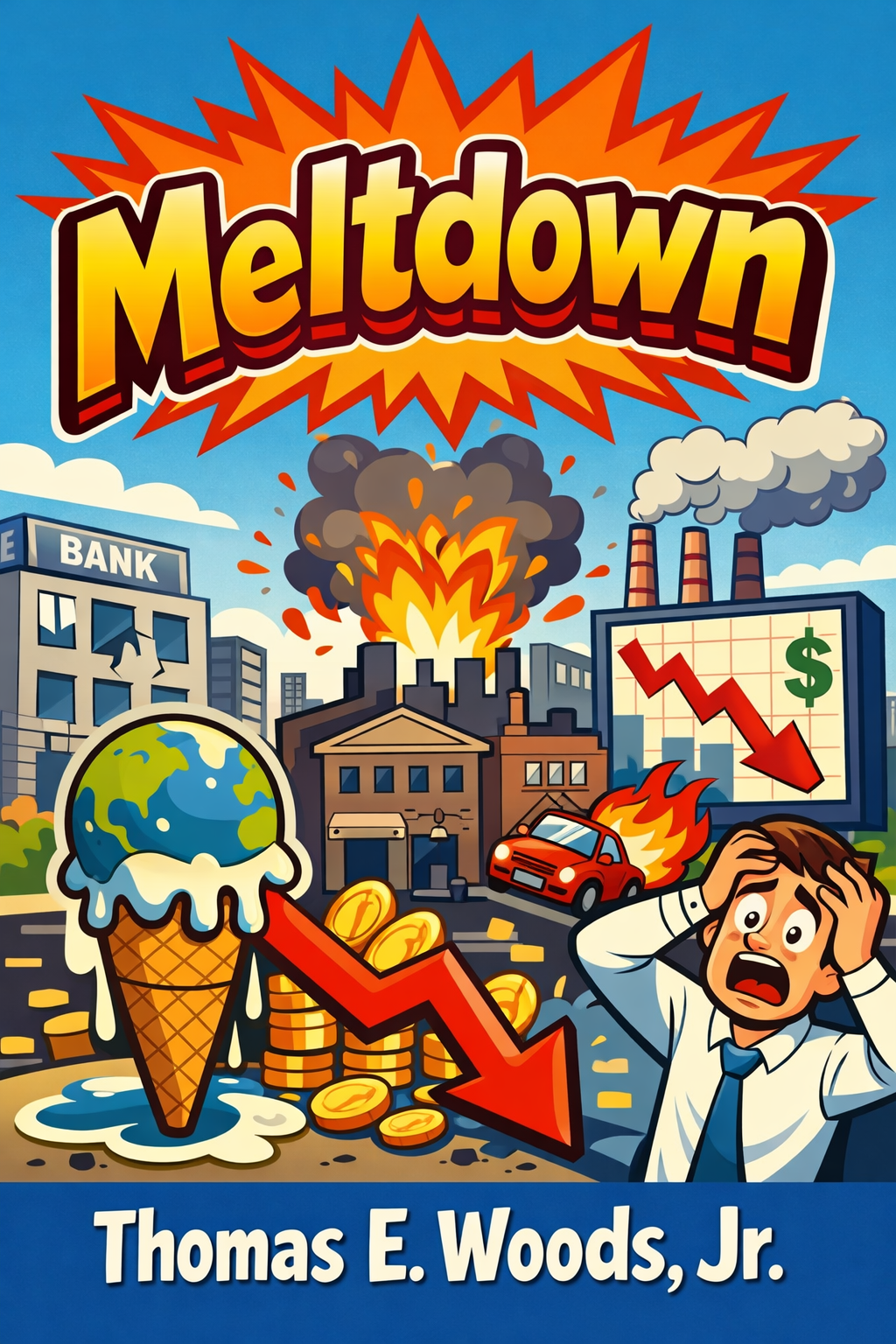
The story of economic calamity, from Dutch tulip mania to the 2008 global financial collapse, is often told as a tale of unchecked market greed. *Meltdown* challenges this narrative head-on, presenting a compelling case that the true architect of modern crises is not deregulation, but government itself. The book invites you on a journey to uncover the suppressed truths behind boom-and-bust cycles, arguing that the very institutions tasked with repair are the source of the damage. It promises not just diagnosis, but a bold prescription for a more stable economic future, rooted in a school of thought often sidelined in mainstream discourse.
The genesis of the 2008 crisis, according to this analysis, lies in a series of well-intentioned but disastrous government policies. It began with mandates for government-sponsored entities to promote homeownership among low-income groups, leading to mortgages requiring no down payment and classified as secure by compliant rating agencies. This artificial creation of risk was then supercharged by the Federal Reserve, which flooded the economy with cheap money by slashing interest rates. The resulting housing boom, fueled by speculative fever, was an illusion built on debt. When reality set in and prices fell, the house of cards collapsed. The key takeaway is that the crisis was not a failure of the free market, but a direct consequence of policies that encouraged people to spend money they did not have and incentivized banks to take risks they would otherwise have avoided.
To understand why these interventions inevitably lead to collapse, the book turns to the business cycle theory of economist Friedrich Hayek. The theory explains how government-suppressed interest rates act as a potent economic distortion. By making credit artificially cheap, central banks create the false signal that society has more saved resources available for long-term investment than it actually does. Entrepreneurs, responding to these false signals, embark on ambitious projects—like tech start-ups in the 1990s or suburban housing developments in the 2000s—that the real pool of savings cannot sustain. This leads to a boom characterized by malinvestment. When the scarcity of real resources finally becomes apparent, the boom turns to bust, revealing the wasted capital and failed ventures. The cycle is not an inherent flaw of capitalism, but a predictable outcome of monetary manipulation.
Furthermore, government action does not cease with the crash; it often exacerbates and prolongs the pain. The book draws a parallel to the Great Depression, arguing that its severity and length were not due to a lack of intervention, but because of it. The inflationary policies of the 1920s set the stage for the 1929 crash. The subsequent New Deal, rather than allowing the economy to correct and reallocate resources based on real consumer demand, froze the malinvestments in place through massive public works and support for failing businesses. High taxes and constant uncertainty stifled the natural recovery process. The lesson applied to the 2008 crisis is that bailouts perpetuate the problem by rewarding failure, preventing the necessary liquidation of bad investments, and signaling that risk will be socialized while profits remain private.
The path to prevention, therefore, requires dismantling the mechanisms of crisis creation. This means, first and foremost, ending the practice of bailouts for financial institutions. Allowing failed entities to go bankrupt, while painful in the short term, is essential for clearing the deck and restoring market discipline. More fundamentally, it requires a radical reassessment of the Federal Reserve. The Fed’s role as a central planner of money and its position as a “lender of last resort” encourages the very risk-taking that leads to disaster. The book argues for stripping the Fed of its power to manipulate interest rates, allowing them to float freely to reflect real economic conditions rather than bureaucratic whims.
The most profound proposal for lasting stability is a return to a monetary system anchored in reality: a commodity standard like gold. Tying paper currency to a tangible, limited asset like gold would severely constrain the government’s ability to print money at will, ending the cycle of artificial booms. Critics warn that such a system could lead to deflation—a general fall in prices—which they view as a catastrophe. However, the book turns this fear on its head, arguing that deflation driven by productivity gains and sound money is a healthy phenomenon. It increases the purchasing power of ordinary people’s savings and wages, rewarding prudence over speculation. The true fear of deflation among policymakers, the book suggests, is that it would expose the government’s inability to use hidden inflation as a tool of economic control and covert taxation. Ultimately, *Meltdown* concludes that economic peace will not be found in more complex regulation or smarter central planners, but in humility—by limiting government’s power to distort the most vital signals in the economy and allowing individuals, freely exchanging in a market with sound money, to build genuine, sustainable prosperity.