Description
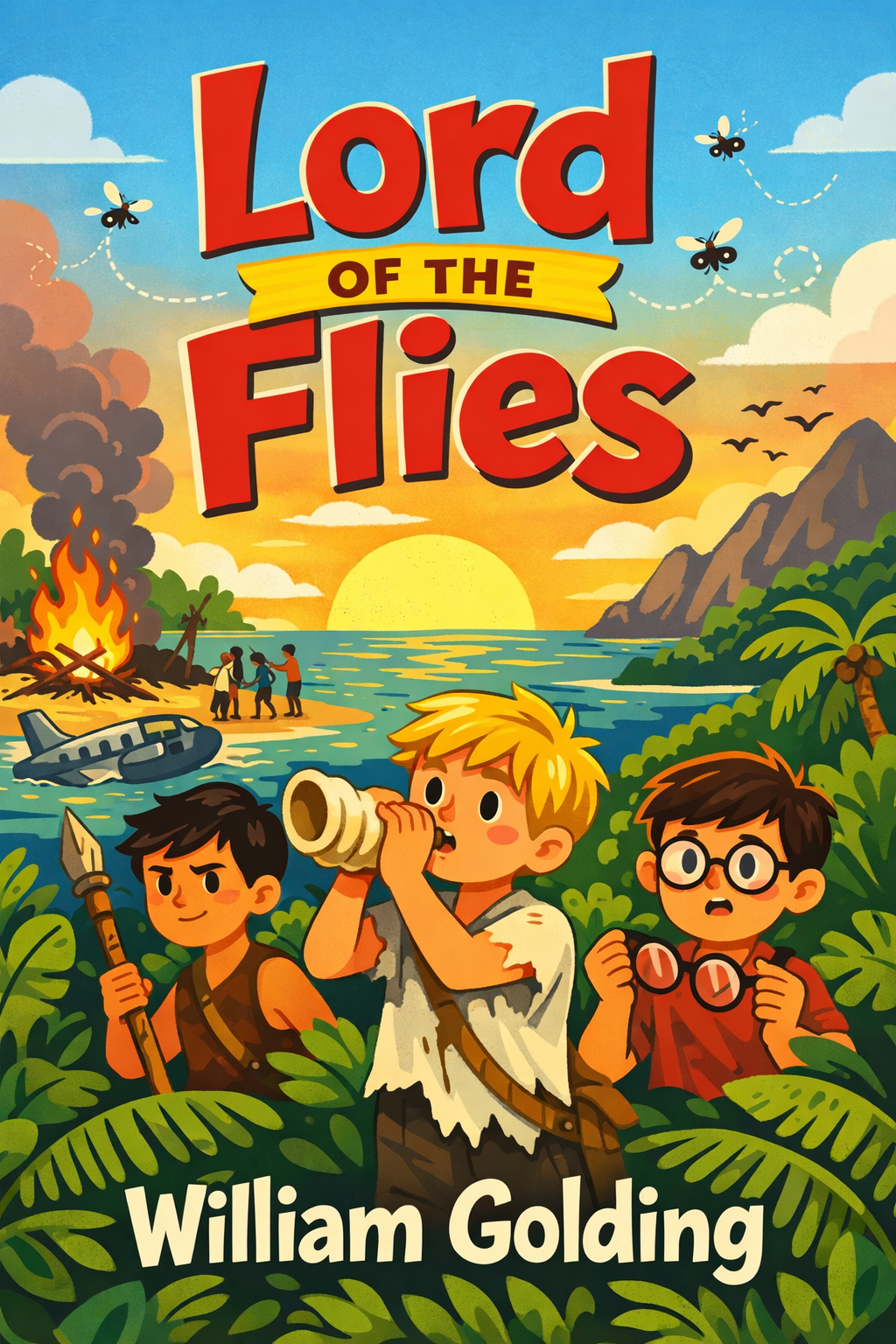
William Golding’s *Lord of the Flies* presents a harrowing thought experiment: strip away the rules, structures, and authorities of adult society, and what remains of human nature? The novel follows a group of British schoolboys whose plane crashes on a remote, uninhabited tropical island. Initially, their situation seems like a childhood fantasy of freedom. They elect a leader, Ralph, who prioritizes rescue, symbolized by the maintenance of a signal fire. He is aided by Piggy, a boy whose intellectual reasoning and commitment to order provide the group’s initial moral compass. They establish a simple democracy using a conch shell as a speaking token, a powerful symbol of their fragile social contract.
Yet, this order is quickly challenged. A rival faction emerges under Jack, a choir leader driven by a lust for hunting, power, and dominance. The boys’ initial unity fractures along the fundamental fault line between the impulses toward civilization and savagery. Ralph represents the former, clinging to the hope of rescue and the rules that make communal life possible. Jack embodies the latter, increasingly viewing the island not as a prison to escape but as a kingdom to conquer through force. His focus shifts from the communal good to the thrill of the hunt, and he manipulates the younger boys’ growing fear of an imaginary “beast” to consolidate his power. The signal fire, their tether to civilization, is allowed to die, marking a pivotal turn inward toward the island’s dark heart.
This descent is witnessed most poignantly through Simon, a solitary, introspective boy who represents a spiritual, innate goodness. While the others bicker or hunt, Simon seeks solace in a hidden forest glade, helping the vulnerable younger children. In a state of exhausted delirium, he confronts the true nature of the beast during a haunting dialogue with a pig’s head mounted on a stake, swarming with flies. This “Lord of the Flies” reveals the terrifying truth: the beast is not an external monster but the capacity for evil within each human being. Simon’s tragic fate seals this revelation. When he discovers that the feared beast is actually the corpse of a dead parachutist, he rushes to tell the others, only to be mistaken for the monster himself. In a frenzied, ritualistic dance driven by fear and mob mentality, the boys, including Ralph and Piggy, collectively murder Simon, shattering the last vestiges of their innocence.
The final stages of the collapse are swift and brutal. With Simon dead, Piggy becomes the last voice of reason. Jack’s tribe, now painted and tribal, steals Piggy’s glasses—the tool for making fire—to cement their control. When Ralph and Piggy confront them to demand the glasses back, Roger, a boy who has fully embraced cruelty, releases a boulder that kills Piggy and destroys the conch shell. The simultaneous destruction of the intellectual and the symbolic heart of their democracy signifies the complete triumph of savage anarchy. Ralph is now hunted like an animal, and the island is set ablaze as Jack’s tribe seeks to smoke him out.
The novel’s devastating climax is interrupted by the abrupt arrival of a naval officer. The fire meant to kill Ralph has served as a signal fire after all, drawing a warship. The officer, expecting a playful adventure story from the boys, is stunned to find them painted, bloodied, and sobbing. The rescue is not a triumphant return to safety but a jarring re-entry into a world the novel has subtly implicated all along. The officer’s own cruiser, a tool of war, hints that the savagery on the island is not an aberration but a microcosm of the adult world from which the boys came. The line between the civilized man and the savage boy proves terrifyingly thin. Golding’s masterpiece forces a profound reflection: civilization is not a permanent state but a deliberate, ongoing struggle against the darkness we all carry within. The true “lord of the flies” is not confined to a deserted island; it is a potential resident in every human heart, kept in check only by the conscious, collective will to be good.