Description
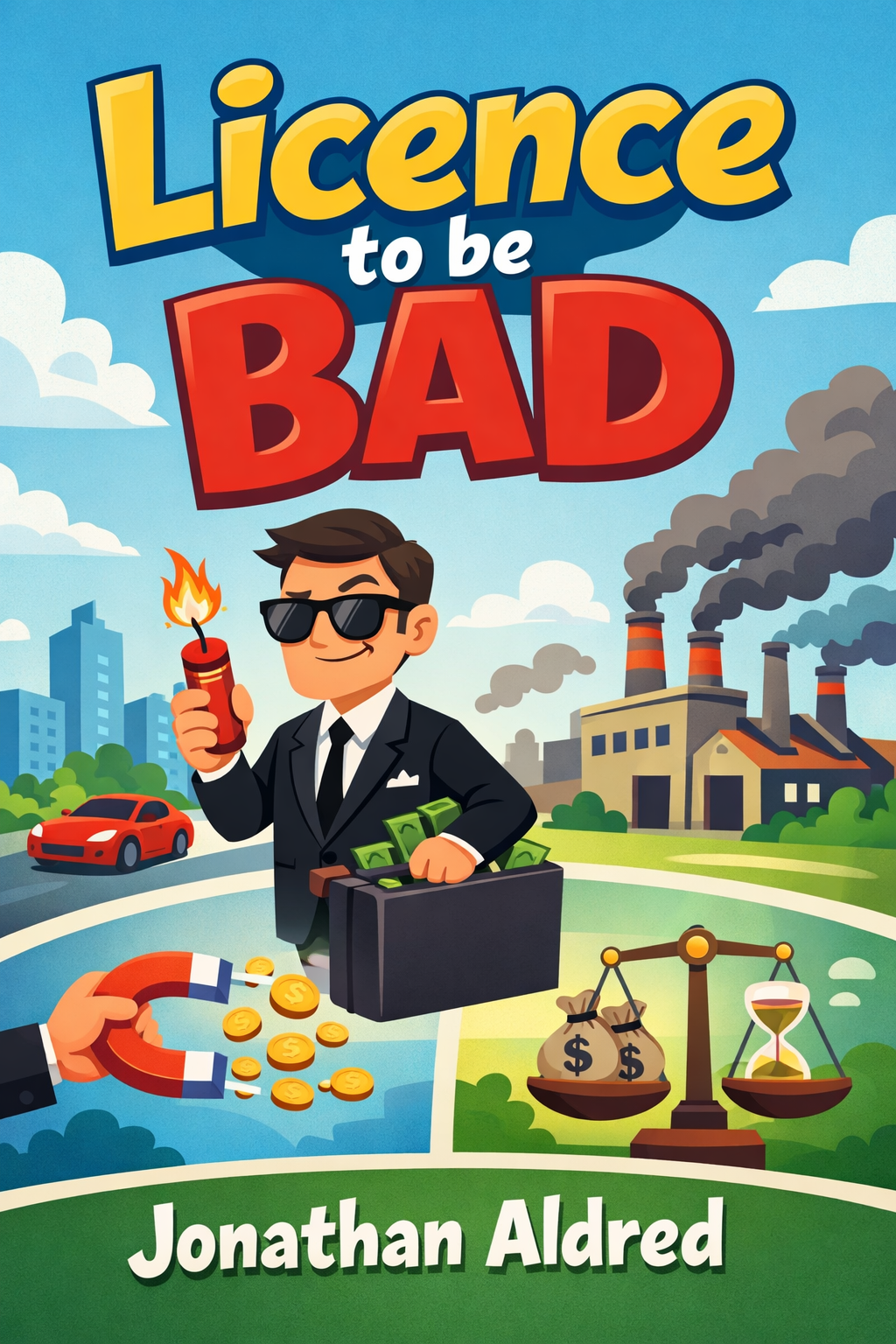
For decades, a particular brand of economics has been presented not as a set of ideas, but as a revealed science, offering objective laws about how societies should be organized. This book argues that this is a dangerous illusion. The economic theories that have risen to dominance since the mid-twentieth century are not immutable truths, but a collection of controversial and often flawed models that actively shape our world for the worse. They provide, in effect, a licence to be bad by justifying selfishness, undermining collective action, and portraying a coldly transactional view of human life as natural and rational.
The story begins not in a laboratory, but at a mountain retreat. In 1947, as much of the world embraced government-led reconstruction, a small group of economists led by Friedrich Hayek met in Mont Pèlerin, Switzerland. They championed radical free-market ideology, arguing that governments should minimize their role in the economy. This thinking, later crystallized by the Chicago School, became the intellectual backbone for the policies of Reagan and Thatcher. Its influence is now so pervasive that its tenets—deregulation, privatization, the supremacy of markets—are often seen as simple common sense. Yet this worldview is far from neutral. It frames events like the 2008 financial crisis not as a failure of reckless banks, but of overzealous regulators, effectively blaming the police for the burglary.
This economic perspective is built on models that assume human beings are fundamentally and consistently self-interested. Game theory, for instance, famously reduces complex social interactions to puzzles like the Prisoner’s Dilemma, where the “rational” choice is always to betray your partner for personal gain. This logic is then applied to everything from crowd behavior to climate negotiations, creating a expectation that cooperation is naive and selfishness is smart. While people demonstrably do cooperate, the very prevalence of this theory encourages a more selfish outlook, making the world it describes more of a reality.
A similar distortion occurred with the work of Ronald Coase. His nuanced observation about how farmers negotiate over straying cattle—considering the costs of fences versus the costs of damage—was twisted into the “Coase Theorem.” This misinterpretation suggested that if transaction costs were low, private deals would always solve social problems efficiently, making government intervention unnecessary. This inspired misguided policies, like attempting to bribe employers to hire the unemployed, and extreme ideas like creating a free market for babies. Coase’s point about the real-world friction of transaction costs was lost, replaced by an ideology that puts private dealmaking on a pedestal.
This bias extends to a deep-seated suspicion of government and collective action. Economic theories like public choice theory insist that everyone in politics, from voters to civil servants, is motivated solely by narrow self-interest. Meanwhile, Arrow’s Impossibility Theorem is often summarized by the dramatic but misleading slogan “democracy is impossible.” While based on abstract mathematical models with limited real-world applicability, such ideas have seeped into public consciousness, fostering cynicism about public institutions and the very possibility of effective governance. This cynicism can become self-fulfilling: if we are told everyone in government is corrupt or incompetent, we erode the trust and civic engagement that makes democracy function.
The consequences of applying this stripped-down economic logic to everyday life are often absurd and damaging. It leads to the “free-rider” problem, where the rational individual is told to contribute nothing to a common good—be it public broadcasting or reducing carbon emissions—because their personal contribution seems negligible. This thinking paralyzes collective action on the most pressing issues of our time. Furthermore, economics frequently misapplies its own tools, such as incentives. Human motivation is complex, and financial incentives can sometimes “crowd out” intrinsic moral or social motivations, as seen when attempts to pay people for good behavior backfire.
The flaws run even deeper, into the very mathematics of decision-making. Models for calculating risk and probability, like the expected utility theory, fail to capture how real people actually perceive and react to danger. They cannot account for the profound difference between a voluntary risk and an imposed one, or the visceral fear of a catastrophic, low-probability event. By ignoring these human realities, economic models can justify inadequate protections against financial or environmental disasters.
Ultimately, this constellation of ideas has made modern economics needlessly tolerant of extreme inequality. By framing the market as an impartial judge of worth, it suggests that vast fortunes are simply rewards for talent and innovation, while poverty is a personal failing. This ignores the social foundations of all wealth and the corrosive effects of inequality on democracy and social cohesion. The book concludes that economics must shed its pretensions of being a hard science and recognize itself as a moral and political project. The dominant theories of the last half-century have not merely described the world; they have remade it into a harsher, more divided, and more selfish place. It is time to revoke the licence to be bad and build an economics that serves humanity, rather than forcing humanity to conform to its bleak and limited vision.