Description
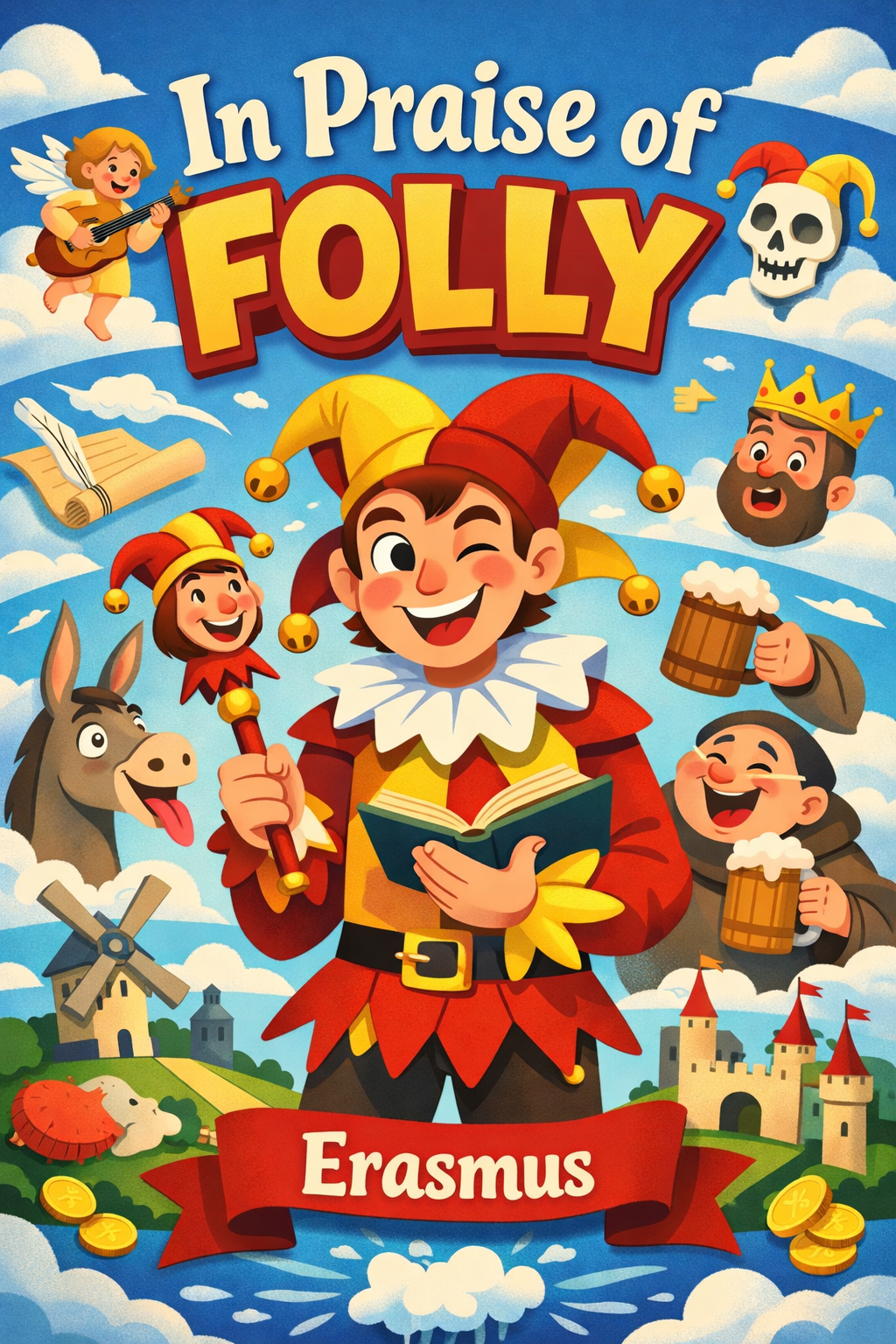
In a bold and delightfully ironic performance, the goddess Folly steps onto an imaginary stage to deliver a passionate oration in praise of herself. She claims authorship of all human affairs, arguing that without her benevolent influence, life would be barren, relationships would crumble, and society would cease to function. With sharp wit and relentless logic turned playfully on its head, she constructs a world where foolishness is not a vice but the very glue of existence.
Folly begins by examining the origins of life, suggesting that the foolish self-love of parents is what propels the creation of children. She then guides us through every stage of human development, asserting that the joys of youth, the comforts of friendship, and the bonds of marriage all depend on a generous measure of delusion, flattery, and blind affection. Without the “folly” of overlooking flaws and inflating virtues, she contends, no company would be tolerable and no partnership would last. Her analysis extends to the professional sphere, where she notes that success often belongs not to the sober and cautious, but to the bold, the rash, and the overconfident—all disciples in her school.
The heart of her argument turns toward the pinnacle of human aspiration: wisdom and happiness. Here, Folly makes her most provocative claim. The so-called wise person, burdened by knowledge, doubt, and the grim realities of life, is doomed to misery and isolation. True happiness, she insists, is the province of the foolish, the simple, and the self-deceived. The happy man is the one lost in a pleasant dream, convinced of his own importance, surrounded by admirers who share in the collective illusion. She paints the philosopher as a pitiable figure, while celebrating the blissful ignorance of the common man who finds contentment in trivial pursuits.
No institution is spared her satirical gaze. Folly launches a brilliant, double-edged critique of the powerful and the pious. Kings, courtiers, and statesmen are revealed to be actors on a stage of vanity, sustained by pomp, ceremony, and the folly of their subjects. Her most biting commentary is reserved for the religious establishment. With daring irony, she contrasts the simple, heartfelt, and often foolish devotion of common believers with the complex, prideful, and quarrelsome theology of scholars, monks, and church officials. She suggests that the humble, foolish faith of a peasant may be closer to the spirit of true religion than the arrogant disputations of theologians. In doing so, she uses her own foolish persona to expose the deeper, more dangerous follies of pride, greed, and dogmatism.
The essay culminates in a surprising and almost mystical twist. Folly connects her own divine madness to the highest forms of spiritual ecstasy described by poets and philosophers. She references the Christian idea of becoming “fools for Christ,” suggesting that the ultimate transcendence of worldly wisdom is a sacred kind of folly. In this state, the soul is so overwhelmed by divine love that it abandons reason and embraces a glorious, irrational bliss. Thus, she completes her argument by placing herself at the very foundation of both earthly joy and heavenly rapture.
Throughout this masterful work, the author uses Folly as a perfect mirror. By having the embodiment of foolishness speak in such clever, learned, and persuasive terms, he creates a relentless irony that forces the reader to constantly question who is truly wise and who is truly foolish. The essay is not a celebration of stupidity, but a profound exploration of human nature, a challenge to intellectual arrogance, and a timeless reminder that a life devoid of some charitable folly may be no life at all. It is a defense of the necessary illusions that make our shared existence not just bearable, but beautiful.