Description
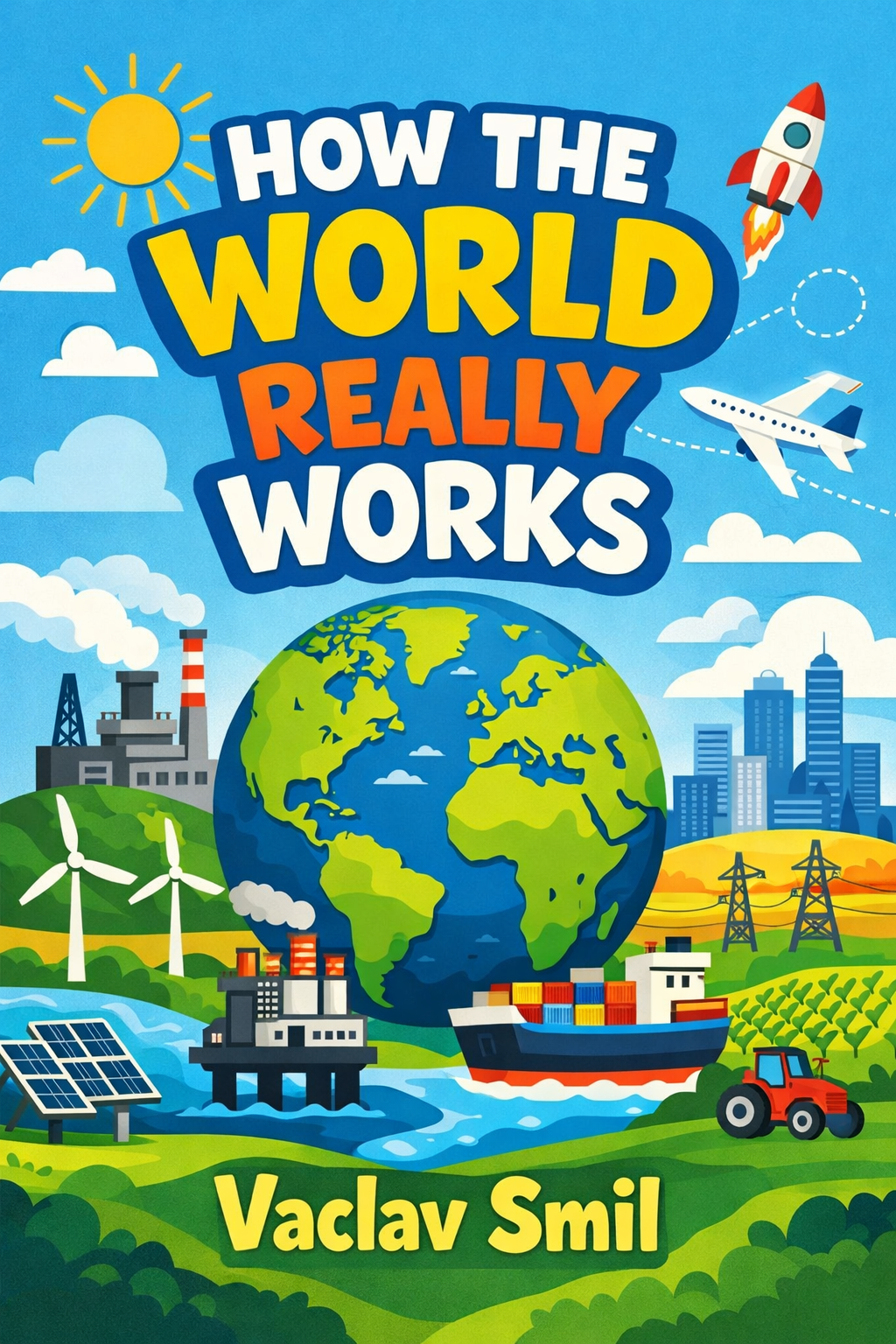
In an age of overwhelming specialization, it is easy to lose sight of the basic principles that underpin our existence. This book argues for a return to foundational knowledge, positing that a functioning democracy depends on citizens who understand the core processes that feed, power, and build our society. It distills the complex machinery of modern life into essential truths, focusing on the pivotal role of energy conversion and the systems it enables. The narrative begins not with industrial revolutions, but with the very origins of life, framing our entire history as a continuous story of harnessing energy.
The epic of life on Earth is, at its heart, a chronicle of energy transformation. Billions of years ago, the first single-celled organisms performed a quiet miracle: photosynthesis. By converting solar radiation, water, and carbon dioxide into organic compounds, they not only sustained themselves but gradually filled the atmosphere with oxygen, creating the conditions for complex life. This established the pattern for all that followed. For humans, the first great leap was mastering fire, an act of extrasomatic energy conversion that allowed us to cook food, alter landscapes, and protect ourselves. Later, we domesticated animals, harnessing their muscle power for labor, and then learned to capture the energy of wind and water. Each step represented a new way to access and direct the free energy essential for survival and advancement.
To grasp our current reality, one must first understand what energy truly is. In its simplest physical definition, energy is the capacity to do work—to create motion or change against resistance. It cannot be created or destroyed, only converted from one form to another, a principle known as the conservation of energy. The food we eat contains chemical energy, converted into kinetic energy when we move. A lump of coal holds chemical energy that can become thermal energy to boil water, producing steam whose mechanical energy can drive an engine. Our species’ evolutionary advantage has been its unparalleled skill in capturing and converting these stores of free energy, bending them to our will. This mastery finds its most profound expression in how we feed ourselves.
The story of modern food is a story of fossil fuels. While photosynthesis remains the indispensable solar-powered base of all agriculture, our ability to feed nearly eight billion people rests on a foundation of coal, oil, and natural gas. This hybrid system began with mechanization—tractors, combines, and trucks that replaced animal and human labor, all powered by diesel. But the more profound revolution was chemical. Plants require nitrogen to grow, yet most atmospheric nitrogen is inert and inaccessible. For millennia, farmers relied on slow natural processes or planted nitrogen-fixing crops to replenish soil. In the early twentieth century, the Haber-Bosch process changed everything. By using immense heat and pressure, largely derived from natural gas, it “fixes” atmospheric nitrogen into ammonia, the key ingredient in synthetic fertilizer. This innovation single-handedly removed a fundamental limit on crop yields. Today, the abundant harvests that stock our supermarkets are as much a product of fossil fuels as of sunshine and soil.
This agricultural revolution directly fueled another transformation: urbanization. When farming required the labor of the majority, people lived on the land. Fossil-fueled mechanization changed that calculus. As fewer hands could produce more food, populations migrated to cities in search of new opportunities. Cities, in turn, became hubs of industry and innovation, their growth sustained by the steady flow of energy-dense food from the countryside. The metropolis is a physical manifestation of surplus energy, a place where human effort is redirected from subsistence to creation, commerce, and culture.
At the heart of the modern city, and indeed the modern world, is electricity. It is the ultimate refined energy carrier, capable of being generated from multiple sources—burning coal, harnessing rivers, splitting atoms, or capturing wind—and transmitted instantly over vast distances to perform an astonishing variety of tasks. Electricity powers the lights, heating, and appliances of our homes; it drives the motors in factories and offices; it enables the global network of computers and communications that define contemporary life. It is the invisible bloodstream of civilization, so ubiquitous that its absence reveals how utterly dependent we have become. Understanding its generation, distribution, and use is to understand the pulse of the modern age.
Ultimately, this exploration reveals a world built on interconnected physical realities. Our prosperity, our global population, and our daily comforts are not abstract economic outcomes but direct consequences of our mastery of energy flows. To discuss the future—whether addressing climate change, planning new technologies, or considering economic policy—without this foundational knowledge is to build on sand. The book is a compelling reminder that before we can change how the world works, we must first understand how it really works.