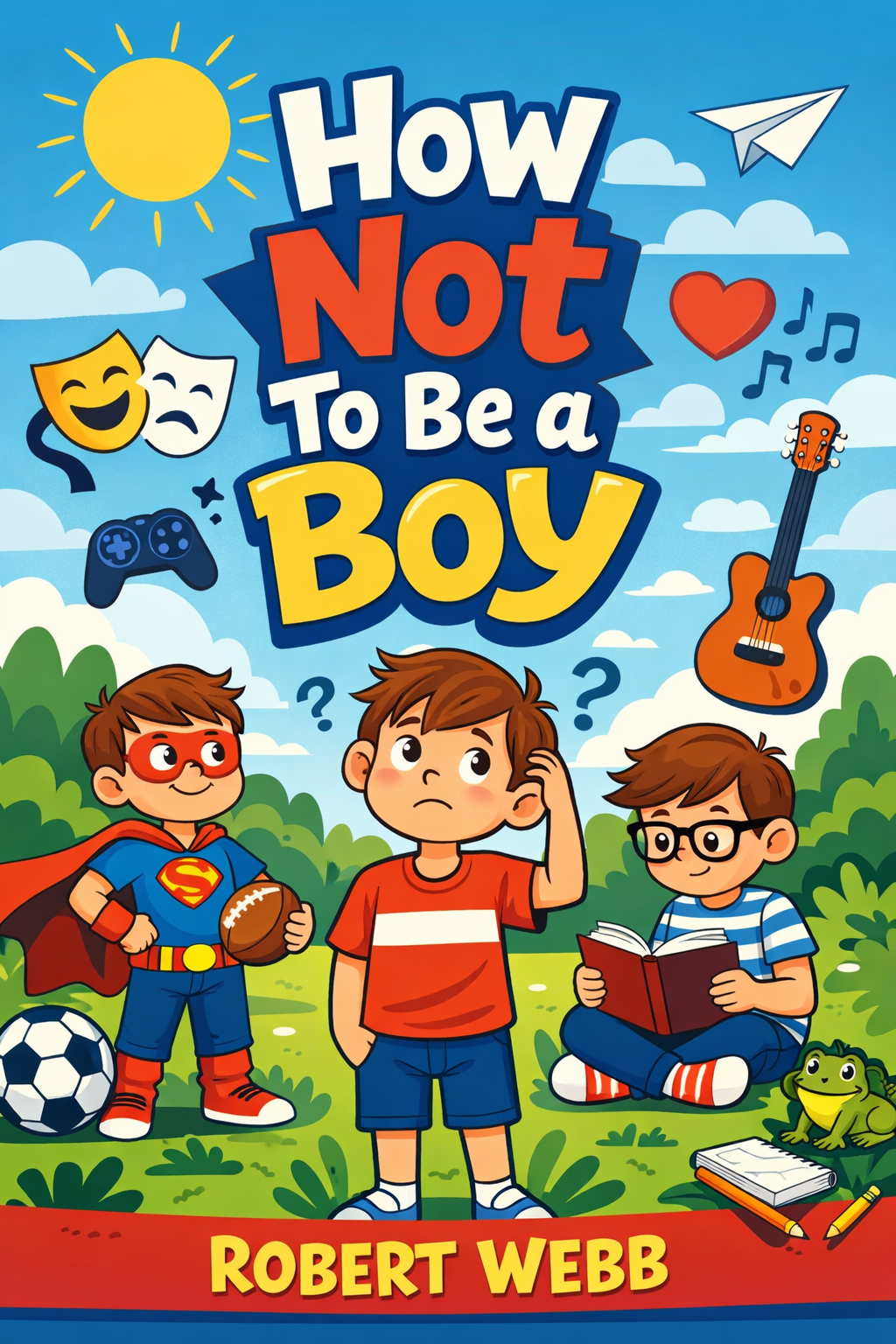
Description
Robert Webb’s “How Not To Be a Boy” is a deeply personal and sharply funny manifesto against the confining rules of traditional masculinity. Framed through the lens of his own life—from a childhood in rural England to the stages of Cambridge University and his career in comedy—Webb dismantles the idea that typical male behavior is innate. He argues compellingly that from the playground onward, boys are funneled into a narrow identity through social pressure, bullying, and outdated expectations, with damaging consequences for their emotional lives and relationships.
The book begins by challenging the very foundation of gender stereotypes: the myth of the biological “male brain.” Webb, referencing contemporary neuroscience, asserts that brains cannot be neatly categorized by gender. Behavioral differences, he insists, are learned. He illustrates this with poignant examples, like how mothers unconsciously perceive the physical capabilities of their infant sons and daughters differently, setting the stage for a lifetime of biased expectations. This early conditioning creates a blueprint for a restricted male existence.
This conditioning is enforced with brutal efficiency through a rigid, unspoken dress code and a culture of playground policing. Webb recounts a childhood crisis over a pair of “girl’s socks” that led to immediate ridicule, a situation he could only deflect with a well-aimed insult. This episode underscores a central theme: the price of non-conformity is social exile, teaching boys to aggressively defend their masculinity and police others. The rules extend far beyond clothing, governing acceptable interests and behaviors. Boys are steered toward rough physical play and away from intellectual pursuits, which are unfairly branded as unmanly. Webb describes the affectionate yet physically demanding dynamic with his older brothers, where pain was to be ignored, and the anti-intellectual atmosphere of school, where academic curiosity could make you a target.
This system, Webb argues, actively discourages boys from developing essential social and emotional skills. Where girls are often encouraged to navigate complex social bonds, boys are left communicationally stunted. He offers an achingly awkward anecdote about being unable to correct a classmate’s blatantly wrong moves during a chess game, preferring a silent, confused defeat over a potentially empathetic conversation. This deficiency carries into adulthood, manifesting in men who struggle to express vulnerability, maintain deep friendships, or be thoughtful partners. Webb is unflinching in connecting these stunted social skills to the phenomenon of the “bad boyfriend”—the man who cannot articulate his feelings or muster the basic decency to end a relationship properly.
Ultimately, Webb paints a picture of a masculinity in crisis, one that leaves men tyrannically overorganized in some aspects of life while emotionally illiterate in others. Yet, the book is not a despairing one. It is a call to liberation. By sharing his own path—including his love for music, his academic pursuits, and the nurturing relationships with his brothers that defied stereotype—Webb demonstrates that a richer, more compassionate way to be a man is possible. He normalizes male sensitivity, tears, and deep emotional bonds, arguing that rejecting the old rules isn’t a loss but a gain of full humanity. “How Not To Be a Boy” is an invitation to unlearn the toxic scripts and embrace a more authentic, connected, and ultimately happier self.